Fly Leader Midsection Length Calculator
Build a balanced fly leader by matching midsection length to total leader, butt power, tippet length, fly size, wind, and presentation style.
📌Scenario presets
⚙Leader inputs
Leader midsection forecast
Calculation breakdown
📊Taper profile data
Delicate Dry
Standard Trout
Nymph Power
Saltwater
📐Leader reference tables
| Leader use | Total length | Butt section | Midsection | Tippet section | Notes |
|---|---|---|---|---|---|
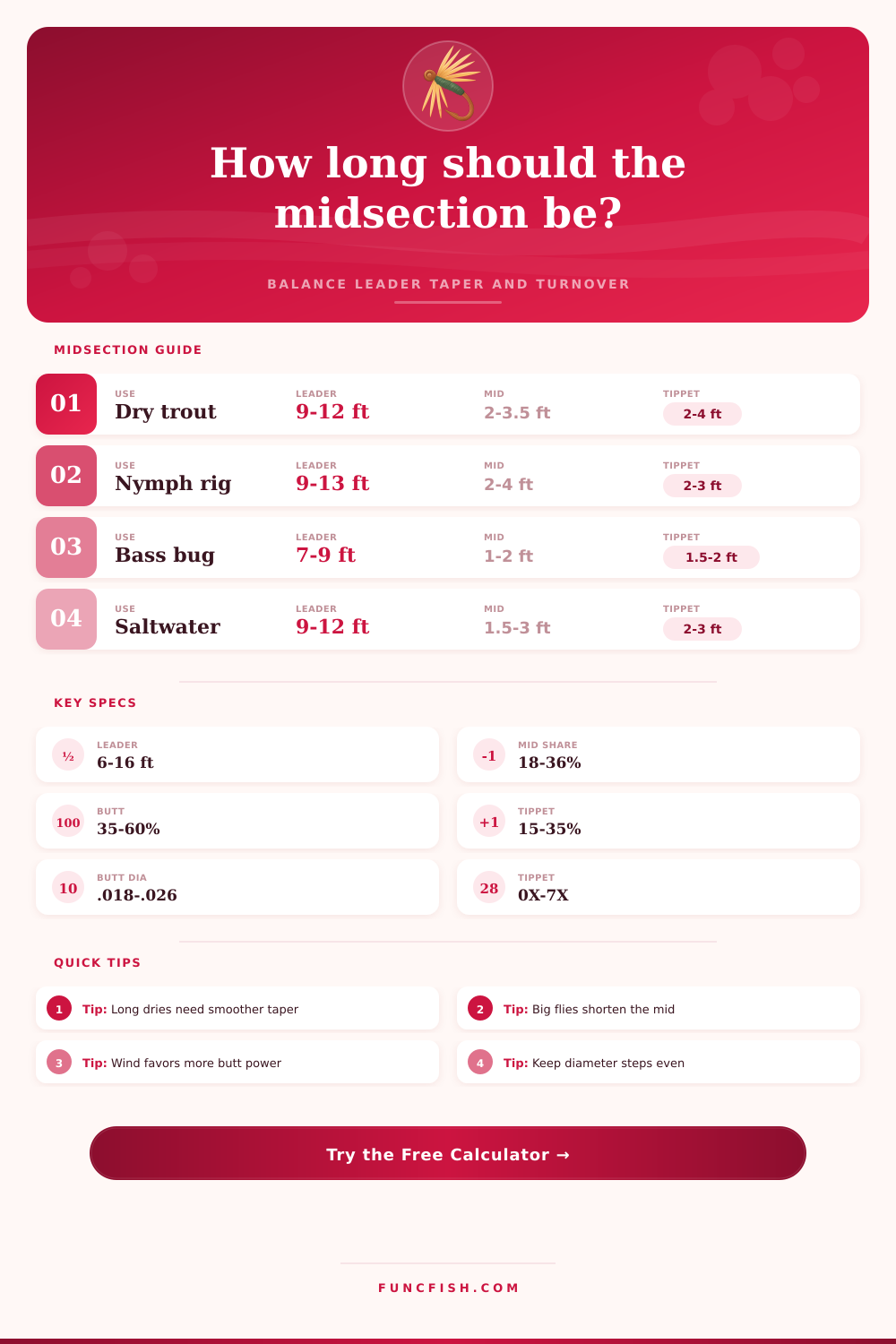
| Small dry fly | 9-12 ft / 2.7-3.7 m | 40-48% | 28-36% | 22-32% | Longer midsection smooths tiny fly turnover. |
| General trout | 7.5-10 ft / 2.3-3.0 m | 50-58% | 20-28% | 18-26% | Good starting point for 4-6 wt rods. |
| Indicator nymph | 9-13 ft / 2.7-4.0 m | 55-62% | 18-24% | 16-24% | Shorter midsection keeps the rig turning over. |
| Bass or pike | 6-9 ft / 1.8-2.7 m | 58-68% | 12-22% | 15-25% | Power in the butt section carries bulky flies. |
| Saltwater flats | 9-12 ft / 2.7-3.7 m | 58-65% | 15-24% | 18-26% | Stiff material and short steps help in wind. |
| Tippet size | Diameter | Typical fly size | Suggested mid dia. | Butt diameter | Use case |
|---|---|---|---|---|---|
| 7X-6X | .004-.005 in / .10-.13 mm | 22-18 | .007-.011 in | .017-.021 in | Spring creek dries and emergers. |
| 5X-4X | .006-.007 in / .15-.18 mm | 18-12 | .010-.014 in | .019-.023 in | General trout dry and nymph rigs. |
| 3X-2X | .008-.009 in / .20-.23 mm | 12-6 | .013-.017 in | .022-.026 in | Streamers, hoppers, and light bass. |
| 1X-0X | .010-.011 in / .25-.28 mm | 8-2 | .016-.021 in | .024-.030 in | Bass bugs and wind resistant flies. |
| 20-40 lb | .016-.024 in / .41-.61 mm | 1/0-4/0 | .023-.032 in | .030-.040 in | Saltwater, pike, and bite leaders. |
| Species / rig | Rod size | Leader length | Midsection range | Turnover goal | Material note |
|---|---|---|---|---|---|
| Trout dry fly | 3-5 wt | 9-12 ft | 2.5-4 ft | Soft to balanced | Supple nylon protects fine tippet. |
| Trout nymph | 4-7 wt | 9-13 ft | 1.8-3 ft | Positive | Stiffer butt supports indicator mass. |
| Bass popper | 6-8 wt | 7-9 ft | 1-2 ft | Hard | Short heavy leaders carry air resistance. |
| Bonefish flat | 7-9 wt | 9-12 ft | 1.5-3 ft | Positive | Stiff mono helps punch into wind. |
| Steelhead swing | 6-8 wt | 10-15 ft | 2-4.5 ft | Balanced | Keep steps simple for sink-tip loops. |
💡Practical notes
Midsection role: The midsection is the hinge between fly line energy and fine tippet. If it is too long for a bulky fly, loops collapse. If it is too short for a dry fly, the leader lands harshly.
Diameter steps: Better leaders usually step down through diameter rather than length alone. A smooth midsection uses two or three pieces that avoid one abrupt drop from butt material to tippet.
You have cast a perfect loop, but then it collapses into a heap of spaghetti right before fly lands. A fish spots the commotion and spits out your offering. You didn’t cast poorly, but rather built a bad midsection. Leaders aren’t just links from the hook to the line; they’re mechanical transformers. They takes the energy created by heavy fly line and deliver a delicate presentation while not startling or breaking off the fish.
These numbers comes from the calculator. Knowing why it’s giving them lets you adjust every knot you tie. The hinge The middle of the system is what does all the work. If loop is too long, it collapses before it reaches its goal, splashing and startling the fish and breaking line. Too short, and you’ll hit fine tippet dead center with your heavy butt section. Shorter is not better then. That’s where the adjustability comes into play. Depending on the situation, the tool will find the right mix for success.
How to Fix Your Leader for Better Casts
Does it have to resist wind? Because if it does, you’ve got a failed presentation most likely. A big hopper look like a parachute in the wind. You need a stiffer, shorter midsection to punch through that drag. A tiny midge isn’t even aware of air. It want a long taper to let it float gently to the bottom. It sounds subtle on paper, but it is different than out on water.
The material makes a difference, as you may have guessed. Fluorocarbon is stiffer and sinks. It is good for nymphing rigs in which you want leader to sink fast. Nylon floats and is supple. It is great for dry flies when you don’t want to shock the fish and want leader to lie flat. That’s why the calculator also factors material into its turnover score. Are you getting the right turnover for the fly? Will it turn over easily without shocking the fly?
A low score indicates the midsection could be too long or too weak, resulting in line collapse. A higher score indicate the leader is matched to the weight of the fly. All of that changes with wind. To get the line to turn over in the air you want some mass to it and that’s where the butt section comes into play. You shorten the midsection proportionately to the wind speed, so now you have traded delicacy for power. The reference table lays this out clearly for various species.
For trout, you would use long leaders with an extended midsection which allows your fly to drift unseen. For bass, you are looking at short leaders and a lot of hard turnover due to weight of the flies. A bass leader setup is not going to work for trout. Sure you may be able to get there. But you won’t get the precision to set hook effectively.
Most of us purchase premade leaders and use them straight from the package. But the world changes by the day. A windy river demands one taper while a narrow spring creek need another. Use this tool to dial in these factors on-the-fly. Increase your fly size, account for wind drag, then see how suggested mid section changes. It trains you to think of the leader as a system that’s constantly changing. You start learning to predict collapse in advance.
Tying leaders well is all about transferring energy. The butt section absorbs the energy of the line. The midsection absorbs some but allows for a transition to the tippet that present the fly. If you get it right, you make effortless casts. If you get it wrong, you’re beating your own tackle. Dial in on the balance of power and finesse with the tool.
When you do, the leader will straighten out, the loop will open, and the fly will settle softly onto the water. Fishing becomes not a struggle with equipment, but a dialogue with the fish. You should of used it sooner.