Fly Line Head Length Calculator
Estimate the best fly line head length, grain window, carry length, and turnover score from line weight, line type, rod length, casting distance, fly size, wind, sink rate, and angler skill.
📌Named fly line presets
⚙Head length inputs
Fly line head results
Calculation breakdown
🎣Fly line and rod comparison grid
WF trout
DT dry
Spey
Shooting
📊Reference tables
| Line weight | AFTMA 30 ft grains | Balanced rod use | Typical fly range |
|---|---|---|---|
| 2-3 wt | 80-100 gr | Creeks, small dries | 18-24 dries, small nymphs |
| 4-5 wt | 120-140 gr | Trout dry, nymph, light streamer | 10-20 dries, size 8-14 nymphs |
| 6-7 wt | 160-185 gr | Indicator rigs, bass, light spey | 4-10 streamers, weighted nymphs |
| 8-9 wt | 210-240 gr | Salt flats, pike, heavy sink tips | 1/0-4 streamers and crab flies |
| 10-12 wt | 280-380 gr | Tarpon, surf, big wind, heavy heads | 2/0-6/0 baitfish patterns |
| Line type | Head length tendency | Best carry habit | Adjustment note |
|---|---|---|---|
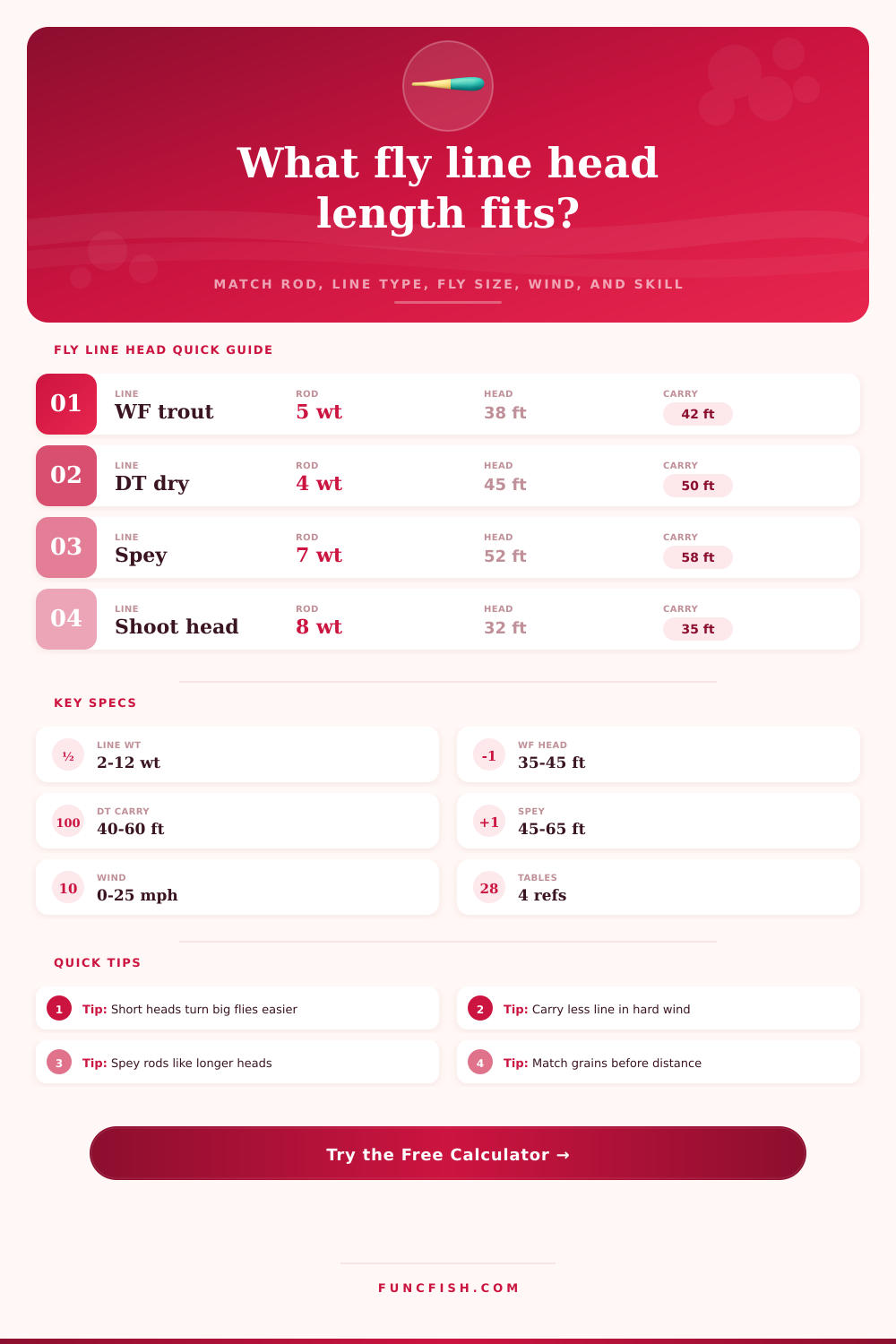
| Weight forward (WF) | 34-46 ft / 10.4-14.0 m | Carry most of the head plus 2-6 ft | Most forgiving all-around choice |
| Double taper (DT) | 42-60 ft / 12.8-18.3 m | Carry grows gradually with skill | Great for roll casts and soft turnover |
| Spey / switch | 42-65 ft / 12.8-19.8 m | Carry head plus leader at anchor | Rod length strongly affects match |
| Shooting head | 26-38 ft / 7.9-11.6 m | Carry head just outside the tip | Best when wind and big flies need punch |
| Condition | Head direction | Grain direction | Turnover effect |
|---|---|---|---|
| Calm, small dry fly | Longer by 2-5 ft | Stay near standard | Softer presentation |
| Moderate wind 8-15 mph | Shorter by 2-4 ft | Add 5-8% | Tighter loop and faster load |
| Large streamer or bass bug | Shorter by 4-8 ft | Add 8-14% | More front mass for turnover |
| Sink 6+ or T material | Shorter by 3-7 ft | Add 8-16% | Less false casting, more authority |
| Rod length | Single-hand WF | Switch / spey | Carry cue |
|---|---|---|---|
| 7-8 ft / 2.1-2.4 m | 28-38 ft heads | Not typical | Keep head compact |
| 8.5-9.5 ft / 2.6-2.9 m | 34-46 ft heads | Short switch only | Carry head plus a few feet |
| 10-11.5 ft / 3.0-3.5 m | 36-50 ft heads | 30-45 ft heads | Match stroke length to belly |
| 12-15 ft / 3.7-4.6 m | Rare overhead use | 45-65 ft heads | Anchor control sets the carry |
🔍Rod and line matching notes
Short fast rods
Compact WF or shooting heads load quickly and keep big flies from collapsing the loop on short casts.
Medium trout rods
A 35-45 ft WF head gives enough carry for normal fishing distances without demanding expert timing.
Switch rods
Short spey and Skagit heads favor controlled anchors, heavier grain windows, and limited overhang.
Long spey rods
Longer heads reward smooth tempo and line stick control, especially when flies are small or sparse.
💡Head length tips
Tip: If the fly kicks over late or piles up, shorten the head or increase the grain window before changing the rod.
Tip: If the rod feels overloaded close in, reduce grains first; if it only fails at distance, reduce carry length.
Choosing an correct fly line head length is another necessary task for anyone who takes up the sport of fly fishing. By choosing the correct length for the head of a fly line, a person will ensures that the line will function correct while fishing. The length of the head of a fly line determine the amount of line that can be carried while fishing.
Additionally, the length of the head of the line will determine how much line will turn over while fishing. If the length of the head of the line are incorrect for the fishing situation, then the line may collapse into a pile or the line may not land on the water with the correct amount of authority. Every type of fly line come with a standard grain count between the first thirty feet of the line.
How to Choose the Right Fly Line Head Length
However, because fishing conditions change, the length of the head of the line will have to change according to specific variable. For instance, the longer the fishing rod, the longer the line that will be require to flex the rod correctly. However, if the fishing situation involves the presence of the wind or if the fly that is being targeted is bulky, then a shorter length of the head of the line will be required.
Additionally, the distance at which the angler want to cast will change the length of the head of the line. An angler can use a calculator to determine these variables in order to choose the perfect length for the head of the line. The types of tapers that the line features will also change how the line will behave while fishing.
For instance, if the fishing line features weights that are forward on the line, then more of the line will load on the rod rapid, but the fly line will have less time to carry the line. However, if the fishing line features a double-taper, then the line will even out the weight along the line, allowing the line to travel further and land on the water more soft. Spey and switch lines requires a different head length on the line compared with conventional lines.
Additionally, shooting heads for long distances are much shorter and heavier to travel through the wind and turn over large fly. The size of the fly and the rate at which it will sink will also change the length of the head of the line. For instance, small dry fly require less mass in the line to turn over the fly.
Additionally, if the fish targeted is a large streamer or a large crab fly, then more front weight will be required on the line so that the line does not collapse on itself. The addition of sink tips or sinking lines to the line will increase the density of the line. This will change the way that the line interacts with the water and the effort required to lift the line for the next cast.
The calculator account for this by adjusting the length of the head of the line and the grain count of the line. Another variable in determining the length of the head of the line is the presence of the wind. The wind can open the line or push it offline from the target of the cast.
If there are steady breeze in the fishing area, then shortening the length of the head and adding more mass to the line will help the line maintain its momentum down the path of the cast. Another factor in determining the length of the head of the line is the skill level of the fly fisherman. Beginners will benefit from a shorter length of the head of the line to forgive mistake in the timing of the cast.
An advanced fisherman will be able to carry more line in the air then a beginner. Additionally, the action of the fishing rod will change the length of the head of the line. For instance, a slow fishing rod prefers a lower length of the head of the line and a lighter grain count.
In contrast, a fast fishing rod will work better with a heavier weight of the fly line head. The different style of casting will play a similar role in determining the length of the head of the line. For instance, the techniques used in casting overhead false casts will require a different length of the head of the line than Spey casting.
These preference will be accounted for in the calculator. Another problem that may occur is attempting to achieve more distance with the fly line without adjusting the length of the head of the line. If the length of the head of the line is too long for the rod that is being used, the turnover of the line may suffer after long casts.
This is because the length of the head of the line cannot turn over the line of that length. In most instances, shortening the length of the head of the line or increasing the grain count will fix this problem. Using a short and heavy head of the line for delicate work on small water may also cause problems.
The line may land in a way that the fly presentation may suffer. Various table can be used to determine the weight of the line according to the size of the fly and the length of the rod. These tables are not strict rules, but they can show the angler where the setup of the line will start.
Once the angler understands each variable and its effect on the length of the head of the line, these tables will assist in the determination of the length of the head of the line. The length of the head of the line is a compromise between three variables: the load on the rod, the turnover of the line, and the length of the head of the line that will be carried out of the rod. There is no perfect length of the head of the line that will work for each rod, each type of fly, and each condition of the wind.
Thus, the tester will have to test the recommendation from the calculator on the water to determine how the line will perform.