Fly Tippet Ring Size Calculator
Match tippet ring diameter, rated strength, and knot clearance to your fly size, tippet X, leader butt, species, and presentation style.
📌Scenario presets
⚙Tippet ring settings
Tippet ring match
Full breakdown
📋Tippet ring reference grid
Micro Trout
Standard Trout
Heavy Trout
Spey / Salt
📐Reference tables
| Tippet size | Diameter | Typical test | Common ring |
|---|---|---|---|
| 8X | 0.003 in / 0.08 mm | 1.2 lb / 0.5 kg | 1.5 mm micro |
| 7X | 0.004 in / 0.10 mm | 2.0 lb / 0.9 kg | 1.5 mm micro |
| 6X | 0.005 in / 0.13 mm | 3.5 lb / 1.6 kg | 1.5-2.0 mm |
| 5X | 0.006 in / 0.15 mm | 5.0 lb / 2.3 kg | 1.5-2.0 mm |
| 4X | 0.007 in / 0.18 mm | 6.5 lb / 2.9 kg | 2.0 mm |
| 3X | 0.008 in / 0.20 mm | 8.5 lb / 3.9 kg | 2.0 mm |
| 2X | 0.009 in / 0.23 mm | 10 lb / 4.5 kg | 2.0-2.5 mm |
| 0X | 0.011 in / 0.28 mm | 14 lb / 6.4 kg | 2.5 mm |
| Scenario | Priority | Suggested OD | Notes |
|---|---|---|---|
| Small dries #18-24 | Stealth | 1.5 mm | Best with 7X-5X |
| Dry-dropper trout | Balanced | 2.0 mm | Good knot room |
| Euro nymph | Low sag | 1.5-2.0 mm | Use smallest safe ring |
| Streamers #8-2 | Strength | 2.5 mm | Better heavy tippet clearance |
| Steelhead swing | Turnover | 2.5-3.0 mm | Check knot bulk |
| Pike wire bite | Strength | 3.0 mm | Wire needs a larger bore |
| Knot pairing | Bulk allowance | Best bore | Ring decision |
|---|---|---|---|
| 6X to 4X mono | 0.35-0.48 mm | 0.70 mm | 1.5 mm ring |
| 5X fluoro to 3X | 0.45-0.62 mm | 0.95 mm | 2.0 mm ring |
| 3X to 0X streamer | 0.62-0.86 mm | 1.20 mm | 2.5 mm ring |
| 16 lb to 20 lb | 0.85-1.05 mm | 1.20 mm | 2.5 mm ring |
| Wire to hard mono | 1.05-1.35 mm | 1.45 mm | 3.0 mm ring |
| Braid to fluoro | 0.80-1.20 mm | 1.45 mm | 3.0 mm ring |
| Fly class | Tippet window | Ring limit | Presentation check |
|---|---|---|---|
| #22-18 dry | 8X-6X | 1.5 mm | Keep ring high on leader |
| #18-14 dry | 6X-4X | 1.5-2.0 mm | Watch drag on soft hackles |
| #16-10 nymph | 6X-3X | 2.0 mm | Good for tippet changes |
| #10-4 streamer | 3X-0X | 2.5 mm | Turnover outweighs stealth |
| Spey tube fly | 12-20 lb | 2.5-3.0 mm | Check heavy butt knots |
| Pike fly 1/0+ | 20-30 lb | 3.0 mm | Use room for bite tippet |
💡Practical checks
Tip: The ring should normally test stronger than the tippet section, but it does not need to be stronger than the whole fly line system.
Tip: If two clinch knots crowd the ring, move up one outside diameter before increasing tippet strength.
Even if you get good casting distance, the line lands softly and it feels like there is something wrong with the rig. It could be your tippet ring; maybe it seem too beefy, or maybe you’re just not trusting the presentation. A tippet ring might seem insignificant, but it can make all the difference between a leader that floats in the water properly and a leader that flutters and dances in mid-air.
It isn’t about memorizing chart after chart of tradeoffs between strength vs. Stealth; its more about knowing what works best based off your understanding of those trade-offs. Once you know what size leader (diameter) you want and what species you are targeting, use the calculator above to do the math for you.
How to Choose the Right Tippet Ring
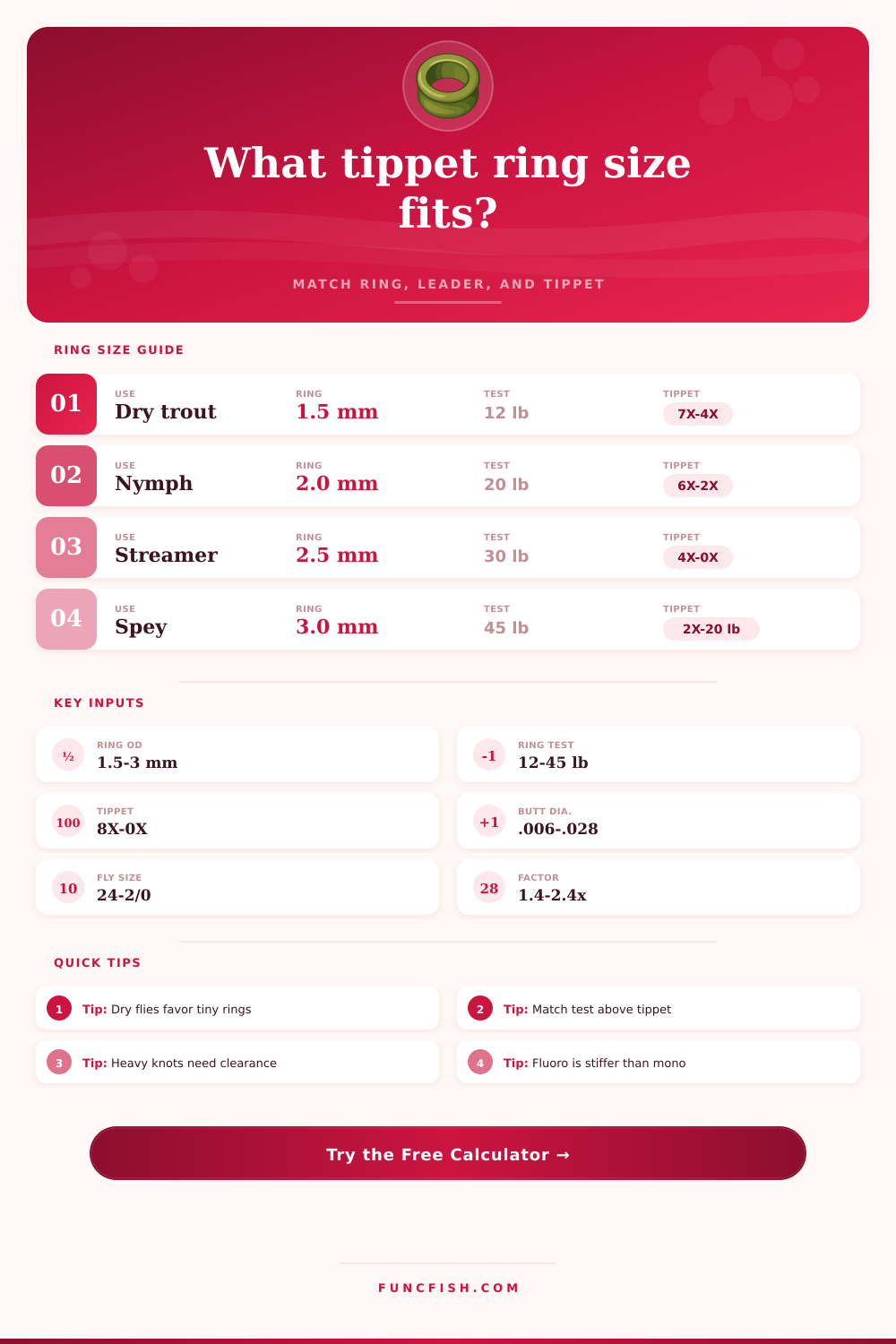
No more guesswork: Will my 1.5 millimeter ring be strong enough for a brown trout, or will it be too bulky and noticeable to use on a dry fly? Choose between durability and visibility. The smaller the ring the more easy it will hide in contrasty water. But the smaller the ring the less area you have for big fat knot. So if you’re fishing little dries on 7X or even 8X tippet, a big ol’ metal bead can become an anchor.
But make that ring too small and you begin to run into some mechanical issues. You want to have enough of the knot laying up against the wall of the ring where it is not getting crushed or pinched. If you go too small with the bore of the ring, your knot strength becomes poor and unreliable. This depends on size of your tippet material and diameter of your leaders. That’s what folks do wrong. They over emphasize the invisibility factor until they snap off at the first good fish and learn a painful lesson in clearance.
But type of material also makes a big difference, because different lines behave differently when tied off. For instance, fluorocarbon is far stiffer than traditional nylon mono. It won’t bend around a tight curve easy. It needs a little more space within the ring to tie an even knot without losing strength or kinking. If you go from a soft dry fly tippet to a heavier fluoro for nymph fishing, you’ll frequently have to increase your ring size a notch or two to give yourself enough room for this stiffness. By accounting for material differences, the tool takes into account whether you’re using a stiffer, more rigid material (copolymer blends) vs something more flexible like mono, and adjusts its clearance recommendations accordingly. This way, the recommendation isn’t only about breaking strength, but also about physical fit.
So what about the ring? Think of it as a middle part between your tapered leader and tippet section. What if something breaks there? Well, you’re losing more than just the fly. Now you may have broken off end of a custom built leader. So make sure the ring you use is rated far above your tippet size so it will fail in the correct spot. Your tippet. By doing this you save your remaining gear and ultimateley money over time.
The table on the page shows where these match up with common situations in terms of test rating and outside diameter. From here you begin to see trends within varying styles of fishing. For example, you may notice a trend toward using a bit bigger ring when fishing streamers. Sure they want a strong ring, but also those are heavy flies and require good turnover in order to throw well. A little bigger ring does this while keeping things less noticeable to the eye.
There are also seasonal considerations that don’t always come through in the numbers: Tippet becomes less pliable and tougher to tie cleanly in cold weather. Your hands is numb, and your knots get fatter unintentionally. Using a ring with a slightly larger hole as an insurance policy on a day like that makes a lot of sense, just in case you lose a bit of dexterity. On an active summertime trout trip, where stealth is most important, use those tiny rings if your knot tying skills is sharp enough to go to the edge.
At the end of the day, choosing a tippet ring is all about finding the best balance between conflicting requirements. We need something strong enough to handle the fish while remaining unnoticeable to the fish. It needs to be big enough to guard our knots while being small enough to avoid influencing drag. There’s no one perfect tippet ring for everything. But there is the best choice based off what’s presented to us each day.
When we can consider visual impact, knot bulk, and material stiffness at the same time, we’re able to create a system that functions as one and not two. When that connection feel just right, you have that silent assurance with your setup once again. You could of tuned out the tackle and stay tuned into the fish.