Ice Hole Spacing Calculator
Calculate center-to-center ice hole spacing, grid capacity, tip-up spread, sonar clearance, and auger count for jigging, searching, shelter fishing, and predator sets.
❄Preset ice layouts
⚙Hole spacing inputs
Search grid: balances coverage and walking time by spacing holes wider than a jigging cluster but closer than a predator tip-up spread.
Ice hole spacing results
Spacing is based on scenario baseline, target species movement, hole diameter, active-line clearance, electronics separation, and water clarity.
Calculation breakdown
🔩Auger and hole reference
6 in Panfish
8 in Walleye
10 in Predator
Sight Opening
📊Layout matching cards
Inside Shelter
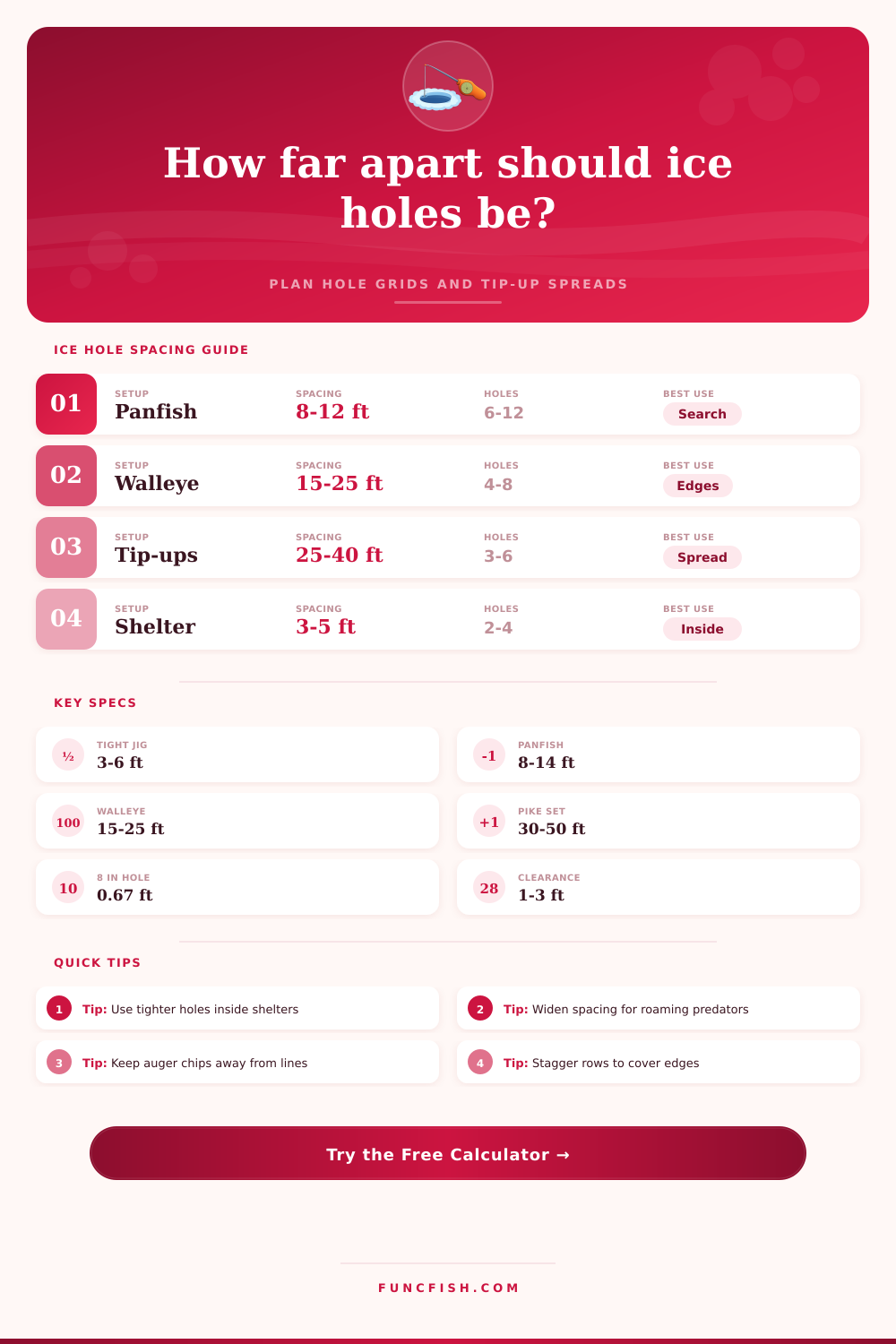
3-5 ftShort center spacing fits anglers, heaters, electronics, and rod sweeps inside a hub or flip-over floor.
Search Grid
10-20 ftEven spacing covers a flat or basin without drilling so tightly that every hole reads the same fish.
Breakline Row
15-30 ftA row follows depth change, weed edge, or transition bottom while keeping holes easy to revisit.
Predator Spread
30-50 ftWide spacing lets larger bait sets cover lanes, points, and weed pockets without tangling nearby lines.
📐Spacing reference tables
| Fishing setup | Typical spacing | Best pattern | Reason to adjust |
|---|---|---|---|
| Shelter jigging pair | 3-5 ft / 0.9-1.5 m | Cluster | Rod sweep and transducer clearance |
| Panfish basin scouting | 8-14 ft / 2.4-4.3 m | Grid | Mark suspended schools efficiently |
| Crappie night setup | 10-18 ft / 3.0-5.5 m | Staggered grid | Cover roaming fish without too much noise |
| Walleye breakline row | 15-25 ft / 4.6-7.6 m | Single row | Follow the edge of depth change |
| Lake trout fan | 20-35 ft / 6.1-10.7 m | Fan | Cover different angles from one starting point |
| Pike tip-up spread | 30-50 ft / 9.1-15.2 m | Wide spread | Separate bait lanes and running fish |
| Species group | Movement radius | Hole diameter | Spacing note |
|---|---|---|---|
| Bluegill / perch | Small to medium | 5-7 in | Use closer holes for basin probing |
| Crappie | Suspended roam | 6-8 in | Stagger rows to follow school travel |
| Walleye / sauger | Edge patrol | 7-9 in | Run holes parallel to breaklines |
| Lake trout | Wide roam | 8-10 in | Widen spacing over points and humps |
| Pike / pickerel | Ambush lanes | 8-10 in | Keep bait sets well separated |
| Burbot / eelpout | Bottom crawl | 8-10 in | Use moderate spacing on flats |
Spacing results are planning estimates for hole layout and fishing efficiency. Always make local ice condition decisions with appropriate on-site judgment.
💡Spacing calculation notes
Measure between hole centers, not ice edges. The calculator adds auger diameter and working clearance so nearby lines, transducers, and skimmer work do not collide.
A staggered grid usually covers more water with the same hole count, while a straight row is better when you are tracing a weed edge or breakline.
So there you are, full of hope, drilling your initial hole on a frozen lake only to find three minutes later that your sonar hole has been drilled right into the path of your friends’ rod. The battle of ice shavings and lines isn’t just annoying; it’s a structural failure of your plan. Good ice-hole spacing makes all the difference between a chaotic tangle of nylon and a methodical search for fish.
How does an angler do this? Most of us do it by instinct. We drill until we either get tired or find fish. Turning hole placement into a strategic grid will change amount of water you can efficienty cover. It transforms random augering into a system. All you have to do is input the layout style and the species you’re targeting. The calculator does the math for you so you don’t waste time wondering if eighteen feet is too wide for perch or too narrow for pike.
How to Space Your Ice Fishing Holes
Why does that matter? That has to do more with how the fish behave and less with how long your measuring tape are. For instance, panfish such as perch and bluegill generaly hold in schools very close together and suspend over particular bottom structure. They won’t wander around all day. If you’re trying to find a suspended school of sunfish and you’ve spaced out your holes forty feet apart, chances are you’ll never hit them. You might as well be flipping through a stack of books and only looking at half of each page, but the one you need isn’t there. With tighter spacing, you can quickly locate where they is suspended off of the surface or bottom.
Conversely predator fishing requires an entirely different approach. Walleyes are cruising defined highway areas in the water column, along edges and drop offs. Northern pike set up on key ambush spots like rocky points or heavy weed growth. The fish hold large areas. For instance if you space your holes too tight for walleyes, you’re duplicating coverage. You’ll drill several holes scanning the same length of blank water because the fish just wasn’t there in that particular ten foot square block. Widening your hole spacing allow you to show the bait to more of the breakline where the action is occurring. It’s about exposing the bait to as many potential feeding lanes as possible, not saturating a small area.
And then we go inside the portable shelter and it gets interesting again. Now space is limited. Can two adult-sized sofa stand comfortabley in this area? Will there be room for a heater that doesn’t blow out? Tripping over your rod holders? Electronics? Will there be enough space between the holes to have a flasher unit on each side without interfering with another’s reading? These are all physical considerations.
And because they are physical, the calculator takes them into account when offering recommendations based off use of camera or live sonar. That’s a technical detail that isn’t always considered. Noise on your screen in place of fish arches equals interference. There’s no substitution for good data and not even good bait will make up for that.
How aggressive can I be with my holes Surprisingly this has a lot to do with water clarity. The fish is going to be a little more careless around the hole when visibility is low. So you aren’t afraid to crowd them together. But when the water is crystal clear you might spook a fish away from the commotion of all the jigging and drilling around. Clear water forces you to space out your efforts. This minimizes the activity at one hole so fish aren’t deterred from coming to another, while also allowing for multiple angles of approach. Again it makes you consider both location and stealth.
Beyond spacing, how you make your holes is important too. For example, a straight row covers less area than a staggered grid which doesn’t have any blind spots between rows. Following an edge along a weed line (that’s logical). When probing a flat basin, fanning out or clustering your points will help you find depth differences. That’s all spelled out nicely in the reference table on the page. It is matched with situations such as lake trout hunting or night crappie fishing.
Ice fishing is a numbers game, and that ultimately translates into managing probabilities. The odds don’t change. You still can’t make the fish go where you want them to be, but you could of managed the odds by how well you can put yourself in their face. Getting hung up on the exact number of feet doesn’t matter as much as knowing why you’re spreading out like you do. Panic drilling isn’t good; drill to plan. Don’t measure once, measure twice…not necessarily for the hole but for the gap between holes.
If you work within the restrictions of what you’ve got and within the fish’s habits, you quit struggling against the ice and start using it to your advantage. And that step-by-step strategy will translate into a productive day, despite the frosty morning. You will spend more time pulling fish down in the dark water and less time unraveling all those line messes.