Weakfish Weight Calculator
Estimate weakfish weight from total or fork length, widest girth, body depth, estuary, inlet, or surf habitat, condition, maturity class, forage pattern, confidence, and unit mode.
📌Named weakfish presets
⚙Measurements and weakfish profile
Estimator note: this tool is for field weight estimates and logbook comparisons. It uses body-shape labels only and stays focused on measurement math.
Weakfish weight estimate
Calculation breakdown
📊Weakfish factor grid
Length basis
Classic core
Depth profile
Confidence band
🐟Weakfish and drum comparison grid
📘Weakfish reference tables
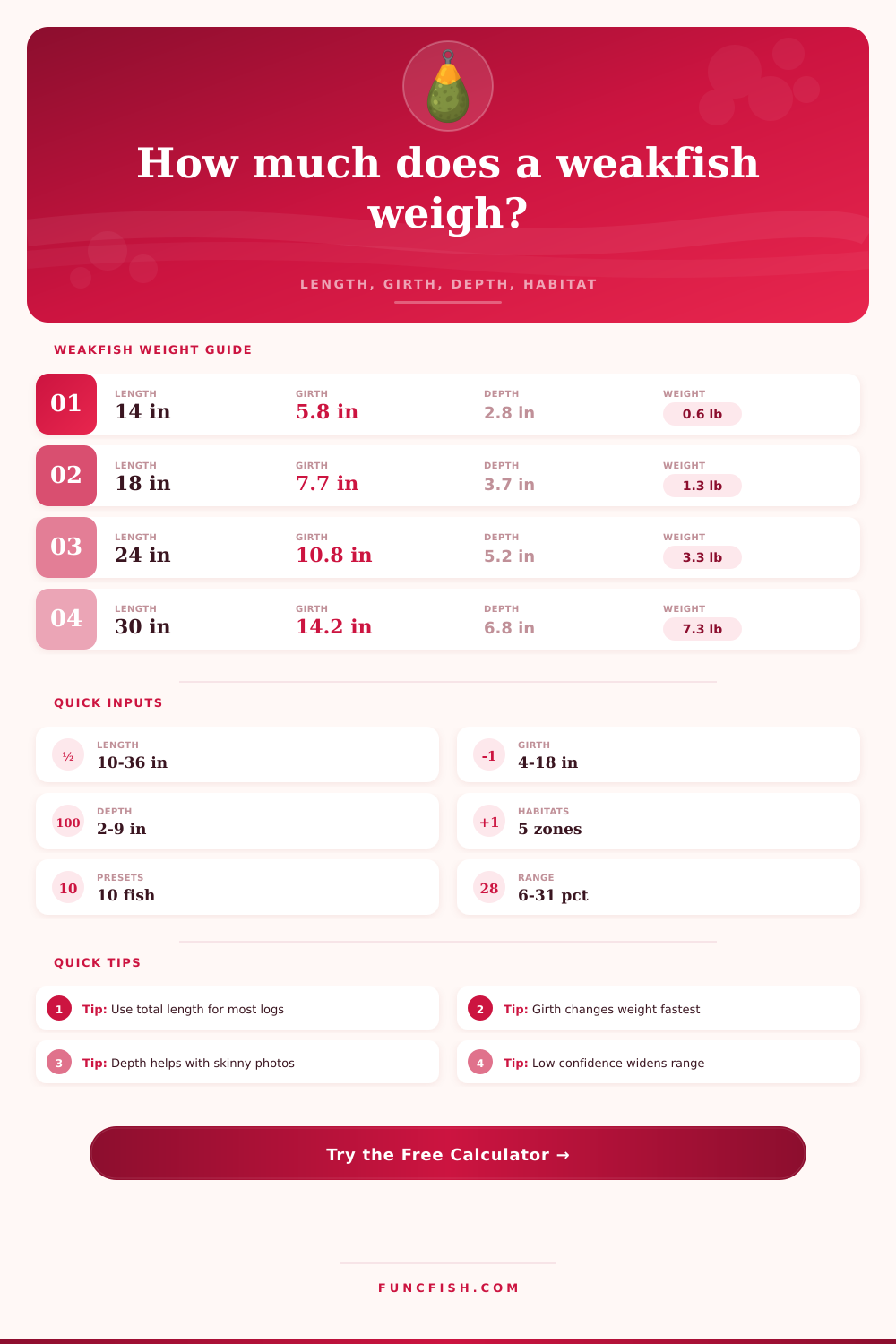
| Total length | Typical girth | Typical depth | Estimated weight |
|---|---|---|---|
| 12 in / 30 cm | 4.7-5.3 in / 12-13 cm | 2.2-2.6 in / 6-7 cm | 0.3-0.5 lb / 0.1-0.2 kg |
| 16 in / 41 cm | 6.4-7.2 in / 16-18 cm | 3.0-3.5 in / 8-9 cm | 0.8-1.1 lb / 0.4-0.5 kg |
| 20 in / 51 cm | 8.2-9.3 in / 21-24 cm | 3.9-4.6 in / 10-12 cm | 1.7-2.4 lb / 0.8-1.1 kg |
| 24 in / 61 cm | 10.4-11.8 in / 26-30 cm | 5.0-5.7 in / 13-14 cm | 3.0-4.1 lb / 1.4-1.9 kg |
| 28 in / 71 cm | 12.5-14.0 in / 32-36 cm | 5.9-6.8 in / 15-17 cm | 5.0-6.9 lb / 2.3-3.1 kg |
| 32 in / 81 cm | 14.5-16.4 in / 37-42 cm | 6.8-7.8 in / 17-20 cm | 7.8-10.8 lb / 3.5-4.9 kg |
| Maturity class | Expected girth ratio | Depth ratio | Calculator note |
|---|---|---|---|
| Juvenile spike or small school fish | 0.38-0.42 of total length | 0.17-0.20 of total length | Light frame, high divisor, fast length changes |
| Schoolie adult | 0.40-0.46 of total length | 0.19-0.22 of total length | Most common balanced weakfish profile |
| Mature bay weakfish | 0.44-0.50 of total length | 0.20-0.235 of total length | Better fit for larger estuary fish |
| Large tiderunner weakfish | 0.47-0.54 of total length | 0.215-0.25 of total length | Heavy shoulders and deeper body possible |
| Post-spawn spent adult | 0.39-0.46 of total length | 0.18-0.22 of total length | Length can stay high while belly mass drops |
| Habitat or forage | Weight factor | Range effect | Shape cue |
|---|---|---|---|
| Estuary grass flat | 0.99 | Normal | Shrimp and small bait, often leaner girth |
| Creek mouth or back bay seam | 1.00 | Normal | Mixed bait, balanced profile |
| Bay channel edge | 1.02 | Slightly wider | Adult fish can hold fuller shoulders |
| Inlet rip or bridge shadow | 1.03 | Wider | Current-fed forage and variable photos |
| Open beach surf trough | 0.98 | Wider | Surf fish may look long and bright but lean |
| Peanut bunker or mullet peak | 1.05-1.08 | Normal | Larger bait often fills belly and shoulders |
| Measurement | Best point | Common miss | Effect on result |
|---|---|---|---|
| Total length | Nose to pinched tail tip | Using fork length without telling the model | Can understate weight and class |
| Fork length | Nose to inside tail fork | Mixing fork and total logs together | Calculator converts by about 1.07x |
| Widest girth | Deepest shoulder-belly loop | Tape behind the belly or too loose | Largest change because girth is squared |
| Body depth | Vertical back-to-belly depth | Reading a diagonal photo angle | Helps catch long, thin estimates |
| Confidence | Stable board and tape measurement | Memory or one quick dock photo | Widens or tightens the final band |
💡Measurement tip boxes
Weakfish are more slender than drum, so a single long length can exaggerate size. Girth drives the formula, while depth keeps long, thin fish from reading too heavy.
If your note says fork length, choose fork length before calculating. The tool converts it to estimated total length so presets, tables, and result cards stay comparable.
These estimates are useful for field notes and photo review. A certified scale is the only final weight.
When you catch a weakfish, you may want to know weight of that weakfish. You cannot always relying on the length of the weakfish to determine it’s weight. For instance, a weakfish may be very long but thin with little body masses, or it may be short but heavy with alot of body mass.
To determine the weight of a weakfish, there are calculators that use the girth, depth, and habitat of the fish to calculate weight of the weakfish. Weakfish can live in a variety of different habitats. For instance, they may live in grass flats, inlet rips, or open surf troughs.
How to Calculate the Weight of a Weakfish
Each of these different habitats may exhibit different body shapes in the weakfish that live in those areas. For instance, weakfish that live on grass flats may be lean, while weakfish that live in creek mouths may be round in they shape. Thus, when calculating the weight of a weakfish, it is important to select the habitat in which the weakfish is caught in the calculator.
If the user selects the incorrect habitat, the weight calculation will be inaccurate. Girth is one of the most important measurement in calculating the weight of a weakfish. The calculator calculates the weight of the fish by taking the girth of the fish and multiply that value by itself (squaring that value).
Thus, any change in the girth of the weakfish will have a greater impact upon the calculated weight than any change in the length of the weakfish. Depth is another parameter used in the calculation to help verify the girth measurement. For instance, if the depth of the weakfish is relatively shallow, the weight of the weakfish will be lower in the calculator.
Additionally, both maturity and condition can be entered into the calculator; weakfish that have finished spawning may have the same length as a weakfish that has not yet spawned, but the weakfish that has finished spawning will normally weigh less than the weakfish that has not yet spawned. The weakfish eats food that will affect weight of the weakfish. For instance, a weakfish that eats peanut bunker will weigh more than a weakfish that eats spearing.
Thus, the food that is selected in the calculator will impact the weight calculation. Additionally, there are confidence level for each measurement. For instance, if a tape measure determines the girth of the weakfish, the confidence level will be high; if it was determined from memory, the confidence level will be low.
The calculator will output a central estimate of the weight of the weakfish along with a spread of the potential weight of the weakfish to indicate its accuracy. Weakfish will have different weight. For instance, a 24-inch weakfish may weigh three and a half pounds one day but only weigh three pounds the next.
This fluctuation in weight is normal; the body mass of a weakfish may change. Thus, the reference tables include the weight ranges of weakfish of each length rather than the weight of each individual weakfish of that length. The weight ranges allow for individuals to determine if the weight of their weakfish is normal or unusual.
Weakfish length measurements must be accurate. For instance, the length measurement can be either fork length or total length. Fork length is the length of the fish from the head to the fork in the tail; total length is the length of the fish from the head to the end of the tail.
Most logbook use total length measurements. Thus, the calculator can calculate total length from fork length to ensure that all measurements are the same. Weakfish are different from red drum and black drum.
For instance, red drum and black drum has deeper bodies and are rounder in shape than weakfish; thus, they tend to have more body mass or weight than weakfish of the same length. Because weakfish have less body mass than drum fish, each calculator use a different divisor for calculating the weight of the weakfish. Additionally, each habitat has different profile ratios according to their shape, and each maturity stage of a weakfish has different profile ratios; thus, each profile ratio will result in an accurate weight calculation for the specific type of weakfish.
The condition index is the output that shows how the calculated weakfish compare to average weakfish of the same length. Thus, a condition index value of around one hundred is normal. A value much above one hundred indicates the weakfish has unusually full body mass; a value much below one hundred indicates the weakfish has unusually lean body mass.
Thus, the condition index can be used to explain the difference in the body weight of weakfish of the same length. The inputs used in calculating the weight of the weakfish should be recorded in your notes. For instance, the length basis (total length, fork length), habitat, and girth of the weakfish should be noted.
These input will allow you to determine any patterns in the weight of the weakfish over time. The calculator accounts for these inputs so that they can be used for your records. The calculator is useful even when you do not have immediate access to the weakfish’s weight.
For instance, if you take the time to measure the length, habitat, and confidence in the measurement of the weakfish, you can have a weight estimate for the fish. Using these estimate over time will allow you to determine the effect of bait, water temperature, and other factor on the weakfish. Additionally, the calculator allows you to remove the need for performing the arithmetic calculation needed to determine the weight.