
That big ol’ “average” looking fish comes along, one that feels heavy but doesn’t quite fit the bill as far as the eye can see. So you go ahead and pull her out of the water. You weigh her on the scale and you’re wondering… do I keep her? Do I let her go?
Length might be how you start measuring, but weight actualy matters when it comes to gauging population health or bragging. Length is. So you pick up your fish and lay ’em next to your boot for a bit, or perhaps you’ve got a measuring board. Either way, you come up with some number in inches. But inches don’t always tell the tale.
Why Fish Weight Matters More Than Length
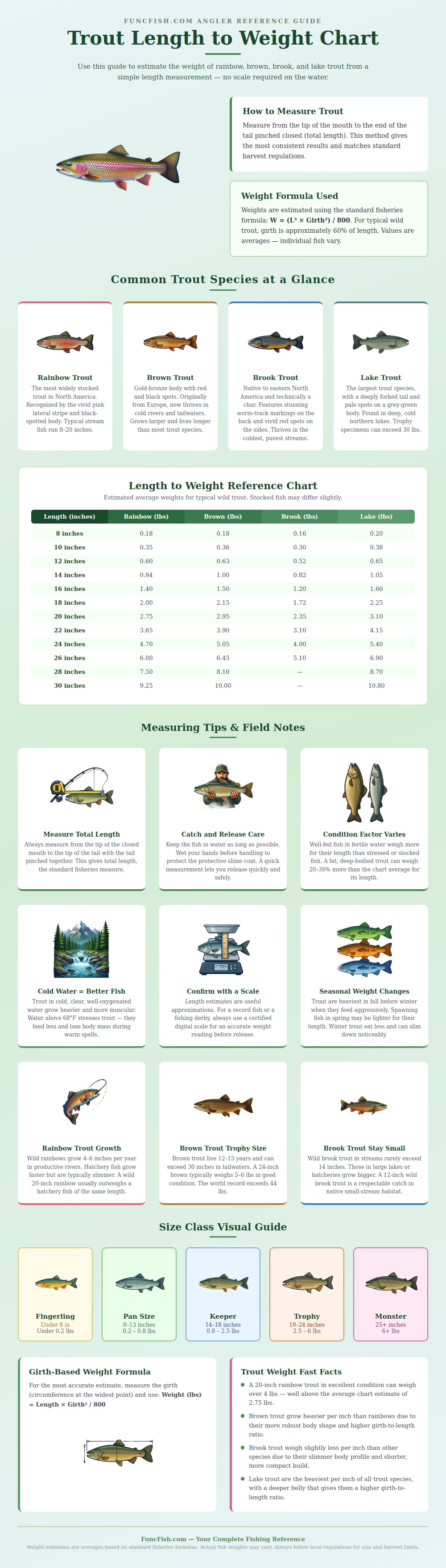
A 20-inch fish caught off a tailwater full of nutrients will outweigh a 20-inch fish caught off a high altitude stream. When weighing your catch just for fun or determining the health of a given population, that’s important stuff. This chart takes the guessing game out of what you see in the water and shows you how length relates to weight amongst various species.
It is easy to think all trout are created equal when it comes to growth rates, but they aren’t. When you take two trout of equal size (length), one is not necessarily going to be heavier then the other one. It is very rare for a brown trout and a rainbow trout of the same length to weigh the same. You can see how well this chart breaks information down in separate columns.
If you’re familiar with rainbows, they tend to be built similarly and are widely stocked, so we use them as our standard for comparison. Brown trout has a stronger body type. They also get thicker for their length, so a 14 inch brown is nearly always heavier than a rainbow of equal length. This is why browns seem mighty on the end of your line even though they might initially look like a rainbow.
This is important to know because we’ve all seen those big fish pictures from Alaska, Canada or Montana where it was caught and looks a lot like a rainbow but then the angler weighs it and finds out it’s a brown. At the other extreme are brook trout. These are compact, skinny fish built to live in cool, well-oxygenated waters. Their bodies aren’t designed for bulk but rather for maneuverability.
And it’s true, they’re estimated to be lighter in weight than similar-sized brown or lake trout. That’s reflected directly in the chart where the brookie lines has less weight assigned than similarly sized browns or lakes. It’s a matter of structure and makes a big difference in tackle selection as well. Finer tippets and lighter line will better imitate a natural drift while preserving the peace of the water column. Overplaying these fish can mean breaking them off or overworking them when they’re on the sensitive side of delicate hooks. Play ’em right with a brookie.
Then there’s lake trout. Lake trout are special cases. They live in cold northern waters and deep lakes where plenty of food helps them grow large. This makes them the big boys of the family. You’ll notice on the chart that they dominate the poundage classes for longer sizes. Why? As lake trout age, they develop significant girth. Their bodies is shaped differently with deeper bodies and more forked tails, which helps them maintain speed over long distances in open water.
If you’ve hooked into one, you know right away they have some weight to them. Not only do they fight, but they also exert a heavy constant drag, draining your rod tip at breakneck speed. Knowing a lake trout weighs more per inch helps an angler pack the proper tackle before setting the hook. A trophy fish caught on ten-pound line designated for rainbows can be the stuff of nightmares.
Getting the estimates right is half the battle. And part of that is making an accurate measurement. You need to measure the fish, total length, which is from the tip of its closed mouth to the end of the tail, pinching those lobes together. Avoid fork length, which excludes the tail fin entirely and confuses the math. Shorter measurements throw off the math. But here’s the deal: flatten out that tail and make your estimate match up with what is actualy there. Then you’re good. And I mean good, as in not looking like a fool in front of your friends.
That’s a little bit of technical detail, but that’s how they made the reference guide match the way standard fisheries data is formatted. Consistency is important. It lets you compare things over time, by season, or across different bodies of water. A hidden factor in weight is water temperature. If the water is clear and cold, trout feed aggressively. Their bellies are filled with smaller fish or insects through spring and into fall. When the water gets warmer than sixty-eight degrees in late summer, however, their metabolism begins to slow. They still don’t have much to do but burn stored energy just trying to breathe, so they eat less.
That means a fish caught in July might weigh a pound less than it did in September, even if its length has not changed. That’s why all the charts are accompanied by disclaimers regarding average. They’re snapshots at peak condition, not set-in-stone rules of nature. How about condition factor? It’s a bigger deal than you might imagine.
A fat trout tells you there are plenty of food items around and the overall ecosystem health is good. A skinny trout will tell you it faces some kind of stress, has to compete for something or lives somewhere less than ideal. So when you pick up a trout that seems heavier and denser than you’d expect for its size, take note. What you’re looking at is proof positive of an environment that has been churning out healthy fish after healthy fish over time. And that’s what leads to those wild fish being so much better than their hatchery counterparts, weight wise. Hatchery fish may be long but they weigh less than wild fish. They have less muscle definition and lack the girth.
Understanding those factors can change how you look at any given catch. Suddenly instead of looking at a ruler with a mere number on it, you read the tale of a fish’s existence, A slender brookie or robust brown? Rich river or stressed out pond? It adds a new side to the game beyond just packing ‘em into the cooler. Next time you hook one and pull it up on the scale, ask yourself what you see in its bodyweight. What did it tell you about where it lived? Maybe the scale is broken, but the story is written all over the fish.