Top Shot Length Calculator
Estimate top shot length, braid backing left on the reel, spool fill, shock stretch, knot clearance, and connection suitability for casting, trolling, stand-up, surf, and wind-on leader systems.
📌Top shot presets
⚙Top shot setup settings
Use the spool rating printed as mono length at its listed mono diameter.
Example: many 12 lb mono ratings are close to 0.013-0.014 in.
Use actual fighting drag, not the line rating printed on the spool.
Top shot length forecast
Full calculation breakdown
🧵Material comparison grid
Nylon Mono
Fluorocarbon
Wind-On Mono
Wire Guard
📊Scenario length table
| Fishing scenario | Top shot starting point | Why it changes | Connection note |
|---|---|---|---|
| Bass braid to fluoro | 6-18 ft / 1.8-5.5 m | Clear water, cover, and knot through guides | FG or Alberto must pass small guides cleanly |
| Trout stream spinning | 8-20 ft / 2.4-6.1 m | Long enough for stealth but short enough for tiny guides | Fine knots reduce slap on light rods |
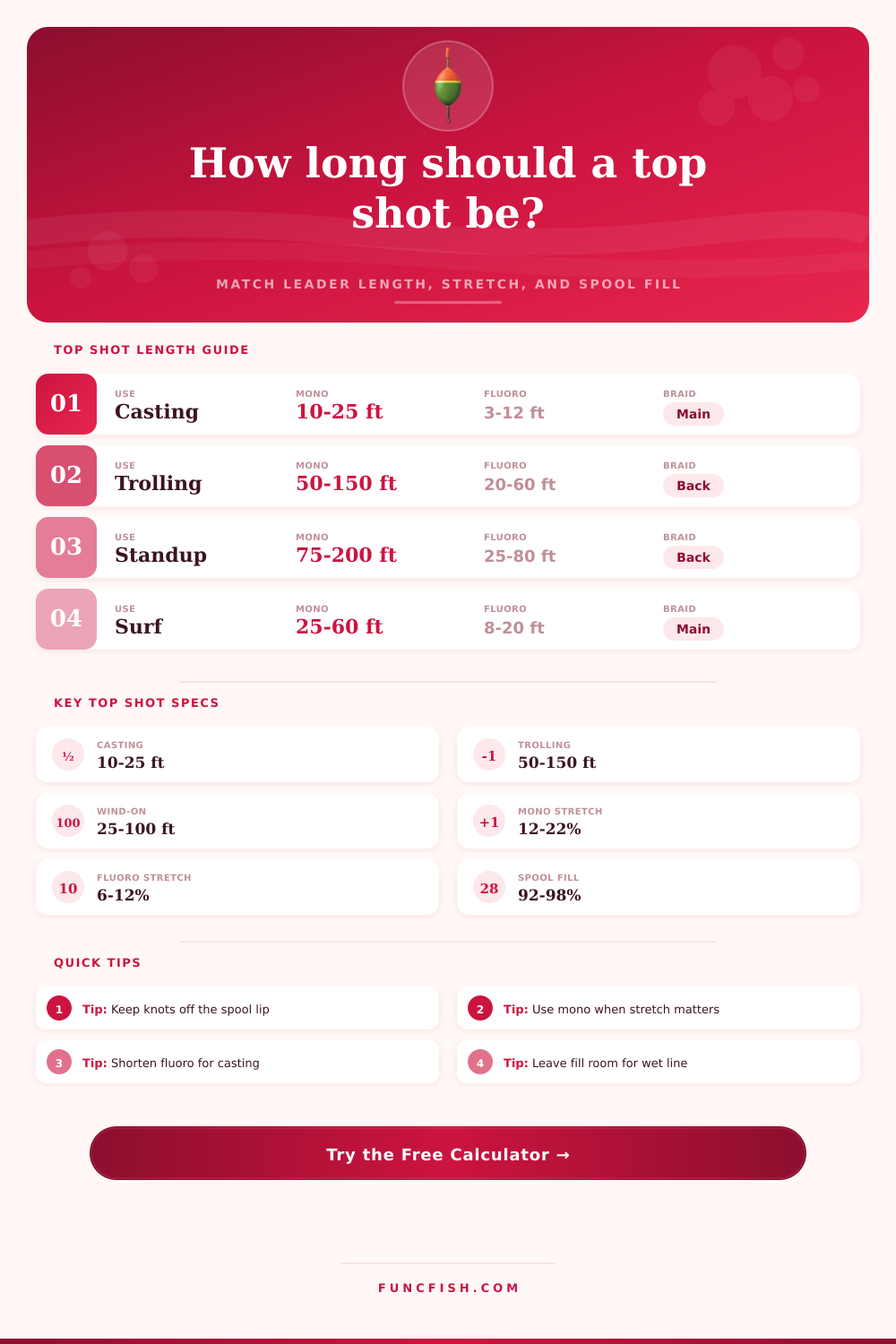
| Offshore trolling | 50-150 ft / 15-46 m | Mono stretch cushions strikes behind braid | Swivel or wind-on may stay outside rod tip |
| Stand-up tuna wind-on | 75-200 ft / 23-61 m | Long topshot aids handling near the boat | Loop-to-loop and wind-on sleeves need large guides |
| Surf casting shock | 25-60 ft / 7.6-18 m | Needs enough wraps on spool for casting load | Slim knot prevents guide slap and crack-offs |
| Kayak inshore fluoro | 4-12 ft / 1.2-3.7 m | Shorter leaders cast better in close quarters | Keep the knot outside micro tips if possible |
📏Diameter and capacity reference
| Line class | Mono diameter | Braid diameter | Capacity effect |
|---|---|---|---|
| 10 lb / 4.5 kg | 0.011 in / 0.28 mm | 0.006 in / 0.15 mm | Thin top shot saves spool space |
| 20 lb / 9 kg | 0.018 in / 0.46 mm | 0.009 in / 0.23 mm | Mono uses about 4x braid volume |
| 40 lb / 18 kg | 0.024 in / 0.61 mm | 0.013 in / 0.33 mm | Long top shots quickly reduce backing |
| 80 lb / 36 kg | 0.035 in / 0.89 mm | 0.019 in / 0.48 mm | Wind-on length should match reel size |
| 130 lb / 59 kg | 0.050 in / 1.27 mm | 0.028 in / 0.71 mm | Big-game tops need measured fill checks |
🐟Species and technique matching
| Target or technique | Top shot material | Typical drag | Length bias |
|---|---|---|---|
| Largemouth around grass | Fluorocarbon or hard mono | 4-8 lb / 1.8-3.6 kg | Short to medium for casting |
| Trout in clear streams | Soft fluoro or fine mono | 1-3 lb / 0.5-1.4 kg | Long enough for stealth |
| Bluefin or yellowfin tuna | Mono wind-on or fluoro wind-on | 18-45 lb / 8-20 kg | Long for shock and boat handling |
| Striped bass surf | Hard mono shock leader | 8-15 lb / 3.6-6.8 kg | Rod length plus spool wraps |
| Pike and musky casting | Wire bite guard or hard fluoro | 6-14 lb / 2.7-6.4 kg | Short bite protection section |
| Deep drop bottom rigs | Wind-on mono or hollow splice | 12-30 lb / 5.4-13.6 kg | Medium for handling near terminal rig |
🔗Connection comparison
| Connection | Bulk rating | Best top shot length | Guide clearance note |
|---|---|---|---|
| FG knot | Very slim | Short to medium leaders | Good for casting through standard guides |
| Albright or Alberto | Medium | Short leaders | Can tick micro guides with heavy fluoro |
| PR bobbin knot | Slim and long | Medium to long leaders | Excellent for heavy braid to mono |
| Loop-to-loop wind-on | Large | Boat and trolling top shots | Better with rollers or large guides |
| Hollow-core splice | Smooth | Long big-game tops | Cleanest transition when served correctly |
| Swivel outside guides | External | Any length kept outside tip | Do not reel swivel into guide train |
Top shot measuring tip: For casting rigs, count the rod length, the drop from tip to lure, and the desired wraps on the spool before adding any stealth or abrasion allowance.
Capacity check tip: If a heavy mono top shot pushes fill above the spool lip, shorten the top shot or remove braid backing before fishing it under drag.
When a big bait splashes down following a long cast, think of your connection point. Rod load occurs. Line tension builds. If you guess incorrectly regarding leader length, most battles conclude before they begin. Intuition says use fluorocarbon. Intuition never considers drag dynamics or spool volume. You need math to handle the physics without sacrificing your distance. It makes the complicated math of your reel’s geometry dissapears so you can concentrate on the fish.
For most of us, leader length is a fixed number out of a magazine page, failing to account for the fact our actual equipment matter. Twenty feet of fluoro flies well on a big-spooled, heavy-power surf rod loaded with big guides. However, it could hang up in the tip ring of a super-sensitive trout rod built for spinning ultra-light lures. Guide clearance is where this gets interesting and often means the difference between a great laydown and broken-off rod tips. It also takes into account spool fill percentage so there’s just enough braid backing to absorb shock before touching the drum floor.
How to Choose the Right Leader Length
People miss this one. They load their reel up with thick mono until it appears full, then they ask why they broke off a fish or lost them to snap-offs and brake failure, not realizing there wasn’t enough backing stretch to slow things down. Nearly everything else follows material selection. For example, nylon monofilament has plenty of stretch that softens shock loads from hard-striking tuna or wary bass. But fluorocarbon is stiffer (sinks faster) and renders the line invisible in clear water. That’s a double-edged sword because running too much fluoro through the smaller guides will be harsh on casting distance. The calculator help balance these trade-offs, calculating the shock stretch buffer based off your selected configuration.
If the mainline is braided, there’s no inherent stretch whatsoever, so the leader needs to absorb everything. Go light with the leader and you risk snapping off the hook when you set into a fish. Go heavy and you lose some casting range and sensitivity. Small thing, big difference. For example, let’s say you troll for tuna offshore. In that situation, stealth matters less then being able to work efficiently and absorb shock near the boat. Because you’re fishing such long distances (seventy-five to two-hundred feet or more), you may require up to one-hundred-feet of mono wind-on leader just to bring them safely around the gunnel. It becomes clear from the reference table on the page that each scenario requires very different leader length.
For a kayak angler targeting inshore species, however, only four to twelve-foot leaders is necessary because close quarters means every ounce matters as it relates to casting distance. The beauty of the tool is that it adjusts to these extremes. Selecting your scenario establishes baseline settings for typical cast distance and rod length. This prevents you from accidentally rigging a kayak set-up like an offshore trolling machine.
Another secret ingredient in performance comes from the way it’s connected. While some knots (like an Albright) are bulkier, others (like a streamline FG knot) move freely through even tiny guide rings without any problem. The calculator consider your guide size and your choice of knot to determine if they work together. If the diameter of your line plus the bulk of your knot will cause excessive friction on your particular rod blank, it alerts you to that fact. That’s something many folks overlook until their line breaks off right where they tied the knot. Knowing not only which knot to use but why one knot doesn’t work well in your system means so much more. You never know what you don’t know about rigging.
There are several rigging variables you can’t see. These include the elasticity of your old line and the volume inside the spool. But you can figure that out. Take the diameter of your lines and plug them into this formula. Then take the rated capacity of your reel and plug those numbers in, too. The result will be an estimate of remaining spool volume with your leader tied on. Avoid overfilling the spool to prevent excess drag on the spool or bail which reduces casting distance. Make sure there’s sufficient backing to engage at full-throttle when she makes a run.
So whether you’re launching your boat or stepping back on the bank, just remember that the idea is simple: You want something that can cast it out there, take the hit and then get through the fight without any surprises. Your gut might tell you otherwise but the numbers won’t lie. Let them give you confidence with each cast. Rest assured that whatever length separates your reel from your lure is exactly what you need for the conditions at hand.