
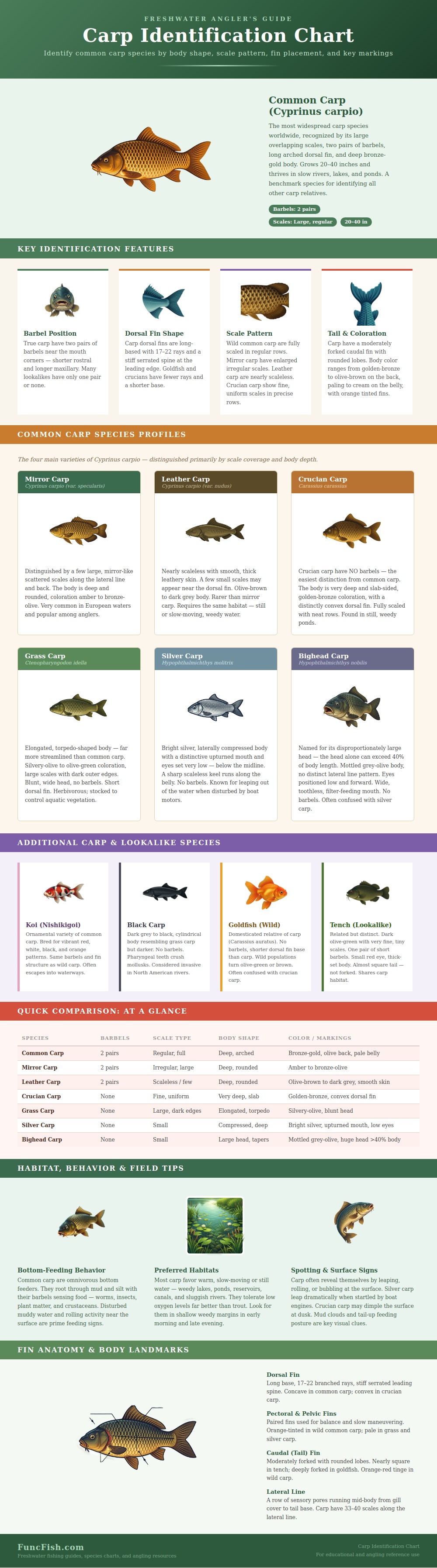
Casting that line out there, feeling that tug: Do you want a trophy fish? Or do you dread pulling up whatever else is in the water? There is the bronze-flanked common carp, the mirror carp lurking in the muck, the silver carp jumping in surprise, and the crucian carp making a game of being hard to find. What’s it gonna be? Identifying fish isn’t just for “the science fair”; knowing what kind youve caught inform how youll attempt to hook, bring aboard, and record catch.
Beyond body shape (see chart above), you can identify fish by their scale patterns. And this becomes relevant when your eyes is squinted against glare on a steamy afternoon. The best place to begin is the mouth region, since that’s where the most consistent indicators are lurking. True carp sport two pair of barbels near the corners of their mouths. Used as sensory whiskers, these help them burrow around in muck for insect larvae and other goodies. Crucian carp? Zip. They have no whiskers whatsoever.
How to Tell Different Fish Apart
Nor do grass carp, though you’ll notice a wider and flatter head on ‘em, sorta squarish relative to common carp’s tapered snout. So if you’re in a weedy lake with both species feeding on the bottom, that characteristic will save your bacon by keeping you from mistaking a grass carp for a common carp. With those whiskers present, you know it’s either a *Cyprinus* species or one of its lookalikes such as tench, which has only a single pair and small scales. This little bit of anatomy eliminates half your trouble before you’ve even netted the critter from the water.
Next up, the scales. As the infographic points out, wild common carp covers themselves in regularly spaced, overlapping rows of armor from nose-to-tail. Not so mirror carp. Instead they sport big wads of random-looking scale patches on the back and lateral line area but otherwise appear naked. Leather carp take it one step farther (practically no scales at all), just super-thick, smooth skin that’s just as described. That’s where new anglers get thrown off because they think “all carp are created equal.” They aren’t.
Now let’s talk about the dorsal (back) fin. Common carp feature a long based dorsal fin with a front edge having a serrated, stiff spine. Crucian carp fins is shorter and curved outward (convex), resulting in a deeper, more slab-sided profile that resembles an overgrown goldfish.
You’ll be able to confirm your visual guesswork through habitat clues. For example, most common carp are found in ponds or sluggish rivers with warm, slow-moving water. This allows them to feed by rolling around and stirring up silt. This is not the case for silver carp. With their upturned mouth, eyes positioned low on head, they’re filter feeders that catch plankton close to the surface. When startled by boat motors, they’ll jump dramatically, screaming out “silver carp” long before you get a clear look at them.
Bighead carp resemble silvers but feature a disproportionately huge head atop a mottled grey-olive body. It’s easy to confuse the two; watch the mouth angle and eye position to tell ’em apart. True carp feature the same fin layout as koi and also have the same barbel structure. Koi are simply ornamental varieties of common carp that has been selectively bred for their colorful patterns (red & white).
When you know what to look for, wild goldfish possess much smaller dorsal fins in addition to having no barbels at all. Tench are dark olive-green and have small scales along with square tails. While they may inhabit similar areas, genetics tell us they aren’t related. Knowing these distinctions allows your approach to fishing to go beyond guesswork to become an acquired skill.
No longer will you react to every splash, instead you’ll anticipate which species will be hanging out where based off their feeding habits and body shapes. The next time you witness a shadow slip underneath the lily pads, you’ll know if it’s after surface filtration or worm rolling. And that knowledge? Well, that’s the true trophy.