
The hermit crab arrives home with you, and yeah, it’s small. It is perhaps downright pitiful. Its white pincers is oversized on its body; they cling to whatever shell you’ve brought it home in. And immediately, you’re wondering: Have I made a mistake? No, nope, not at all. It’s just one of those first-shock moments of the journey.
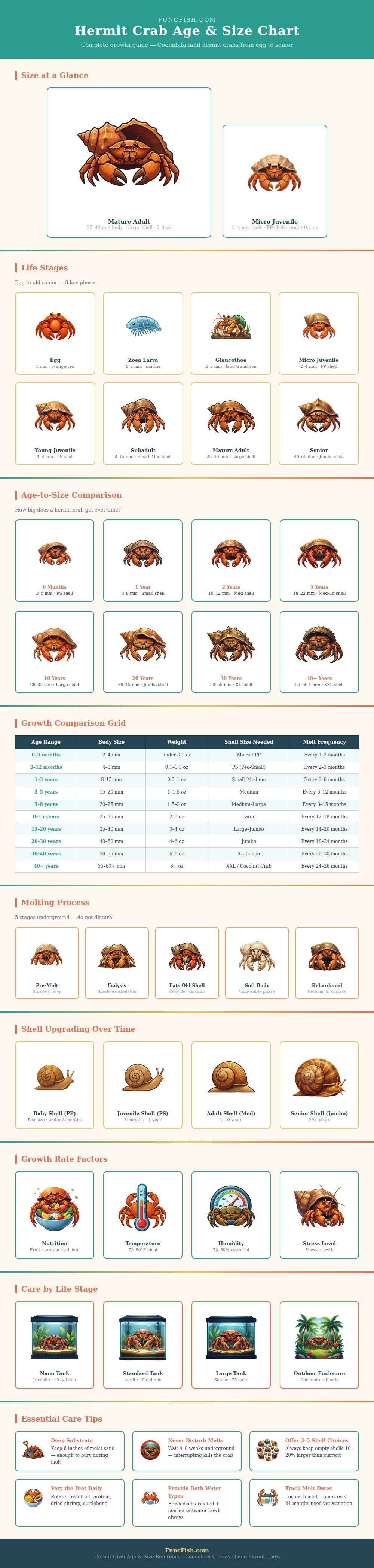
Knowing what phase your crab is in… And what that means, transforms everything about how you’ll provide for it. Here’s a handy chart breaking down those life-cycle stages (above) so that you know that a millimeter-long creature will grow up to be quite a sizable animal who realy needs room to roam.
How to Care for Your Hermit Crab
Watching them grow isn’t enough. Realizing when you need to switch from baby food to full-on adult territory is half the adventure. “People assume it’s all about size; however, in reality it’s all about timing. A senior crab will go up to almost two years between shed cycles, whereas a micro juvenile is molting every couple of weeks. This completely alters how you monitor.”
If you’re working with a tiny, 4-8 mm long, hungry-and-growing-fast young crab, you’ve got to be on it. You can’t let it languish, as it requires constant attention… Especially since the risk of something eating it are higher. If that same crab makes it to its tenth birthday and becomes roughly thirty millimeters, well, it doesn’t require quite as much concern. Slow down; so does she. She’ll eat when she’s ready, and worrying if it was “enough” today won’t make any difference.
It’s a marathon, not a sprint and running it like one typically leads to trouble for both parties. Here’s where it gets hairy for new keepers: They come from sea to sand. Larval hermit crabs begin life adrift in the oceans as zoea, eventually crawling onto shore seeking shelter within an empty shell. That’s the change from zoea to glaucothoe, as the infographic explains.
And this is why humidity matters for later care. Their gills require some moisture or else, well, they becomes suffocated because the gills glue themselves shut. Despite being terrestrial creatures, their gills still must be moist. So yes, you’re not just housing a creature, you’re providing a microclimate that replicates a tropical beach. Humidity of between 70-80% is not optional. It’s a matter of survival.
Your crabs will spend all day trying to find something to hide under as they get bigger. Give ’em choices! Always have multiple empty shells on hand… All of them sized slightly larger than what they currently occupy. That way, when it comes time for a molt, they won’t stress out about finding shelter.
Once they molt, they are vulnerable. Molting is an underground event. They dig a deep hole in the substrate. Then they shed their exoskeleton and consume the old shell to recycle calcium. Finally, they hang tight while their new body firms up. It doesn’t take much to disturb this and kill a perfectly healthy crab. Leave them alone. Believe me, these guys knows what to do, they’ve been doing it for millions of years.
The other factor that really makes them do well with these transitions is good nutrition. Healthy molting relies on a balanced diet containing some calcium source, protein, and even fresh fruits. The result of poor nutrition is often a malformed new shell or one that is simply weaker. Check out the data above with the weight gain. Healthy crabs will steadily put on mass over time. In fact, some 20 year old crabs can reach several ounces in weight. That’s considerable for what looks like a tiny little creature! It’s the result of good care over many, many years.
And then there’s space. They’re often housed in tanks far too small for their size. Adults and seniors will require plenty of space to explore and exercise as they mature. Cramping them up leads to fighting and stress. If possible start off big or have an upgrade planned.
When you watch a hermit crab thriving, what do you see? You see an active, confident, and well-fed crab. It all starts with your first impression when you brought it home. Do you recall how tiny that shell was? Fast forward now. Picture that same shell, but imagine how confident a creature would feel knowing its environment is safe. That’s what we’re looking for.