Fish Scale Calibration Offset Calculator
Estimate zero offset, span error, linearity drift, corrected fish weight, and field confidence from known check weights, displayed readings, tare behavior, temperature, and scale resolution.
📌 Calibration presets
⚙ Scale and check inputs
Calibration results
Calculation breakdown
🧰 Scale profile quick grid
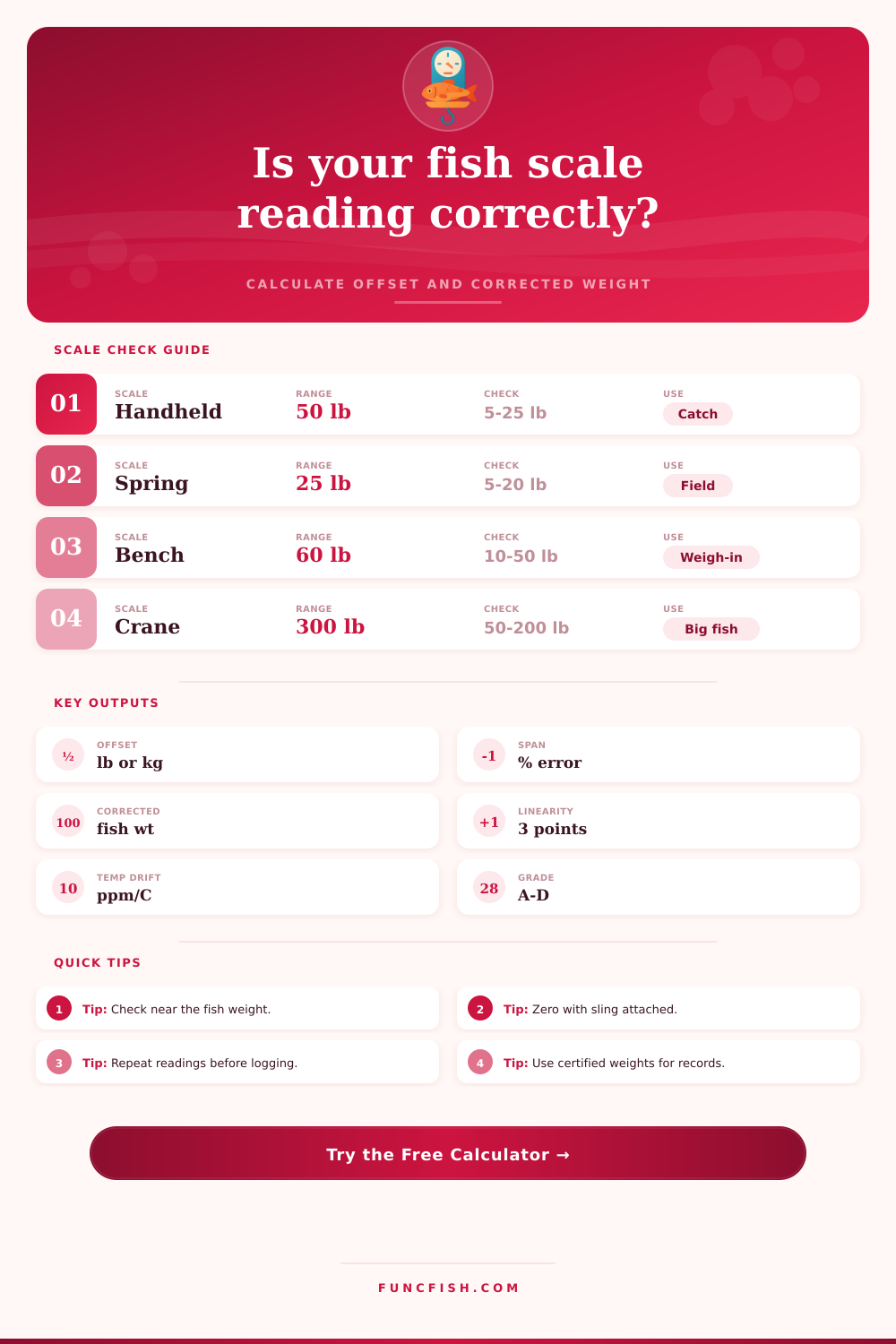
Good for bass, walleye, redfish, and general catch logs when checked near expected weight.
Robust in wet field use, but spring fatigue and angle error can create larger offsets.
Best for tournament tubs and certified checks when level, dry, and warmed up.
Useful for tuna, shark, halibut, and very large sling weights with broad tolerance bands.
📊 Calibration method comparison
Best when fish weight is very close to one known check weight and span error is already small.
Uses low and high weights to estimate slope and intercept across the working range.
Adds a midpoint residual to reveal bowing, worn springs, or load-cell nonlinearity.
Places the fish reading between two check weights to reduce extrapolation risk.
📘 Reference tables
| Scale type | Typical capacity | Typical resolution | Calibration concern |
|---|---|---|---|
| Digital handheld load cell | 25 to 110 lb / 11 to 50 kg | 0.01 to 0.05 lb / 5 to 20 g | Temperature drift, low battery behavior, and sling angle. |
| Spring tube hanging scale | 15 to 50 lb / 7 to 23 kg | 0.25 to 0.5 lb / 100 to 250 g | Zero creep, spring fatigue, parallax, and wet scale sticking. |
| Lip-grip digital scale | 30 to 60 lb / 14 to 27 kg | 0.01 to 0.1 lb / 5 to 50 g | Grip weight, fish movement, and torque if the fish is not vertical. |
| Tournament bench platform | 30 to 100 lb / 14 to 45 kg | 0.005 to 0.02 lb / 2 to 10 g | Level surface, tub tare, water slosh, and warm-up stability. |
| Mechanical dial scale | 25 to 100 lb / 11 to 45 kg | 0.25 to 1 lb / 100 to 500 g | Needle hysteresis, dial reading angle, and shock loading. |
| Crane or tripod scale | 100 to 600 lb / 45 to 272 kg | 0.2 to 1 lb / 100 to 500 g | Sling geometry, hoist motion, and large tare corrections. |
| Result grade | Error band | Reading behavior | Best interpretation |
|---|---|---|---|
| A | Within target tolerance | Small offset, stable repeat readings, low linearity residual | Useful for normal catch records within the checked weight range. |
| B | Up to 2x target | Noticeable correction, but the fish is bracketed by check weights | Apply correction and record that the scale was adjusted by calculation. |
| C | 2x to 4x target | Large span correction or unstable repeated readings | Use for rough logs only unless the scale can be recalibrated and rechecked. |
| D | Above 4x target | Major nonlinearity, extrapolation, or poor repeatability | Do not rely on the reading for close comparisons or record claims. |
| Check point | Why it matters | Good placement | Warning sign |
|---|---|---|---|
| Zero or tare | Removes sling, net, gripper, and empty bucket weight | Same rig used for the fish reading | Scale does not return to zero after unloading. |
| Low check | Sets offset near small fish and panfish weights | 10% to 30% of capacity or expected fish range | Low reading has opposite error from high reading. |
| Mid check | Reveals nonlinearity across common catch weights | Near the fish weight or midpoint of the bracket | Mid residual is larger than display resolution by several steps. |
| High check | Sets span and catches overload or tired spring behavior | Above the fish reading without exceeding capacity | High point drifts after the load is held for a few seconds. |
| Fish scenario | Expected weight range | Suggested check weights | Useful scale style |
|---|---|---|---|
| Bass tournament bag | 2 to 35 lb / 1 to 16 kg | 5, 15, and 30 lb / 2, 7, and 14 kg | Bench platform or checked digital handheld. |
| Trout stream catch | 0.25 to 8 lb / 0.1 to 3.6 kg | 1, 3, and 6 lb / 0.5, 1.5, and 3 kg | Compact digital or light spring scale with fine resolution. |
| Catfish or carp sling | 10 to 80 lb / 5 to 36 kg | 10, 30, and 60 lb / 5, 14, and 27 kg | Hanging digital with strong hook and known sling tare. |
| Offshore deck fish | 20 to 300 lb / 9 to 136 kg | 50, 100, and 200 lb / 23, 45, and 91 kg | Crane scale or tripod scale checked with heavy standards. |
| Ice derby panfish | 0.1 to 5 lb / 0.05 to 2.3 kg | 0.5, 1, and 3 lb / 250 g, 500 g, and 1.5 kg | Digital scale with small resolution and temperature allowance. |
✅ Practical calculation tips
When we pick up a fish on the dock, most of us have seen a number on the scales that doesn’t seem quite right. You know your fish isn’t 6 ounces, but the scale reads 6 ounces to light or too heavy. Whether you’re logging a personal best or getting ready to weigh in at a tournament, it seems like it happens a lot in fishing. And while sometimes it’s the simple issue of how much the hook weighs, most times it’s more than that. Usually its some combination of span drift, zero error and the effect of temperature on the reading. These factors creep in between the time we see the number and the time we log it. Most angler just accept what the number says because there’s no quick way to know how far off it might be.
That’s where a way to approximate actual weight comes in handy. After entering your check weights into calculator, it figures out the math for you. You will no longer have to guess whether something like an additional 1/4 pound is truly there or simply result of scale drift.
Why Fish Scales Are Often Wrong
It begins with your zero point. Taring the scale doesn’t eliminate any error, it has nothing to do with the geometry of a wet sling changing the spring (or load cell) tension ever so slightly. So when you take your zero point with the sling still on, it include that specific amount of weight along with its geometry. Then when you pull the sling away to weigh the fish, you’ve added another variable that alters the baseline. To achieve accurate results, you has to keep everything exactly the same… Setup included… From check to catch.
After that, there’s the span correction. This take into account how well the scale reads throughout its entire range. For example, you may have a digital handheld that measures precisely on five pounds but deviates different than 25 pounds. Spring scales are also far more problematic in this area due to metal fatigue over time.
To calculate the slope, it looks at the difference between your lowest and highest check weights and compares them with known standard values. Once the deviation is calculated (if it’s linear), calculator will multiply your fish weight by some value. That isn’t an addition like an offset would of been. Instead, it means that the scale isn’t simply beginning incorrectly. It’s consistently getting bigger or smaller based off the increasing weight. Knowing that distinction is important since a fixed error can be accounted for by subtraction while a proportional error require mathematical adjustment.
Surprisingly enough, temperature also matters. Thermal expansion affect load cells. You calibrated your digital scale in your cold garage at sixty-eight degrees and now you’re out on a hot dock at eighty-two and all of those internal components move just a little bit. The drift is measured in parts per million per degree Celsius. A small number, but it add up when you’re trying to nail down your weights within ounces. The calculator factors the environmental shift into the confidence grade. It is something easy to forget until you don’t match your buddies’ scales during that friendly weigh-in.
You get back an A to D grade indicating error bands and repeatability of output. An A grade indicates tight variance, and your check weights is surrounding the fish weight closely. You have confidence in that number to use for record-keeping purposes. A C or D grade tells you something isn’t right. Maybe the reading isn’t stable, or maybe the device isn’t linear. Then the corrected weight is a best guess. It’s better to log it as such than to claim more precision then actualy exists.
No field condition is ideal. Fish wiggle, wind rocks the scale, sloshing water enter the tub. These factors add a degree of noise that cannot be entirely accounted for in a calculation. That’s where the repeat spread input comes into play. It allow you to quantify some of that uncertainty. So if it’s reading several display steps different each time, it doesn’t matter what the theoretical calibration is. It tells you that calibration is only half the battle; handling technique matters too.
All this goes back to fishing honestly and accurately; knowing what your scale can do. You need something to stand on when it comes time to argue about pounds and ounces. And you won’t argue about those fractions of a pound so much after that. Regardless of whether it’s a cheapie spring balance or a high-dollar digital platform, the concepts apply equally well. Maintain consistency, check frequently, and always be mindful of where you are weighing them. The key is understanding what you’re really weighing.
Next time you pick up that fish, you won’t guess. You’ll know exactly how much weight you should trust on the display.