Jig Skirt Strand Count Calculator
Estimate how many jig skirt strands and tabs to cut from jig weight, skirt material, collar size, strand length, trailer bulk, cover density, and desired profile.
📌Skirt build presets
⚙Strand count inputs
Jig skirt strand result
Calculation breakdown
🧵Material data grid
Good for clear water, smaller jigs, and subtle skirt motion.
Baseline for common 20 to 22 strand skirt tabs.
Round rubber breathes and looks fuller with fewer strands.
Accent strands add visibility but little body volume.
📊Profile comparison grid
Best for small trailers, clear water, cold fronts, and pressured fish.
Works on swim jigs, bladed jigs, and medium trailers.
Fits craw trailers, stained water, wood, rock, and dock targets.
Builds a large bluegill or punching profile without collapsing.
📘Reference tables
| Material | Bulk factor | Typical strand plan | Best use |
|---|---|---|---|
| Fine-cut silicone | 0.82 | Add 6 to 10 strands | Clear water, small forage, finesse swim jigs |
| Standard silicone | 1.00 | Use calculated count | Everyday bass jigs, spinnerbait skirts, bladed jigs |
| Living rubber | 1.22 | Remove 6 to 12 strands | Cold-water jigs, football heads, slow presentations |
| Flat rubber strips | 1.35 | Remove 10 to 18 strands | Bulky craw, big profile, heavy bottom contact |
| Flash silicone blend | 0.92 | Add a small accent reserve | Wind chop, shad spawn, reaction baits |
| Bucktail or hair blend | 1.16 | Use lower silicone count | Cold water, inshore jigs, natural breathing profile |
| Jig style | Base count | Common weight | Profile note |
|---|---|---|---|
| Micro panfish jig | 18 to 30 | 1/64 to 1/16 oz | Use thin strips and short finished length. |
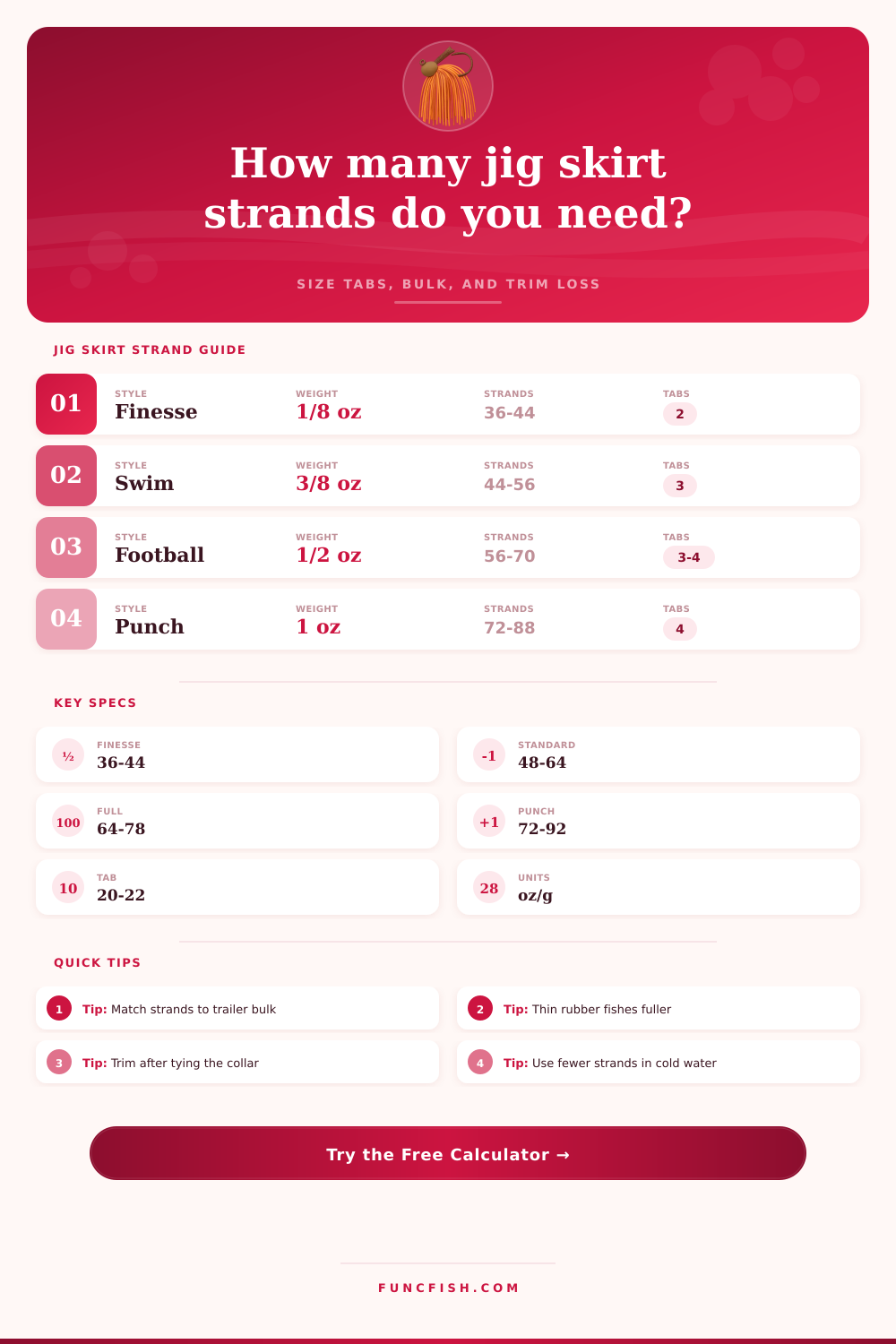
| Finesse bass jig | 36 to 44 | 1/8 to 5/16 oz | Sparse enough to pulse behind small trailers. |
| Swim or bladed jig | 44 to 58 | 1/4 to 1/2 oz | Compact body keeps the bait tracking cleanly. |
| Casting or spinnerbait | 50 to 64 | 3/8 to 3/4 oz | Balanced count for skirt flare and hook clearance. |
| Football jig | 56 to 72 | 3/8 to 1 oz | Full enough to stand out on rock or hard bottom. |
| Punch or flipping jig | 70 to 92 | 3/4 to 1 1/2 oz | High bulk preserves silhouette in grass and cover. |
| Trailer bulk | Adjustment | What it means | Skirt check |
|---|---|---|---|
| No trailer | +8% | Skirt carries most of the visible body | Add enough strands to avoid a hollow look. |
| Slim trailer | +3% | Small tail adds motion but little volume | Keep the skirt slightly fuller than compact. |
| Standard trailer | 0% | Baseline craw, chunk, or swimbait | Use the calculated strand count as shown. |
| Bulky trailer | -8% | Trailer displaces skirt and slows fall | Remove strands to prevent crowding the hook gap. |
| Oversized trailer | -14% | Trailer already makes the bait wide | Cut the skirt shorter or thinner near the hook bend. |
| Jig weight | Light profile | Standard profile | Full profile |
|---|---|---|---|
| 1/16 to 1/8 oz | 18 to 32 strands | 28 to 40 strands | 36 to 48 strands |
| 3/16 to 5/16 oz | 34 to 42 strands | 42 to 54 strands | 54 to 66 strands |
| 3/8 to 1/2 oz | 42 to 52 strands | 52 to 66 strands | 64 to 78 strands |
| 5/8 to 3/4 oz | 52 to 62 strands | 62 to 76 strands | 74 to 88 strands |
| 1 oz and heavier | 60 to 72 strands | 72 to 88 strands | 84 to 104 strands |
💡Build tips
How many times have we had a jig head that looked great on the bench and just didn’t cut it underwater? The skirt would never flare out like it should but always end up as a limp ribbon of nothing. Most of the time it isn’t because of bad hooks or paint job but because the number of strands used are wrong. Too many and they will kill the fall rate by creating drag; too few and the bait appear dead.
With this calculator, you don’t have to guess how many tabs to use to get that full craw look. It calculate the amount based off the size you are targeting and material you want to use. The trick is understanding the bulk and knowing not all strands is created equal in regards to space. For example, a long piece of thin silicone take up less space than an equally long chunky living rubber strip. The tool account for this by adding a bulk factor based on your material selection.
How to Make a Perfect Jig Skirt
If you’re fishing a finesse swim jig, you want more strands to match the volume that heavier materials provides with fewer cuts. But lots of folks miss this point and go off the number of strands rather then the visual volume they see. If you create something like a standard tab punch jig skirt exactly like a finesse swim jig with thinner material, it’s going to appear hollow.
The profile of your lure will also change depending on water temp. You’ll want a sparser skirt when the water is cold. It will fall faster with fewer tentacles capturing the current and triggering sluggish fish that has little desire to chase. By the time the bait reaches the bottom, they have already hit it. As the water warms, the cover gets heavier and the bass get more aggressive. So instead of falling fast, you’d prefer something with a fuller profile that push water, and has more vibration. To account for this, the calculator allow you to choose your preferred skirt profile density and take into account not only the look but the water movement as well.
Trailers also add to the problem, as oversized paddle tails or large creature baits takes up considerable space behind hook. Add a bulky trailer and the skirt strands end up cramped against the trailer and hook shank if you maintain a high strand count. That minimizes the flare and results in a messy-looking rather than layered assembly. When you choose an option with a bulky trailer, the system trims the recommended strand count, leaving sufficient room for the skirt to move freely around the main bait body.
Because the material lays against the hook, type of tying (rubber band or wire) makes a difference, something few anglers consider, but it does. When using a rubber band, the strands can splay out further and because there are fewer, they present a larger silhouette. With wire tying, the material is compressed down to the hook shank so more strands is required for the same apparent size. Knowing this mechanical truth goes into the calculator and keeps you from having something that looks like it was just tied loosely.
There are no absolutes when it comes to trimming because each batch of rubber feel a little different in terms of flexibility and thickness. So cut up your tabs, attach them then let the jig sit in water for a minute to see how it behaves. Does it sink straight down? Does it flutter around? Too slow? Trim a bit less belly material the next time. Does it fluctuate too much? Add an extra strand or two and go from there. The tool gives you a good mathematical starting point but your eyes will have to fine tune it at the end of the day.
Making a quality skirt is a balancing act. You need it to move and grab attention, but not so much that it causes drag and stops natural fall. There’s no one answer; it’s just matching the right quantity of furnitures for the situation.
First thing is first: Use the calculator to give you some numbers. Then get out there and dial it in by hand. A good skirt flows like alive prey. That’s how you catch ’em.