Kayak Seat Position Trim Calculator
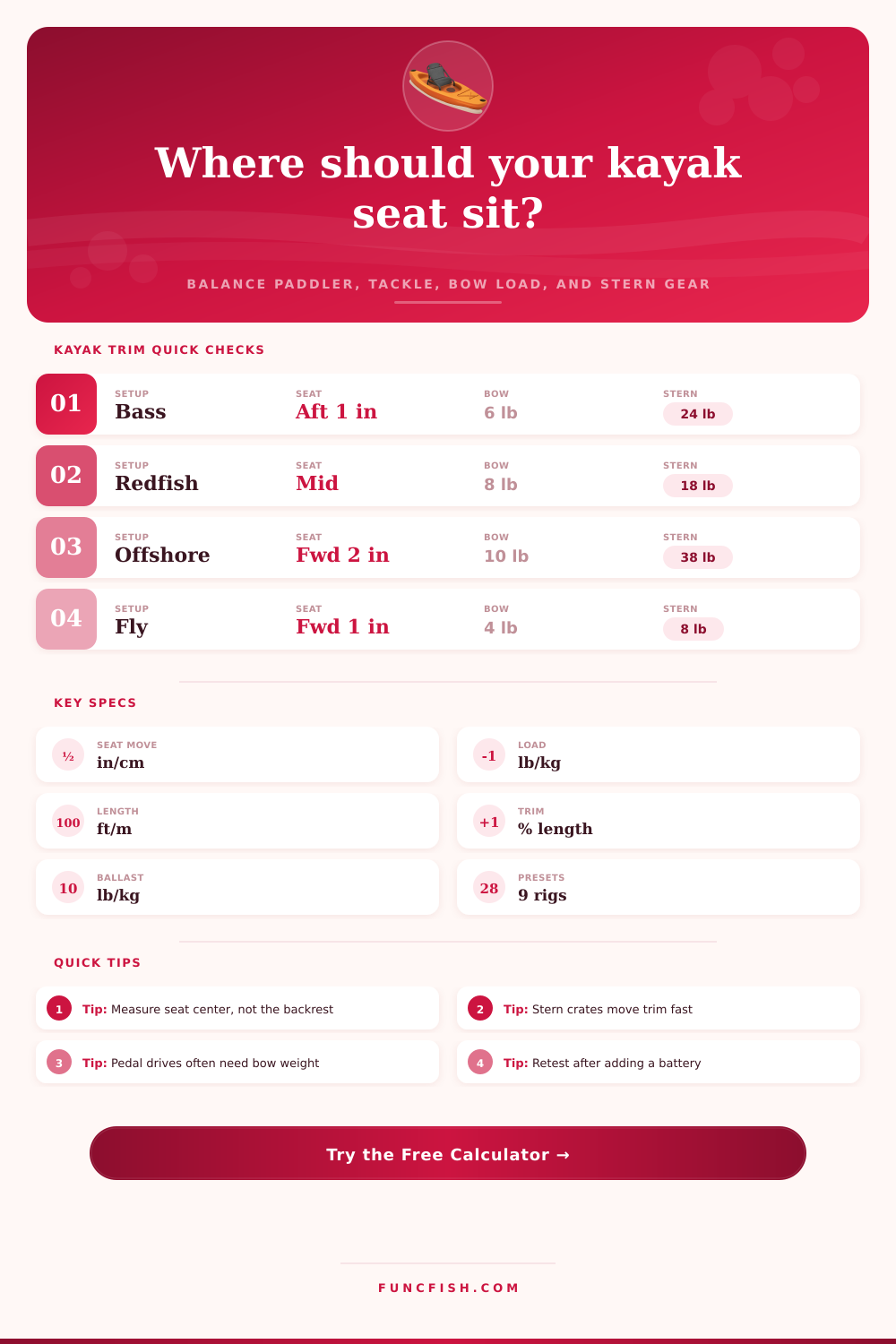
Estimate how far to move a fishing kayak seat forward or aft by balancing hull weight, paddler mass, seat hardware, bow gear, stern tackle, and the fishing layout you carry.
📌Fishing kayak presets
⚙Trim inputs
Kayak trim results
Formula breakdown
📊Current load model snapshot
All weights are converted to a single station measured from the bow.
Moving the paddler and seat changes the largest moment in the kayak.
Battery, bait, crates, and rods shift the neutral target by technique.
The calculator limits the answer to the selected seat track range.
🎣Gear and species comparison grid
Rods and tackle boxes often sit behind the seat, so many bass rigs tolerate a small forward move.
Shallow water sight-fishing favors level trim with modest bow load to reduce stern squat.
Minimal fly or spin gear leaves the paddler as the dominant moving weight.
Tankwell bait systems, safety gear, and batteries usually require forward seat correction.
Anchors and bait buckets can be split fore and aft to keep the waterline even.
Trolling batteries behind the seat need either a forward rail position or bow counterweight.
A touch of bow authority helps punching small waves without burying the nose.
Dense terminal tackle should be placed close to the seat or slightly forward.
📐Reference tables
| Kayak profile | Modeled empty weight | Neutral CG target | Trim tolerance |
|---|---|---|---|
| Compact sit-on-top fishing kayak | 58 lb / 26.3 kg | 51.5% of length from bow | 1.3% of length |
| Open deck fishing kayak | 78 lb / 35.4 kg | 52.5% of length from bow | 1.2% of length |
| Pedal-drive fishing kayak | 105 lb / 47.6 kg | 53.5% of length from bow | 1.0% of length |
| Sit-inside touring/fishing kayak | 62 lb / 28.1 kg | 50.5% of length from bow | 1.1% of length |
| Big-water stable fishing kayak | 95 lb / 43.1 kg | 53.5% of length from bow | 1.0% of length |
| Tandem kayak paddled solo | 82 lb / 37.2 kg | 52.5% of length from bow | 1.4% of length |
| Inflatable fishing kayak | 45 lb / 20.4 kg | 51.0% of length from bow | 1.6% of length |
| Seat type | Seat mass used | Practical travel | Trim note |
|---|---|---|---|
| Fixed low frame seat | 7 lb / 3.2 kg | 2 in / 5 cm | Most correction comes from moving gear, not the seat. |
| Short adjustable track | 9 lb / 4.1 kg | 5 in / 13 cm | Common factory seat rail with useful fine tuning. |
| Long adjustable track | 10 lb / 4.5 kg | 9 in / 23 cm | Best for balancing heavy stern crates or bow bags. |
| High frame seat | 12 lb / 5.4 kg | 6 in / 15 cm | Small trim changes can feel larger due to higher CG. |
| Pedal kayak rail seat | 13 lb / 5.9 kg | 7 in / 18 cm | Forward travel may be limited by comfortable pedal reach. |
| Tandem clip-in seat | 8 lb / 3.6 kg | 14 in / 36 cm | Large station jumps make tandem solo setups sensitive. |
| Inflatable sling seat | 5 lb / 2.3 kg | 8 in / 20 cm | Floor flex can change trim after loading. |
| Fishing layout | Modeled center load | Load station | Trim bias |
|---|---|---|---|
| Bass crate, rods, and stern tackle | 22 lb / 10.0 kg | 72% of length from bow | Slight aft target for casting comfort |
| Redfish flats with light bow bag | 18 lb / 8.2 kg | 62% of length from bow | Nearly level for shallow tracking |
| River smallmouth day rig | 12 lb / 5.4 kg | 55% of length from bow | Slight forward control for current seams |
| Fly trout minimal deck | 8 lb / 3.6 kg | 48% of length from bow | Forward bias keeps stripping deck clear |
| Offshore jigging with tank/battery | 35 lb / 15.9 kg | 70% of length from bow | Forward correction for surf and swell |
| Catfish anchor and bait load | 30 lb / 13.6 kg | 58% of length from bow | Level target for anchored sits |
| Walleye trolling battery and tracks | 28 lb / 12.7 kg | 67% of length from bow | Forward correction for stern battery |
| Blackfish bottom rig and sinkers | 26 lb / 11.8 kg | 57% of length from bow | Level to slight forward trim |
| Observed trim | Likely balance state | Seat adjustment | Gear adjustment |
|---|---|---|---|
| Bow plows and feels sticky | CG too far forward | Move seat aft within track range | Shift dense boxes toward stern, but keep launch safety in mind. |
| Stern squats under paddle or pedal | CG too far aft | Move seat forward if leg reach remains comfortable | Move battery, anchor, or fish bag toward bow hatch. |
| Weathercocks hard in wind | Bow rides high or stern is deep | Test a forward seat correction | Use bow bag weight before adding loose ballast. |
| Deck drains flood near seat | Local load is concentrated | Use small seat changes only | Split tackle between front hatch and tankwell. |
| Level scuppers and easy glide | CG near target | Keep current station | Record this setup as your baseline for future trips. |
💡Trim calculation tips
Trim is something you shouldn’t neglect, but instead make a priority. A lot of anglers load up their kayaks, plop down in the seat and figure out how to handle it once they are on the water. The problem is most fishing kayak aren’t rigged to be balanced without a bunch of weight in them.
Your seat position will be the main way to adjust your balance if you don’t have tackle box or batteries where the boat was designed to have them. You can plug-in your loads (gear) and your weight (paddler), plus hull type into calculator and let it recommend adjustments. But what’s important is knowing what you’re doing with those entries. Essentially, the calculator assume your kayak is like a seesaw and finds its moments relative to some neutral centerline determined by the kayak’s hull shape.
How to Balance Your Fishing Kayak
A long pedal-drive boat balance differently from a short, compact sit-on-top. If you go big on a heavy pedal drive, shifting weight of a heavy motor and track to the stern means moving the neutral reference point back just a bit to account for all that weight in the back. This sounds like a small change, but it affects how much weight you must add to the front to reach a neutral position.
Stern loads are quick to build up and easily overlooked. An electric trolling motor battery is heavy and it’s good for boat’s stability because it rides low. But it’s also located way aft on the boat. Add a tackle crate in the tank well, and now your center of gravity move all the way to the back.
This is why the calculator asks for an input for stern load. If you leave it blank (set to zero) while having thirty pounds of gear riding your butt, the recommended seat position won’t help you one bit. Be honest about what you’ve got in boat.
A bow load matters. Bow loads are critical, even when they is light. That little bag of safety gear or rods up front doesn’t increase overall weight very much, but it puts a lot of weight on a long moment arm. You can move the seat back and forth a couple inches, but if you move 5-pounds from the back to the bow hatch, you will have shifted the trim considerable more.
With a fly fishing set-up that has very little gear on the deck, you’ll find yourself sitting further forward. The lack of heavy tackle boxes pulling the rear down means there’s nothing to weight the bow down with and you end up sitting forward to avoid the nose riding too high in wind and waves.
And there’s your final trim error, and also a recommendation for a seat move. The error number then lets you know just how out of whack you’ll still be with your balance point even when you make the recommended change. A low number means you’re right on. A big number means you’ve got your gear laid out in such an extreme way that moving your seat around within the limits of track will never quite get you balanced again. Time to think about rearranging.
It’s always better to split heavy stuff up by stashing some in the tank well and some forward in the front hatch, rather than piling everything behind you. There’s also another wrinkle with pedal drives. Pedal kayaks tend to squat in the stern because the drive is heavy and aft. And that tendency is what the calculator figures into its formula for that style hull.
To counteract the added weight in the stern (from an anchor or trolling motor), you must have either a really far forward seat location or lots of weight in the bow. Here leg reach are the limit. How far forward can you sit until your feet come off the pedals at their maximum extended position? That’s a physical limitation. A spreadsheet doesn’t trump physics.
Trim Trim can be affected by wind as well. When wind pushes on the bow of a high riding boat it will make the boat weathercock more and cause it to steer sluggishly. Do you constantly have to fight the helm to go straight? Check your trim. Often times just moving some weight up front will level out the boat and solve your steering woes. No rudders need changing. Small thing but it can make a huge difference in comfort for a long day.
To conclude. A static weight-based calculation is a good place to start but remember water is dynamic and hull shape plays complex games with each wave. The calculator gives you a good number to start with and then it’s time to head out with an empty boat and set the baseline. Slowly add your gear one piece at a time. Make sure you check the water line at both the bow and stern scuppers. Tinker with the seat position until the lines match up.
Once the trim is set, the kayak tracks straighter, has less drag, and feels stable enough to attempt standing on. That’s the goal. Knowing exactly how much weight you’re asking that hull to pull will get you there.