
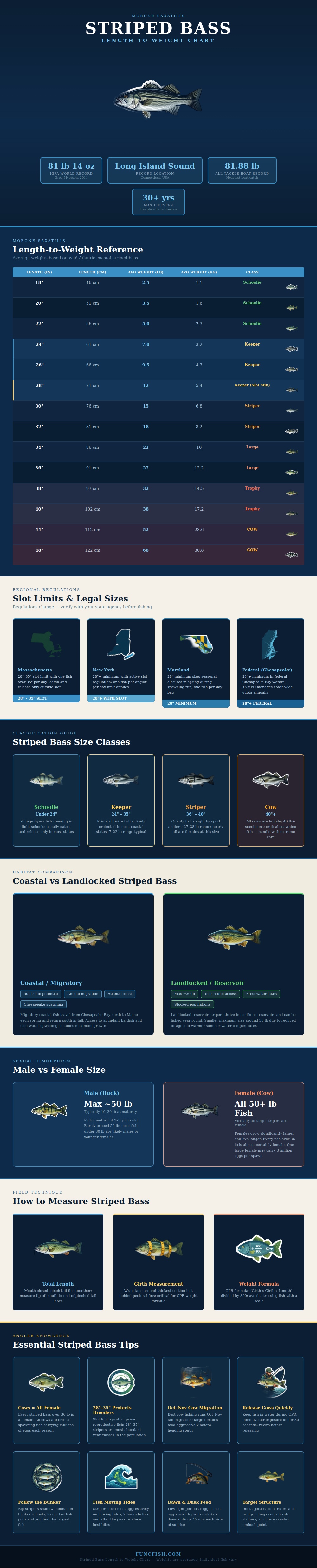
So how does it all come together? Here is how I show length and weight on the chart above. Now you don’t have to guess if you’re fighting a 30 pounder or a 3 pounder when fish is still running deep.
The reason for this is most folks assume that size=bigger=heavier…in a linear fashion. But the biology of a striped bass are much more exponential. For example a 22 inch striper might weigh five pounds. Then stretch out that fish two inches longer and now you’re talking about a 24 inch striper weighing seven pounds. That additional two inches has a lot more girth and muscle mass to it. They grow a lot more outward different than long as they get older and into their prime years.
How Size Affects Weight and Fishing
Knowing this curve will help you adjust your drag accordingly and pick the proper leader strength prior to engaging fish.
In terms of conservation, size trumps pounds. Anything less than 24 inches tend to be an immature female or young male. They roam in close company and aren’t typically considered reproductively viable members of population. In fact, most states safeguard schoolies as catch-and-release fishs. Any striper measuring more than 28 inches is consider part of the prized slot limit class that most fisheries try to preserve. They represent most of the system’s reproductive potential.
The chart demonstrates how quickly a striper gain in mass during the keeper class. A 32-inch striper isn’t merely “a little” bigger then its 28-inch counterpart, it weighs almost twice as much. And that’s the reason folks grapple so fiercely for fish between the 30- and 40-inch range. It’s more than a trophy. It’s more than a bigger meal. It’s a full-grown animal that’s survived several seasons of angling pressure and predation.
Whether a striped bass reaches a certain weight for its size depend largely on its sex. There are virtually no male stripers over 50 pounds. Fifty might be an exception. A female will most likely hit 40 pounds. The difference is dramatic between the sexes biologicaly speaking as well. Females puts all their energy into egg production. And that takes some body weight. Each big girl hold millions of eggs each year. They’re vital to the continued success of population.
That’s one reason current fishing etiquette stresses immediate release for these giants. Even if she looks like a monster on the other end of your line, she can die within minutes once released from hook. The stress reaction in striped bass is so great that lactic acid begin to build up in their bodies. Once back in the water, this can cause death. So treat ‘em easy. Not only is it kinder but it’s crucial to the sustainability of our fishery going forward.
Size can also be tied to habitat. For instance, coastal stripers has access to cold-water upwellings and expansive runs of baitfish that enable them to reach more than a hundred pounds. It is exciting, but generally speaking, landlocked reservoir stripers is limited by warmer water temps and forage. So knowing your habitat will help put expectations into perspective. Are you chasing a cow on a small lake? You’re probably not looking at coastal monster status as much as the higher end of what’s possible for landlocked fish.
Following the bait is often a good tactic. Stripers concentrate on menhaden schools and finding those pods puts you in position with biggest predators. Structures like bridge pilings and jetties offer ambush points where these fish waits for an easy meal.
If you are not carrying scales but opting for a circumference based weight formula, getting your measurements right will help. To keep things consistent, make sure to measure from the tip of the snout to where the tail fins is pressed together. Take your girth measurement just behind the pectoral fins on the largest portion. By doing this you won’t have to stress the fish by holding it up in an awkward position and loading it onto a scale.
Best feeding times is early morning and late afternoon or evening. The biggest females are migrating to the south in the fall and they feed heavily before their long journey begins. Those instinct driven bites in the low light hours aren’t able to be predicted by any chart, but they do happen.
Knowing the correlation between size and weight helps bring you back down to earth. Now, when you catch that forty-inch striper you understand just how much of it there really is, and you begin to respect the strength of such a creature. It makes what was simply a fish catch become a memorable meeting with one of the toughest animals along our coast.