Fishing Rod Split Grip Gap Calculator
Estimate the exposed blank gap between the rear grip and reel seat, then check handle reach, balance, and material limits for a clean custom rod layout.
📌Build presets
⚙Handle layout inputs
Split grip layout result
Formula breakdown
🧰Material and handle comparison grid
UL Graphite
ML Graphite
M Graphite
MH Graphite
Glass Blend
Heavy Blend
Surf Graphite
Salt Composite
📋Split grip reference tables
| Technique | Typical rod length | Common gap window | Layout note |
|---|---|---|---|
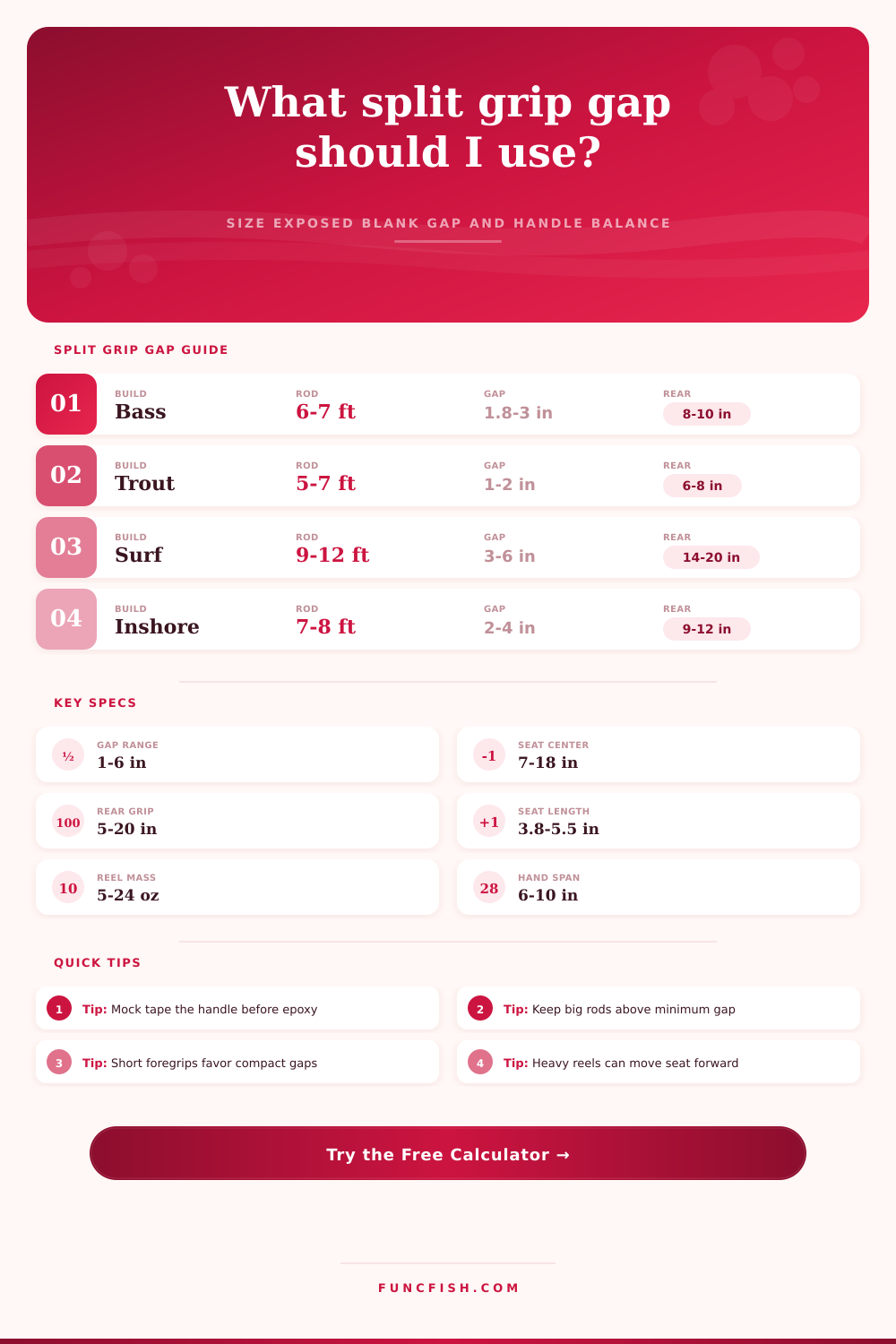
| Trout ultralight | 5 ft 6 in to 6 ft 6 in | 0.8 to 1.8 in | Short rear grip, light reel |
| Bass casting | 6 ft 8 in to 7 ft 6 in | 1.8 to 3.2 in | Palmable seat, compact foregrip |
| Walleye jigging | 6 ft 3 in to 7 ft 1 in | 1.5 to 2.8 in | Neutral hand position |
| Kayak inshore | 6 ft 10 in to 7 ft 6 in | 1.6 to 3.0 in | Keep butt clear of PFD |
| Surf spinning | 9 ft to 12 ft | 3.0 to 6.0 in | Long lever for two-hand casts |
| Swimbait casting | 7 ft 6 in to 8 ft 6 in | 2.5 to 4.5 in | Longer rear grip supports load |
| Rod length class | Reel center from butt | Rear grip starting point | Preferred gap behavior |
|---|---|---|---|
| 5 ft to 6 ft 6 in | 6.5 to 9.0 in | 5.0 to 7.0 in | Small visual gap |
| 6 ft 6 in to 7 ft 6 in | 8.0 to 11.5 in | 7.0 to 10.0 in | Balanced casting gap |
| 7 ft 6 in to 8 ft 6 in | 10.0 to 14.0 in | 9.0 to 12.5 in | Longer exposed blank |
| 9 ft to 10 ft 6 in | 14.0 to 18.0 in | 13.0 to 17.0 in | Leverage gap |
| 10 ft 6 in to 12 ft | 17.0 to 22.0 in | 16.0 to 20.0 in | Two-hand spacing |
| Grip material | Feel and mass | Gap influence | Best match |
|---|---|---|---|
| Grade cork | Light, crisp | Baseline | General freshwater |
| Rubberized cork | Moderate, durable | Shorten slightly | Power casting |
| Light EVA | Light, soft | Can run longer | Finesse spinning |
| Dense EVA | Moderate, firm | Neutral to short | Inshore rods |
| Carbon sleeve | Very light, crisp | Needs structure check | Minimalist builds |
| Hypalon | Heavy, tough | Shorten for balance | Surf and saltwater |
| Build type | Rear grip range | Foregrip range | Seat length range |
|---|---|---|---|
| Ultralight spinning | 5.0 to 7.0 in | 0.0 to 1.0 in | 3.6 to 4.2 in |
| Bass casting | 8.0 to 10.5 in | 0.0 to 1.5 in | 3.8 to 4.5 in |
| Inshore spinning | 8.5 to 11.5 in | 1.0 to 2.5 in | 4.2 to 5.0 in |
| Surf spinning | 14.0 to 20.0 in | 2.0 to 5.0 in | 4.8 to 5.8 in |
| Fly fighting butt | 1.5 to 4.0 in | 0.0 to 0.5 in | 3.5 to 4.3 in |
💡Layout checks
Tip: Tape the rear grip, seat, reel, and foregrip in place before epoxy. A gap that looks perfect on a bench can feel cramped once the reel foot and hand position are included.
Tip: On surf, swimbait, and saltwater rods, do not chase a tiny exposed blank gap. Leave enough handle structure around the seat for hard casts and loaded hooksets.
When custom rod builders design their blanks, they’re thinking about action first, then about hand placement. Don’t make same error. Doing so creates a technically correct rod you’ll find frustrating to cast.
The space I’m referring to is what’s called the split grip gap… The distance from the reel seat to the back handle. It’s the mechanical lever that makes your rod feel more like part of your arm, or something like a hammer.
Why Hand Placement Matters More Than Design
So here’s what you need to know: Functional and visual balance are not quite the same thing; a tiny gap might look sleek, but a bigger gap give you plenty of room to shift hand for long casts. But then again, that big gap can make the rod feel tip-heavy and clumsy. Or maybe you don’t want any gap at all because that looks nice, but now the reel is sitting so far aft that your thumb cannot comfortabley do a roll cast.
Use the calculator above. It factors in reel weight (not just generic reel size) and your hand span. It helps find a middle ground between those two extreme.
Take a heavy swimbait stick versus a finesse spinning rod for trout for example. For the trout rod, typically it’s a light reel with a short rear grip that keep the center of mass near your hand. In this case, a small gap is better, perhaps just an inch or less… Because you don’t want to compromise on sensitivity.
But when you get into a seven-foot heavy composite rod for largemouth bass things are entirely different. You have a heavier reel and a stiffer blank. You also need a bigger gap to slide the reel far enough up the rod to balance it properly. So obviously a one size fits all measurement doesn’t apply.
This matters because it mimics real world physics. Rod length and rear grip size dictate the handle’s anchor points. Reel weight is super important because the weight of a baitcaster can dramatically affect where that rod balances. You’ll find yourself with your head tucked in the whole day if you don’t account for reel weight.
People often overlook hand span. Having a big hand require greater space when pivoting and shifting pressure points. Your pinky could dig in on the reel foot and cause pain and fatigue if your hand span is larger than your gap.
Finally, the type of material matters too, though it’s subtle. A cork butt is lighter and more compressible so you’re able to lay things out a little tighter and not make it harsh on your hand. Rubberized grips are denser and will add some bulk and weight which can mess with the balance if you don’t close the gap up enough. A heavier grip will let you know how much longer the gap needs to be to seat the reel comfortable.
Small errors can compound and lead to a rod that feels wrong. Consider the casting motion itself. As you cast, your top hand controls the reel and your bottom hand anchors the rod. That’s the gap. Too close and your hands collide. Too far apart and you lack leverage on the blank.
The tool contains reference tables with standard ranges for various techniques. These aren’t hard and fast rules, however; they’re simply a starting point. How it fits ultimately depends based off your own body proportions and preferences. Finding the right balance between your hand span, reel weight, and gap size is what makes a rod feel right.
Don’t hesitate to mock the handle up in tape first. Use that tape mockup to see if the layout actualy feels right before you epoxy anything. Test drives are only so good when they’re on paper. Numbers will show you what’s supposed of to work. Your hands will show you what really feels right.
After experimenting with different sizes of gaps and their effect on balance, you’ll begin viewing handle layouts through new eyes. You won’t guess anymore. You’ll engineer.
That transition from hobbyist to actual rod builder is all about mindset. It’s about simple harmony between the hook, the handle and the angler.