Fish Spawning Bed Area Calculator
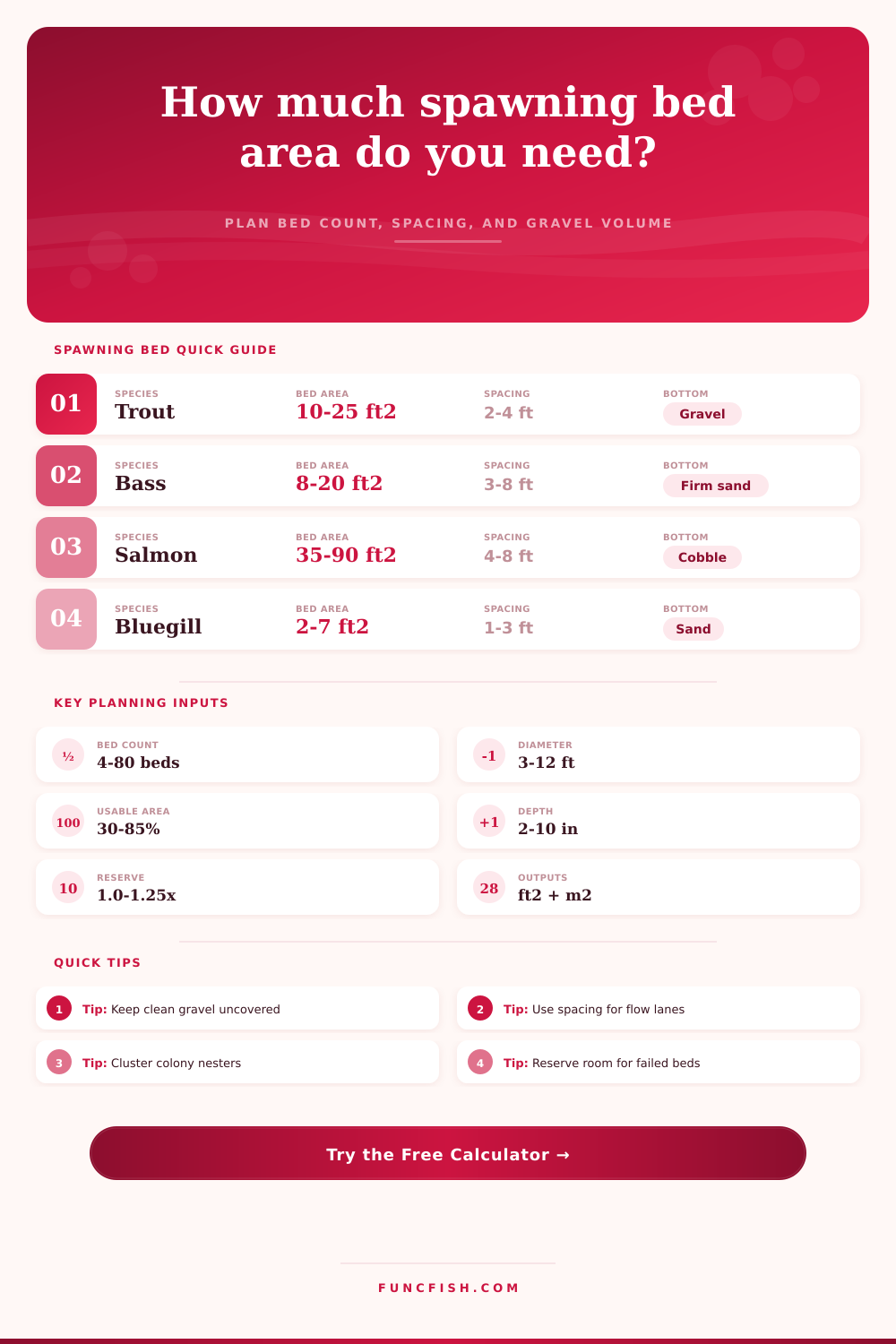
Estimate active bed area, total habitat footprint, clean substrate volume, and layout length for planned spawning beds or monitored natural redds.
📌Scenario presets
⚙Spawning bed settings
Spawning habitat estimate
Formula breakdown
📋Substrate reference grid
Pea gravel blend
Clean spawning gravel
Gravel and cobble
Vegetated margin
📊Species comparison grid
| Species | Typical active bed | Recommended spacing | Preferred substrate | Layout tendency |
|---|---|---|---|---|
| Brook trout | 6-18 ft² | 2-4 ft | Clean gravel | Riffle pockets |
| Rainbow trout | 10-28 ft² | 3-5 ft | Gravel and small cobble | Run margins |
| Smallmouth bass | 8-20 ft² | 4-8 ft | Firm gravel flat | Separated nests |
| Largemouth bass | 10-24 ft² | 5-10 ft | Firm sand and gravel | Protected pockets |
| Bluegill | 2-7 ft² | 1-3 ft | Sand with fine gravel | Dense colony |
| Walleye | 18-45 ft² | 3-7 ft | Cobble shoal | Broad shoal band |
| Chinook salmon | 35-90 ft² | 4-8 ft | Coarse gravel and cobble | Large riffle bar |
| Channel catfish | 8-18 ft² | 4-8 ft | Cavity with firm base | Bank structure |
| Northern pike | 25-80 ft² | 4-10 ft | Vegetated shallow margin | Flooded fringe |
| Yellow perch | 12-35 ft² | 2-5 ft | Vegetation over soft bottom | Cove edge ribbons |
📏Substrate sizing table
| Substrate mix | Calculator depth | Particle range | Best match | Volume note |
|---|---|---|---|---|
| Pea gravel blend | 3 in / 7.6 cm | 3-13 mm | Bluegill, small trout edges | Low volume, easy to embed |
| Clean spawning gravel | 6 in / 15 cm | 10-45 mm | Brook trout, rainbow trout | Balanced bed layer |
| Gravel and cobble | 8 in / 20 cm | 25-100 mm | Walleye, salmonids | More void protection |
| Coarse cobble | 10 in / 25 cm | 75-180 mm | Large salmon, high flow shoals | High volume per area |
| Firm sand and gravel | 4 in / 10 cm | Sand to 25 mm | Bass nests | Compact bed surface |
| Vegetated silt margin | 4 in / 10 cm | Roots and fine soil | Pike, perch | Area matters more than depth |
| Woody cavity base | 5 in / 13 cm | Firm mineral base | Channel catfish | Allows cavity footprint |
| Mixed shoal stone | 7 in / 18 cm | 20-90 mm | Walleye shoals | Good compromise band |
🗺Layout comparison table
| Arrangement | Footprint factor | Corridor width | Best use | Spacing behavior |
|---|---|---|---|---|
| Single run strip | 1.00x | 1.3 bed widths | Riffle or run edge | Long, narrow sequence |
| Paired staggered rows | 0.88x | 2.4 bed widths | Moderate channel margins | Efficient two-row layout |
| Colony cluster | 0.72x | Square-root block | Bluegill and sunfish | Shared edges reduce area |
| Shoal band | 1.18x | 3.0 bed widths | Walleye and salmon shoals | Extra room for flow paths |
| Floodplain margin patch | 1.35x | 4.0 bed widths | Pike and perch margins | Broad shallow patch |
| Cavity set | 1.10x | 1.8 bed widths | Catfish banks and cavities | Structure spacing dominates |
📝Area outcome bands
| Total footprint | Typical scale | Review focus | Layout check |
|---|---|---|---|
| Under 250 ft² | Small patch | Bed diameter accuracy | Confirm each bed fits |
| 250-1,000 ft² | Run or cove segment | Usable fraction | Verify gaps remain open |
| 1,000-5,000 ft² | Shoal or shoreline band | Substrate volume | Break into work cells |
| Over 5,000 ft² | Large habitat reach | Survey uncertainty | Use mapped polygons |
💡Practical calculation checks
Tip: Use the active cleaned bed diameter, not the entire visible shallow zone. The calculator already expands the footprint for spacing and unusable pockets.
Tip: For colony nesters such as bluegill, use the colony preset or cluster layout so shared edges do not overstate the needed footprint.
Beds are picky places for spawning. The water has to be right. Substrate needs to provide the right textures for them to spawn in. There also needs to be enough room so they can use their reproductive energy in safety. That’s not just about having clear water, but it’s also about having the right texture and flow characteristics of bottom layer. And then you have to provide enough space. Creating these beds is an exercise in engineering. You’ve got to know what fish want and how to translate that into measurable requirements.
Fortunately, calculator does all of the math work for you. It takes your limitations at the site along with species preference data, and spits out a concrete plan.
How to Build Fish Beds
First, understand the difference between the bed’s footprint and its actualy use. Only a couple dozen square feet of a brook trout redd might be considered active, the place where the fish is bedding now. That said, fish don’t stack their beds. They requires some breathing room to allow for egg fanning and water flow. You want to account for that. Otherwise, you’re creating a bottleneck, either the fish will leave or those eggs will suffocate in standing water. By blowing out the tiny active area, you get a larger footprint (the total countable area), which accounts for usable space rather than beds.
As for what to use as substrate, besides size, that’s also significant. You don’t want your spaces filled in with silt because the silt will cut out the oxygen from embryos. You want something clean, such as gravel, where water can flow through. Salmonids (salmon and trout) requires coarse, clean material with lots of voids. Sunfish such as bluegill favor smaller pebble-type stuff; bass may be able to deal with harder sand. For the calculator, you can enter the kind of substrate used so volume amount will reflect this. Enough substrate should of been provided to provide a sufficient layer of depth. Too shallow and the eggs will not sit above the mud; too deep and you’re wasting resources. You want something with both permeance and protection.
Finally you’ll notice entries for planning reserves and usable habitat fraction. That’s where we put in some reality check factors. Not all of a stream or pond bed is suitable for spawning, some has unsuitable water depth. Others have tree roots or boulders. The useable fraction shows what percent of your total footprint is actualy useable. Reduce it if you’ve got a messy bottom, then the system inflates the needed area to compensate. And of course you want a reserve, because not all beds will be successful. A few will wash out. Some will become deserted. Add a reserve to ensure you have enough habitat to hold the target population despite those odds. It’s an insurance policy against the uncertainty of nature.
Layout options is influenced by behavior, as well. Riffles tend to have trout spawning in pairs or lines of pairs. Bluegill nest tightly together in colonies. Pike like vegetation edges in flooded areas. Your choice of layout alters the plan’s geometry. A linear and narrow single run strip works. A tight cluster for a group of colonies save space by sharing edges among the nests. By considering these habits, the system tweaks the footprint shape to avoid making a colonial nester conform to a linear layout that doesn’t suit his/her/their social structure.
There are as many ways to create successful spawning habitat as there are fish that spawn. It’s all about matching the physics with the biology. Provide the stage and let the fish perform. Make sure there is enough space for flow and movement, but not too much space so that you can’t maintain clean substrate. Size the area to accommodate imperfection. And use the calculator to give you the dimensions. It’s your turn to make those dimensions work in creating a functioning, healthy ecosystem. Get it right and out of the stones come the next generation of life.