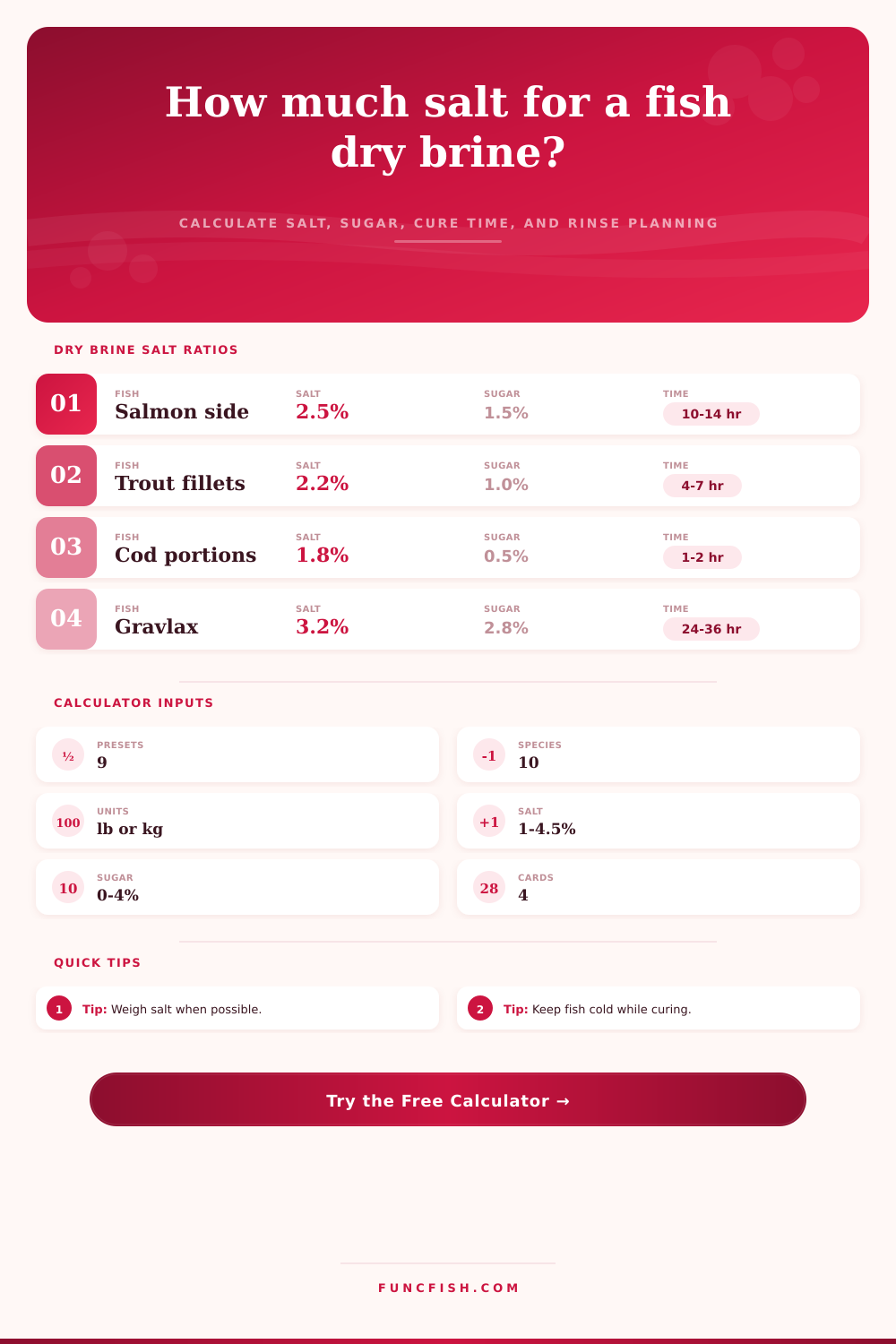
Dry Brine Salt Ratio Calculator
Estimate fish-weight based salt, sugar, total cure mix, cure time, rinse planning, and fridge tray setup for dry brined fish.
🧂Quick presets
Choose a starting profile, then adjust the weight, thickness, salt target, sugar level, and cure conditions to match your fish.
⚙Batch inputs
Dry brine estimate
Calculation breakdown
🐟Species and material grid
Salmon
Trout
Cod
Halibut
Tuna
Mackerel
Snapper
Catfish
Sardine
Mixed tray
📊Dry brine reference tables
| Use case | Salt by weight | Sugar by weight | Typical result |
|---|---|---|---|
| Mild cooking cure | 1.5-2.0% | 0-0.8% | Seasoned, lightly firmed fish |
| Hot smoking prep | 2.2-3.0% | 1.0-2.0% | Balanced salt and browning |
| Cold smoke base | 2.8-3.6% | 1.5-3.0% | Firm texture, longer equalize |
| Gravlax style | 3.0-4.0% | 2.0-4.0% | Sliceable cured fish |
| Jerky strips | 3.0-4.5% | 0.5-2.0% | Salty, low-moisture strips |
| Cut style | Time factor | Surface note | Flip guide |
|---|---|---|---|
| Thin strips | 0.45 | High exposed surface | Once halfway |
| Portion pieces | 0.72 | Open edges speed cure | Once halfway |
| Individual fillets | 0.90 | Moderate thickness | Every 4-6 hr |
| Large side | 1.00 | Skin slows one face | Every 6-8 hr |
| Center loin | 1.28 | Dense center mass | Every 8 hr |
| Whole small fish | 1.18 | Cavity needs even coating | Turn twice |
| Salt type | Approx grams per tbsp | Volume behavior | Best practice |
|---|---|---|---|
| Diamond Crystal kosher | 9 g | Large flakes, light spoon | Weigh if switching brands |
| Morton kosher | 15 g | Denser flakes | Use less volume than Diamond |
| Fine sea salt | 18 g | Packs densely | Spread carefully and evenly |
| Pickling salt | 19 g | Very fine and clean | Best weighed in grams |
| After cure | When to use | Equalize time | Texture effect |
|---|---|---|---|
| Brush only | Accurate low-salt cure | 20-45 min | Most seasoning retained |
| Quick rinse | General smoking prep | 1-2 hr | Balanced surface salt |
| Short soak | Heavy salt or thin fish | 2-4 hr | Milder exterior |
| Overnight equalize | Cold smoke or gravlax | 8-12 hr | Even center-to-edge salt |
✔Dry brine tips
Salmon Side On your kitchen counter sits a piece of fish. It smells fresh and it is ready to cook. But first, let’s look at some fish curing chemistry.
How dry brine works are a combination of preservation disguised as seasoning. It firms up the texture, draws out moisture, and seasons all the way to the bone.
How to Cure Fish with a Calculator
Not all fish are created equal. Structure, density, and oil content varies. A ratio that works for cod can ruin trout. If you guess, you’re screwed.
It does the math for you. All you do is enter weight and the thickness of your fish, then it figures out how much salt for you. No more guesswork on coefficients and conversions.
Enter a fish species, or select one of the presets. Why? Because salt penetration rate depend on the protein structure of each fish. Cod and other lean fishes takes up salt rapidly. Oily dense fish such as tuna or mackerel requires a gentler touch. The tool take that into account automatically. You do not need to remember the rate for each species. Just identify what you got.
Then you add the trimmed weight of the fish. This is where home cook can get imprecise. They eyeball it based off the package label. But that’s the weight of the ice or water in the package. They want to know how much meat there is. That’s what we use in the calculator because that’s what gets salted.
Salt pulls water out by osmosis, we also want to balance some of that with sugar. Which also helps the meat brown up. We let you tweak that ratio of sugar with the tool. If you’re making savory jerky, maybe dial back the sugar. For sweet gravlax, bump it up a bit. It’s personal preference, but the math stay the same.
Another key factor is thickness. Thin tuna will cure within the hour, while a thick piece of salmon could take a couple days. That’s how this tool help with the estimated cure time. It accounts for what type of fish it is, as well as your fridge temperature. If you have a warmer fridge than the cure will occur more quickly. That’s not a good thing because the fish can become too soft. The safer bet is to maintain the temperature at around thirty-eight degrees fahrenheit for a consistent and safe cure. The chart below shows different time factors per cut.
Once you hit calculate, you have a precise amount of grams of salt and sugar to work with. You may even have an estimate of how long it should of take and when it needs to be rinsed.
That’s what some people overlook. An equalization period can actualy help certain cures. This is especially true for those who want the salt to fully disperse, others only require a quick rinse. With this calculator you get a path to follow based off your desired outcome. It doesn’t say which is the right path. It says what you need to do in order to reach your destination.
There are no exceptions to this rule: do not use tablespoons. When working with various salts, there is no such thing as a “tablespoon.” One salt may be light and fluffy while another is heavy and dense. A tablespoon of one is not the same than a tablespoon of another.
Choose your salt from the drop-down on the calculator. If you’re stuck measuring by volume, it will provide precise conversions for you. But get out that scale: There’s just no point in mucking around with error. Weighing the salt only takes ten seconds.
Precision. You need patience. Those two words is what dry brining is all about.
Dry brining is more than simply sprinkling some salt on raw ingredients. It’s transforming those raw ingredients into something flavorful and well-structured. When done correctly, the meat or fish become firm to the touch and will slice cleanly. The flavor is deep and complex. Get it wrong and the result is bland…or worse yet…inedible.
The tool eliminates the guesswork from the process. Set your timer, weigh your fish, and let the chemistry happen.
And the reward? A piece of fish that tastes correct.