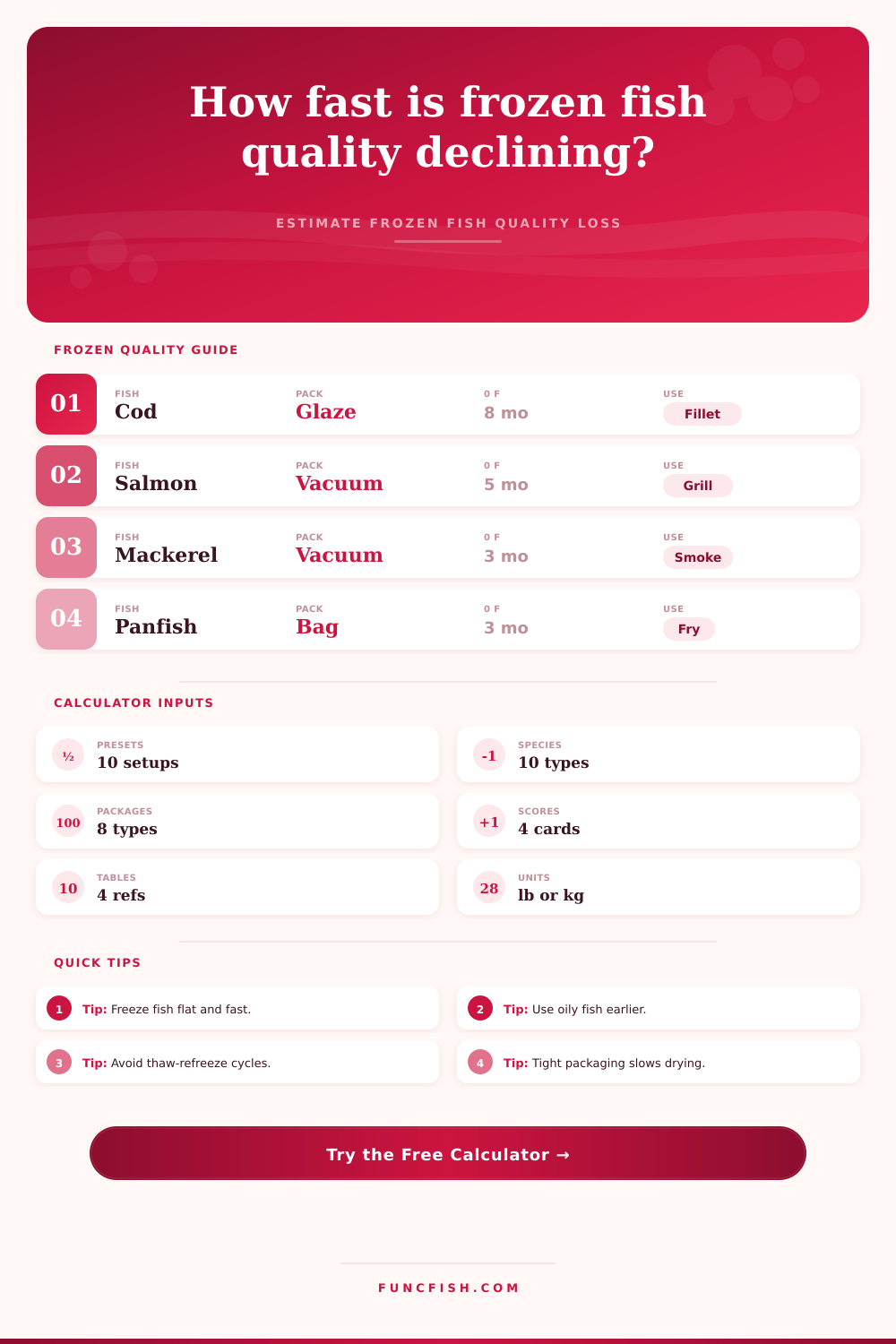
Frozen Fish Quality Decline Calculator
Estimate frozen fish eating quality from storage age, species fat level, package barrier, freezer temperature, thaw history, and portion shape. The model reports quality score, premium time left, texture loss, and oxidation pressure.
📌Quality decline presets
Choose a practical freezer-storage case, then fine-tune the inputs for your batch. Scores estimate quality, not food safety or fishing regulations.
⚙Fish, packaging, and storage inputs
Frozen fish quality estimate
Calculation breakdown
🧊Species and material quality grid
Lean White Fish
Salmon and Trout
Oily Pelagics
Vacuum Pouch
Water Glaze
Double Bag
Freezer Paper
Loose Bag
📊Frozen quality reference tables
| Species group | Premium days | Main decline | Best package |
|---|---|---|---|
| Cod, haddock, pollock | 210-270 | Dry texture | Glaze or vacuum |
| Walleye, perch, bass | 180-230 | Surface drying | Vacuum pouch |
| Salmon, trout, char | 140-190 | Oil oxidation | Vacuum pouch |
| Tuna or swordfish | 160-210 | Color and drip | Chamber pouch |
| Mackerel or bluefish | 80-130 | Rancid notes | Vacuum, short age |
| Shrimp or scallop | 150-200 | Dehydration | Ice glaze |
| Package | Barrier score | Quality factor | Typical use |
|---|---|---|---|
| Chamber vacuum pouch | 96 | 1.34x | Premium fillets |
| Vacuum freezer pouch | 92 | 1.24x | Most fish |
| Water-glazed bag | 84 | 1.16x | Lean fish |
| Double freezer bag | 68 | 0.90x | Short storage |
| Freezer paper plus bag | 58 | 0.78x | Cooked dishes |
| Loose zipper bag | 34 | 0.48x | Use quickly |
| Average temp | Metric | Factor | Quality effect |
|---|---|---|---|
| -10 F | -23 C | 1.18x | Excellent if stable |
| 0 F | -18 C | 1.00x | Standard baseline |
| 5 F | -15 C | 0.83x | Faster drying |
| 10 F | -12 C | 0.66x | Shorter premium life |
| 15 F | -9 C | 0.50x | Use-first storage |
| Score | Status | Expected signs | Best use |
|---|---|---|---|
| 86-100 | Premium | Clean flavor, firm texture | Simple fillets |
| 72-85 | Good | Slight drip or mild drying | Grill, bake, fry |
| 58-71 | Fair | Dry edges, softer flakes | Sauced dishes |
| 40-57 | Low | Strong dehydration likely | Moist cooking only |
| Below 40 | Poor | Quality failure likely | Inspect before use |
💡Frozen quality tips
When a fillet emerges from your freezer spongy, you can tell: the meat’s edges have turned white and chalky. Before it ever reaches the frying pan, the fish has been showing its age through it’s texture. And this is just physics, a chemical reaction, with a completely predictable outcome.
A few ice crystals form. Then they get bigger. They poke holes in cells. Moisture evaporates. Fish dries out. Quality diminishes. Knowing how it degrades make you less likely to cook up a dish of dry cardboard.
How to Keep Frozen Fish Fresh
The calculator above projects how fast it will happen, based off certain factors. Those factor are temperature stability, package barrier quality, and (of course) fat content per species. So instead of vaguely worrying about your old fish, you can quantify their odds of being good enough to eat.
And then there’s the matter of species. Dehydration is a major problem for lean white fish like haddock or cod. Air exposure are their primary issue. What about fatty fish such as salmon or mackerel? They’re a different beast. Fatty acids in these fish quickly oxidize. That results in rancidity and off flavors that is impossible to mask through cooking. To account for this, the tool assigns different baseline decay rates depending on whether the fish is lean or not.
Storing them that way mean expecting different results. Store your mackerel like your cod and you’ll be sad. The oil is a ticking time bomb, a clock running faster then the one driven by moisture loss.
The first thing to consider is packaging. Oxygen is what causes oxidation. Removing it help prevent it. Vapor leads to drying. A simple ziplock bag lets moisture escape and air in. Loose packaging significantly reduces quality factor. See chart on the page for a clear explanation of how barrier scores affect how long the fish remains in the premium category. Using a higher barrier material extends the amount of time the fish stays fresh.
The other thing you don’t think about: temperature consistency. Your typical home freezer cycle on and off. Tiny changes in temperature occur as a result. And those fluctuations kill frozen foods. Why? Because they cause ice crystals to reform, small ones combine into big jagged shards. That’s bad news for the texture of your food. It damages it slow over time.
Typically, a chest freezer is more consistent than an upright model. The cold air settles to the bottom. Plus, frost-free models also removes humidity from the interior air. This can speed up how fast your food dries. So if your freezer temperature fluctuates, the calculator increases the decline rate accordingly. You’re paying extra for those changes in texture.
Another important factor is thawing history. It is better if it has never been frozen. The worst case is a partial thaw followed by freezing. Thawing causes melting of the ice. The ice melt weaken the structure. The weakened structure then refreezes. The water refreezes in bigger clumps. This also harms the flesh. Each cycle compounds the harm.
To predict how much premium time remains, the tool takes these events into account. Thawing and refreezing reduces the premium time remaining. You may still be OK eating it. But that simple grilled fillet? It is probably not so good anymore. Might work best as a chowder or something heavily sauced where the texture is covered up.
Adding an ice glaze helps. It adds a barrier against dehydration. It is a sacrificial layer. The fish will not dry out, the ice does. It is good for lean fish. It is not as good for oily fish where oxidation are a bigger problem. The calculator takes into account the species type and the percent glaze. It will tell you if you need something else or if what you are doing now is OK.
And then it outputs: an estimate of how much longer it will last, plus a score. This isn’t a guarantee. It’s a model. It is a useful one, though. It lets you know what to eat when, so that you can use up the older, more oily fish first, while saving the lean ones for later.
Don’t let them all run out before checking their date. By then the quality has already started slipping away, quietely. The calculator makes it visible. It enables you to keep track of your inventory before you’ve lost any. Do this before the damage is done. This happens when you decide the quality is no longer good enough for you.
To freeze is to preserve a moment. It captures the freshness of that moment when caught. It locks in the freshness. Time cannot be stopped. It can only be slowed.
Quick freezing, stable cold, good packaging; these are the tools. These buy you time. Use it wisely. Plan your meals according to how long they stay fresh. Respect the fat content. Check the temperature. Check the package condition. A small tear can ruin a good batch.
The math is simple. The execution takes attention. The reward is a meal that tastes of the ocean, not the freezer aisle. It stays fresh. Flavor is maintained. Quality is secured.