🎣 Fishing Rod Action Calculator
Match rod action, power, and length to your target species, technique, and lure weight
| Rod Power | Line Test (lb) | Line Test (kg) | Lure Weight (oz) | Lure Weight (g) | Best Use |
|---|---|---|---|---|---|
| Ultralight | 1–4 lb | 0.5–1.8 kg | 1/64–1/8 oz | 0.4–3.5 g | Panfish, tiny trout |
| Light | 4–8 lb | 1.8–3.6 kg | 1/16–1/4 oz | 1.8–7 g | Trout, crappie |
| Medium-Light | 6–10 lb | 2.7–4.5 kg | 1/8–3/8 oz | 3.5–10.6 g | Bass finesse, walleye |
| Medium | 8–14 lb | 3.6–6.4 kg | 1/4–1/2 oz | 7–14.2 g | Bass, walleye, inshore |
| Medium-Heavy | 12–20 lb | 5.4–9.1 kg | 3/8–3/4 oz | 10.6–21.3 g | Bass, pike, striper |
| Heavy | 20–40 lb | 9.1–18.1 kg | 3/4–3 oz | 21.3–85 g | Catfish, surf, salmon |
| Extra Heavy | 30–80 lb | 13.6–36.3 kg | 2–8 oz | 56.7–226.8 g | Offshore, big game |
| Species | Avg Weight | Rod Power | Rod Action | Length (ft) | Length (m) |
|---|---|---|---|---|---|
| Bluegill / Crappie | 0.25–1 lb (0.1–0.45 kg) | Ultralight–Light | Slow–Moderate | 5–6.5 ft | 1.5–2.0 m |
| Rainbow Trout | 0.5–5 lb (0.2–2.3 kg) | Light–Medium-Light | Moderate | 6–7 ft | 1.8–2.1 m |
| Largemouth Bass | 2–8 lb (0.9–3.6 kg) | Medium–Med-Heavy | Fast | 6.5–7.5 ft | 2.0–2.3 m |
| Walleye | 1–10 lb (0.45–4.5 kg) | Medium-Light–Medium | Fast | 6–7 ft | 1.8–2.1 m |
| Northern Pike | 5–25 lb (2.3–11.3 kg) | Medium-Heavy | Fast | 7–7.5 ft | 2.1–2.3 m |
| Channel Catfish | 2–20 lb (0.9–9.1 kg) | Heavy | Moderate | 6.5–8 ft | 2.0–2.4 m |
| Striped Bass | 5–30 lb (2.3–13.6 kg) | Medium-Heavy–Heavy | Fast | 8–10 ft | 2.4–3.0 m |
| Redfish / Red Drum | 3–15 lb (1.4–6.8 kg) | Medium | Moderate-Fast | 7–7.5 ft | 2.1–2.3 m |
| Salmon (Chinook) | 10–50 lb (4.5–22.7 kg) | Heavy | Moderate–Fast | 8–9 ft | 2.4–2.7 m |
| Offshore Tuna | 20–200 lb (9.1–91 kg) | Extra Heavy | Fast | 6–7 ft | 1.8–2.1 m |
| Material | Sensitivity | Weight | Flex / Action | Best For |
|---|---|---|---|---|
| Graphite IM6 | High | Light | Fast | Bass, jigging |
| Graphite IM7 | Very High | Very Light | Fast–Xtra Fast | Finesse, walleye |
| Graphite IM8 | Excellent | Ultra Light | Xtra Fast | Tournament bass |
| Fiberglass | Low | Heavy | Slow–Moderate | Crankbaits, trolling |
| Composite | Moderate | Moderate | Moderate | All-around, beginners |
| Bamboo | Low–Mod | Moderate | Slow | Fly fishing, tradition |
| Carbon Fiber IM10+ | Elite | Featherlight | Xtra Fast | Pro tournament, finesse |
| Boron Composite | Very High | Light | Fast | Flipping, punching |
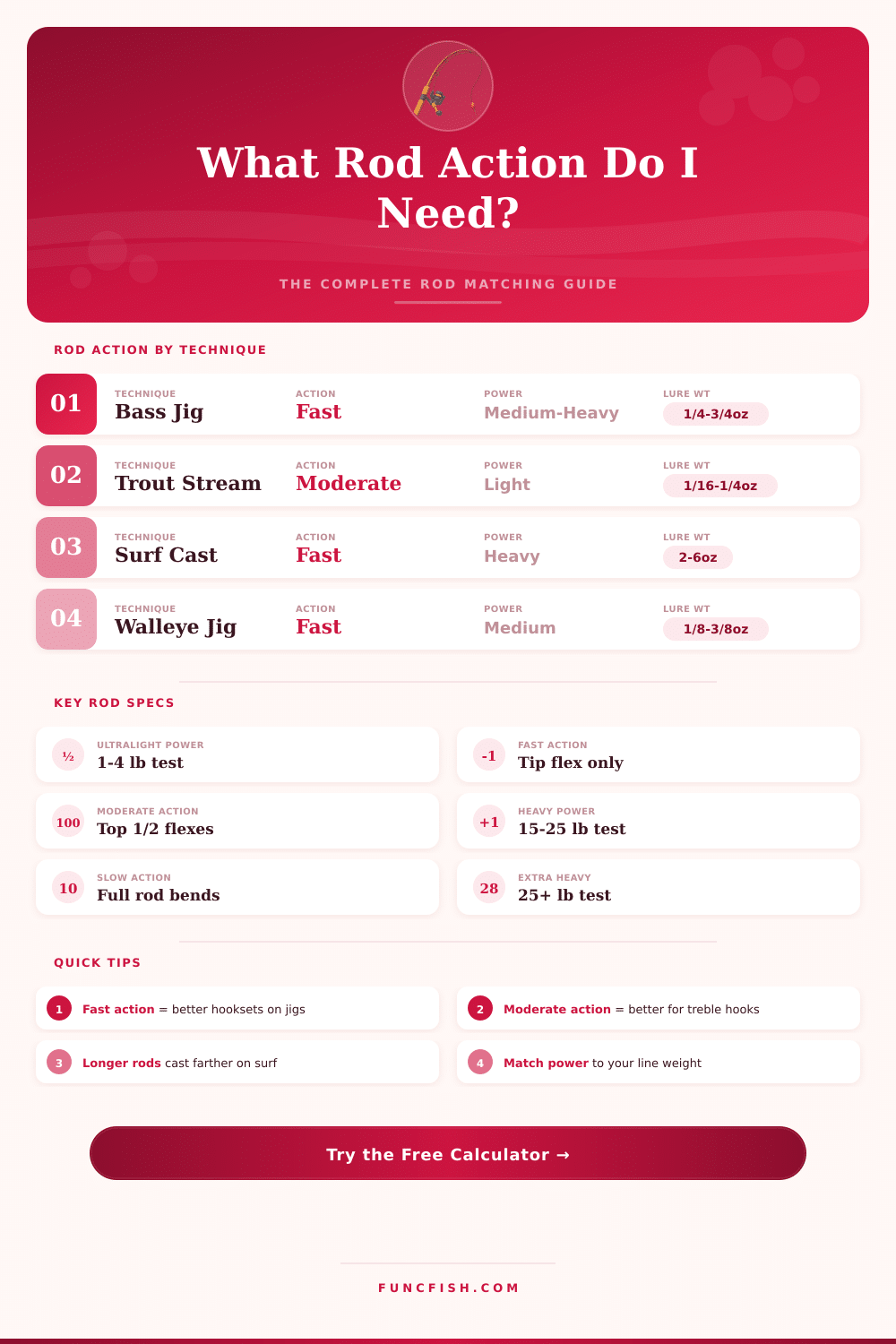
Fishing rod action commonly scares many folks, although it can be quite simple. The action points to where the rod bends when one puts pressure on it. A rod with fast action bends mainly near the tip on the other hand slow action causes bend more below near the handle.
Rods with middle action sit between those extremes, bending in the upper third to half part of the whole length.
What Rod Action and Power Mean
The word “fast” in the name relates to how quickly the rod straightens again after a bend. A rod with very fast action is the most rigid, while slow action makes it the most flexible. So, if someone mentions “fast action”, it means a rod that quickly clicks back to its normal straight position.
The action depends on the material of the rod, on its width and on the length. Easily one can check the action, bending the rod against the floor or ceiling, with the rings upward. Like this one gets a good feel about the flex point.
Here is something that commonly confuses folks. Action and power are not the same. Power points to how much force is needed to fully load the rod.
The ratings of power range from ultra-light to heavy or even extra heavy. An ultra-light rod is slim and easily flexible, good for casting light baits and catching small trout or panfish. A heavy or extra heavy rod is thick and stiff, made for big fish and heavy baits.
Two rods from the same maker can have the same action, but different ratings of power, which makes them good for totally different baits.
Rods with fast action enjoy big popularity, because they many tasks do well. They deliver great feeling, precise casting and strong hook sets. Specially for soft baits they are ideal, because the bend almost only near the tip helps anglers knot the bite and quickly set the hook.
Also, fast action rods offer a bit more cushion during a fish fight than extra fast.
Even so, rods with slower action have their benefits. They cast more smooth, because more part of the blank works during the cast. Slower rods help to keep the fish on the hook, specially with crankbaits and treble hooks.
The broader bend absorbs head moves and stops hooks from popping out. Fast action rods usually match with baits of single hooks, while medium action rods work better with treble hooks.
The choice between braided or mono line also matters. Braided line gives more feeling, so pairing it with a rod of higher power can balance the whole setup. If heavy line goes with a rod of light power, or light line with a heavystrong rod, the line can easily break during the struggle.
Fishing rod action does affect the accuracy of casts, the force of hook sets and the skill to fight fish.