🌊 Fishing Tide Calculator
Find your best bite windows based on tide phase, species, and location type
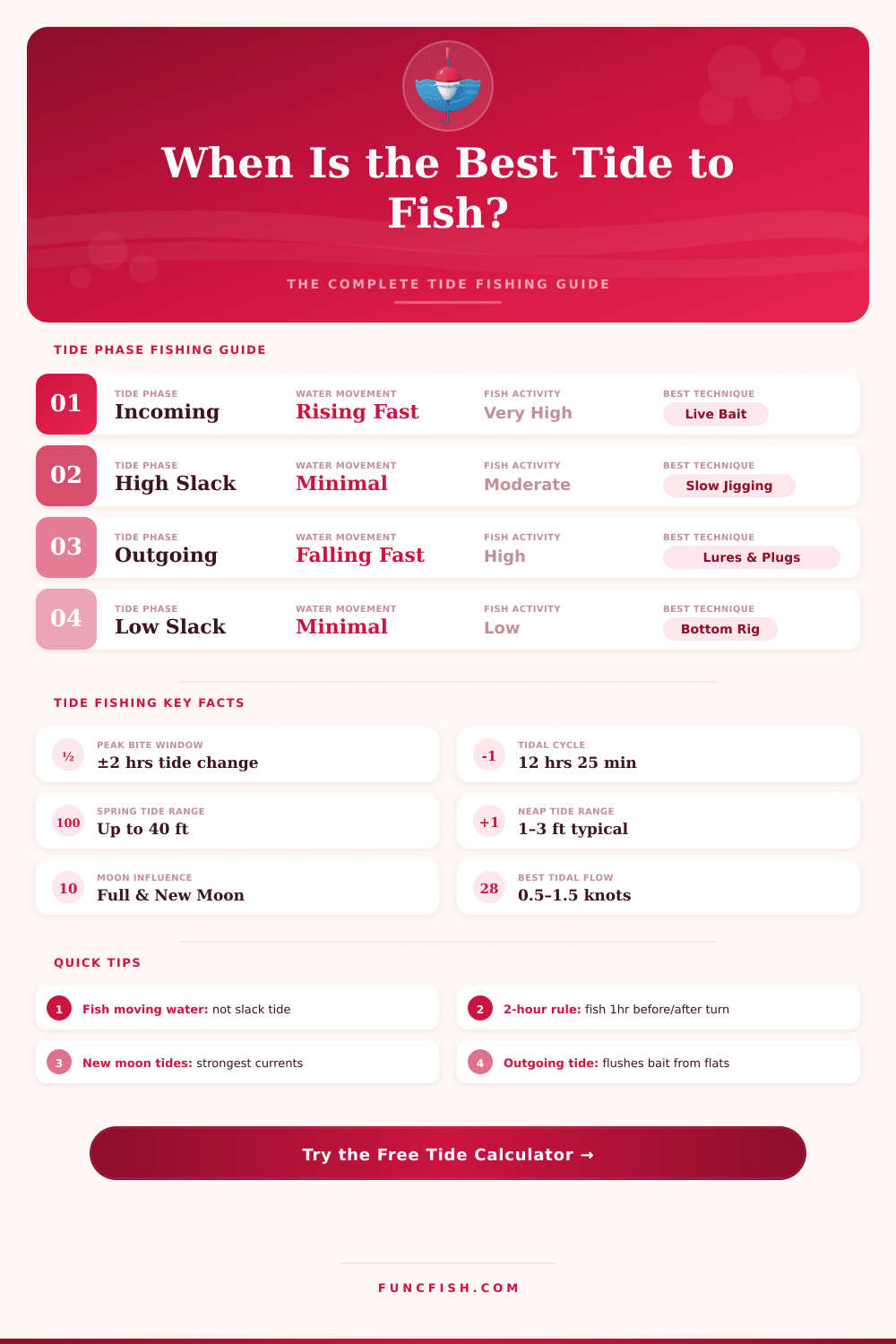
| Tide Phase | Activity Level | Best For | Technique | Bite Score (1-10) |
|---|---|---|---|---|
| Early Incoming (first 1–2 hrs) | Very High | Flats, Estuaries, Surf | Live bait, topwater | 9 |
| Mid Incoming (2–4 hrs) | High | All water types | Lures, jigs | 8 |
| High Slack (0–45 min) | Moderate | Reefs, structures | Slow jigs, finesse | 5 |
| Early Outgoing (first 1–2 hrs) | Very High | Inlets, channels, mangroves | Swimbaits, plugs | 9 |
| Mid Outgoing (2–4 hrs) | High | Points, drop-offs | Jigs, cut bait | 7 |
| Low Slack (0–45 min) | Low | Deep structure only | Bottom rigs | 3 |
| Species | Best Tide Phase | Preferred Current | Typical Weight (lb / kg) | Recommended Gear |
|---|---|---|---|---|
| Striped Bass | Incoming / Outgoing | Moderate–Strong | 5–50 lb / 2.3–22.7 kg | 15–30 lb line, medium-heavy rod |
| Redfish | Outgoing | Moderate | 3–20 lb / 1.4–9 kg | 12–20 lb line, medium rod |
| Bonefish | Incoming (flats flooding) | Slow–Moderate | 2–12 lb / 0.9–5.4 kg | 8 wt fly, 10–12 lb tippet |
| Snook | Outgoing (around structures) | Moderate | 3–30 lb / 1.4–13.6 kg | 15–20 lb line, medium-heavy |
| Flounder | Outgoing | Slow–Moderate | 1–8 lb / 0.45–3.6 kg | 8–15 lb line, light rod |
| Sea Trout | Incoming / High Slack | Slow | 1–6 lb / 0.45–2.7 kg | 8–12 lb line, light-medium |
| Salmon | Incoming (tidal rivers) | Moderate–Strong | 5–40 lb / 2.3–18 kg | 15–25 lb line, medium-heavy |
| Bluefish | Incoming / Outgoing | Strong | 2–15 lb / 0.9–6.8 kg | 10–20 lb line, medium rod |
| Current Speed (mph / km/h) | Water Condition | Best Technique | Sinker / Jig Weight | Line Recommendation |
|---|---|---|---|---|
| < 0.5 mph / 0.8 km/h | Slack / Minimal | Finesse, drop-shot | 1/8–1/4 oz (3.5–7 g) | 6–10 lb mono / fluoro |
| 0.5–1.0 mph / 0.8–1.6 km/h | Gentle Flow | Topwater, swimbaits | 1/4–1/2 oz (7–14 g) | 10–15 lb braid/mono |
| 1.0–2.0 mph / 1.6–3.2 km/h | Ideal Moving | Jigs, live bait | 1/2–1 oz (14–28 g) | 15–20 lb braid |
| 2.0–3.0 mph / 3.2–4.8 km/h | Strong Current | Bottom rigs, heavy jigs | 1–3 oz (28–85 g) | 20–30 lb braid |
| > 3.0 mph / 4.8 km/h | Very Strong | Anchor & bottom only | 3–8 oz (85–227 g) | 30+ lb braid |
Mova water is the place where it really happens the main activity during fishing. Here the reason: the tidal flow the baitfish and food move together, and that action attracts the big predators searching food. What about weak tide?
Then everything becomes calm. Fishes feed quietly, naturally, but you observe only visible slowdown away from the main activity.
How Tides Affect Fishing
The lunar and solar pulls on our oceans, with their weight, is what in the start forms the tides. When everything lines up well, their combined forces raise the water higher at the coast, that is the high tide. Every day you have four such tidal changes, with almost six hours between every shift of high to low.
Many fishers insist on fishing during the two hours before the high tide and the two hours after it. That time commonly results in good catch. Or, you can limit yourself to one hour window in front and after every tidal change, that also works well.
Some days the best moment falls fairly between high and low tide. Actually, the place matters more then everything else here.
When the tide arrives, fishes invade the feeding areas, and later they pull back when it drops. Strong tides bring more food from the depth and attract more little fishes to feed. Big difference between high and low tide causes more strong motion in the water, so that day with strong tidal change commonly gives better results than day with weak flow.
In swampy and soggy areas, the low tide pushes the baitfish directly to the waiting predators. The high tide leads the little fishes back to the shallow nests. During the spring, strong Fishing Tide can really strip a lot.
The shallows warm more quickly, and when the warm water starts to move, it is like turning the key for the bite. The fall tides reverse this situation.
The ideal times are the early morning and the dusk, first. Cloudy sky comes second, later the sunny day. Fishes simply do not like to feel stripped.
The phase of the moon also matters. Tidal charts and solar-lunar charts combine everything. Sunrise, sunset, moonrise, moon phase, high and low tides (so that you plan the fishing).
Low tide strips rocks and allows fishers to reach deeper water. Problem is, that crabs work during low tide and can remove your hook without you even noticing. On the other hand, some places really shine when the water sinks for certain species.
Keeping notes about your catches, tides and weather helps to strip patterns soon. Strong winds from the sea during some days can change the usual tidal flow and raise both the high and lowspots more than usual.