⛵ Fishing Boat Fuel Calculator
Estimate fuel consumption for any fishing trip — enter your distance, speed, and engine specs to plan with confidence.
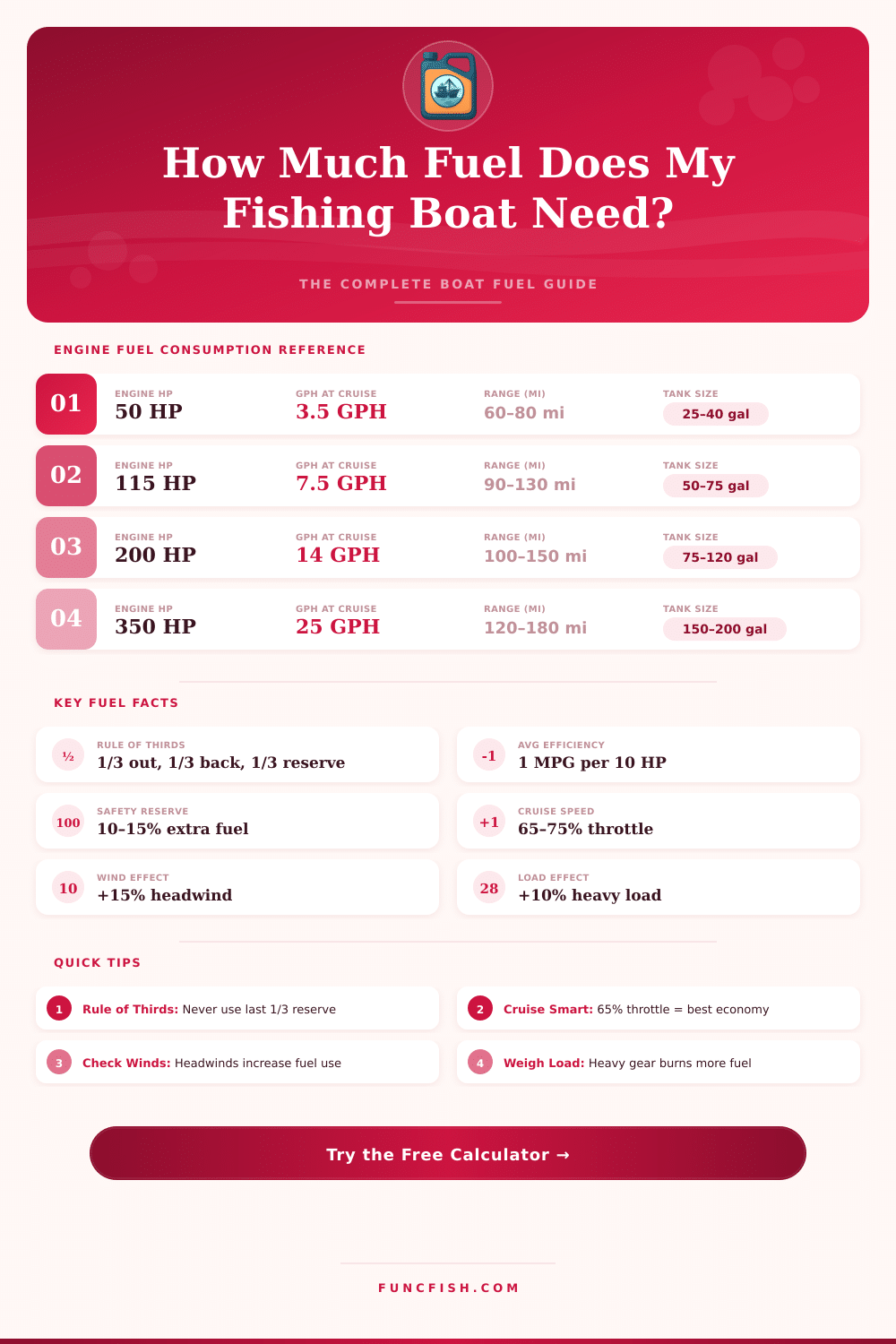
| Scenario | Typical HP | GPH Cruise | Avg Range |
|---|---|---|---|
| Bass / Freshwater | 40–90 HP | 2.5–6 GPH | 50–100 mi |
| Inshore / Bay | 90–150 HP | 6–10 GPH | 60–130 mi |
| Offshore / Deep Sea | 150–400+ HP | 12–30 GPH | 80–200 mi |
| River / Drift | 25–75 HP | 1.5–5 GPH | 40–80 mi |
| Great Lakes | 100–250 HP | 7–18 GPH | 70–160 mi |
| Slow Troll / Crappie | 25–60 HP | 0.5–2 GPH | 40–70 mi |
| Engine Type | Efficiency | Load Factor | Idle GPH |
|---|---|---|---|
| 4-Stroke Outboard | Best (1.0x) | Low | 0.5–1.2 |
| 2-Stroke Outboard | Good (1.2x) | Medium | 0.8–1.8 |
| Inboard Gas | Fair (1.35x) | High | 1.0–2.5 |
| Diesel Inboard | Best (0.8x) | Low–Med | 0.6–1.5 |
| Trolling (Electric) | Excellent | Very Low | N/A |
| Electric Outboard | Excellent | Very Low | N/A |
| Target Species | Typical Range | Rec. Engine HP | Est. Fuel / Trip | Boat Size |
|---|---|---|---|---|
| Largemouth Bass | 10–40 mi | 40–90 HP | 5–20 gal | 14–21 ft |
| Striped Bass | 20–60 mi | 90–175 HP | 15–40 gal | 18–24 ft |
| Walleye | 15–50 mi | 60–115 HP | 8–25 gal | 16–22 ft |
| Yellowfin Tuna | 40–120 mi | 200–400+ HP | 60–180 gal | 25–40 ft |
| Salmon (Great Lakes) | 30–80 mi | 115–250 HP | 30–90 gal | 20–30 ft |
| Redfish / Red Drum | 15–50 mi | 90–150 HP | 12–35 gal | 17–22 ft |
| Flounder | 10–40 mi | 75–130 HP | 8–28 gal | 16–22 ft |
| Crappie | 5–20 mi | 25–60 HP | 2–8 gal | 12–18 ft |
| Catfish | 10–30 mi | 40–90 HP | 4–15 gal | 14–20 ft |
| Trout (Mountain) | 5–20 mi | 15–40 HP | 1–5 gal | 10–16 ft |
| Factor | Condition | Fuel Penalty | Notes |
|---|---|---|---|
| Wind / Chop | Headwind 15 mph+ | +15–25% | Most impactful factor offshore |
| Wind / Chop | Calm, flat water | 0% | Best-case scenario |
| Boat Load | Heavy (max crew) | +10–15% | More weight = more fuel |
| Boat Load | Light (1 angler) | 0% | Baseline efficiency |
| Engine Age | Older than 10 yrs | +5–20% | Wear reduces efficiency |
| Hull Fouling | Dirty hull / barnacles | +10–30% | Clean hull regularly |
| Prop Condition | Damaged / wrong pitch | +5–20% | Match prop to engine |
| Current | Against current | +5–15% | River / tidal areas |
Fuel ranks between those themes, that each owner of fishing boat must care about. The kind of fuel, that one uses, truly depends on the engine itself. Whether the maker advises, that one should pour in the tank.
That information one finds usually directly in the manual of the owner whether dealing about engine of Yamaha, Mercury, Suzuki or some other brand.
How to Choose Fuel for Your Fishing Boat
Many discussions happen around ethanol against gasoline without ethanol for outboard motors. Use fuel without ethanol helps to protect the engine and extend its lifespan. Gas engines are designed to work well with fuel, that holds no more than ten percent of ethanol.
When the boat is used commonly, then fuel with ethanol widely works. Even so, if the boat stands weeks or months without motion, better choose the no-ethanol type, because ethanol fuel quickly separates.
At the coast gasoline almost always costs more than filling at average stations. The extra price can reach one and half until double per gallon. Some coasts require even six dollars each gallon or more.
These extra expenses can upset, but the right fuel helps to keep teh engine in good shape, what saves money over time.
Expenses for fuel add up quickly according to the kind of boat. Little gear with 60 horsepower outboard motor maybe uses less than five gallons during a day of coastal fishing. On the other hand, chase boats with big engines for deep waters can spend thousand until three thousand dollars in fuel for one day.
One trip to the sea can cost easily five hundred dollars only for gas. Average journey too islands can use 56 until 65 gallons in one day.
Injection system for fuel delivers better efficiency than carburetor systems. Four-stroke engines usually consume less than two-stroke. A boat with fiberglass body in the range of 15 until 17 feet, with 60 until 90 horsepower four-stroke engine, forms an efficient combination.
More lightweight boats, like aluminum jon boats, reach 25 until 30 miles in hour with 25 horsepower engine and use around six gallons.
Many makers produce portable tanks for fuel in boats. Six gallons are the maximum, that folk can easily carry. Red tins work for gasoline, while yellow are for diesel.
Plastic jerry cans give a practical way to add reserve. Some fishers even use fuel bags, when the built-in tank is too small for long trips.
Heavy body helps in rough water, but uses more fuel. Smooth shape of the body widely gives better distance per liter. To compare efficiency between boats, it matters to take alike sizes.
Diesel seems safer to carry in a boat, and one uses it almost always in fishing boat or diving boats. Globally fishing boats, that work by means of maritime diesel, release until 159 millions oftons of carbon dioxide each year.