🎣 Spinning Reel Line Calculator
Calculate exactly how much fishing line to put on your spinning reel — mono, braid, or fluorocarbon
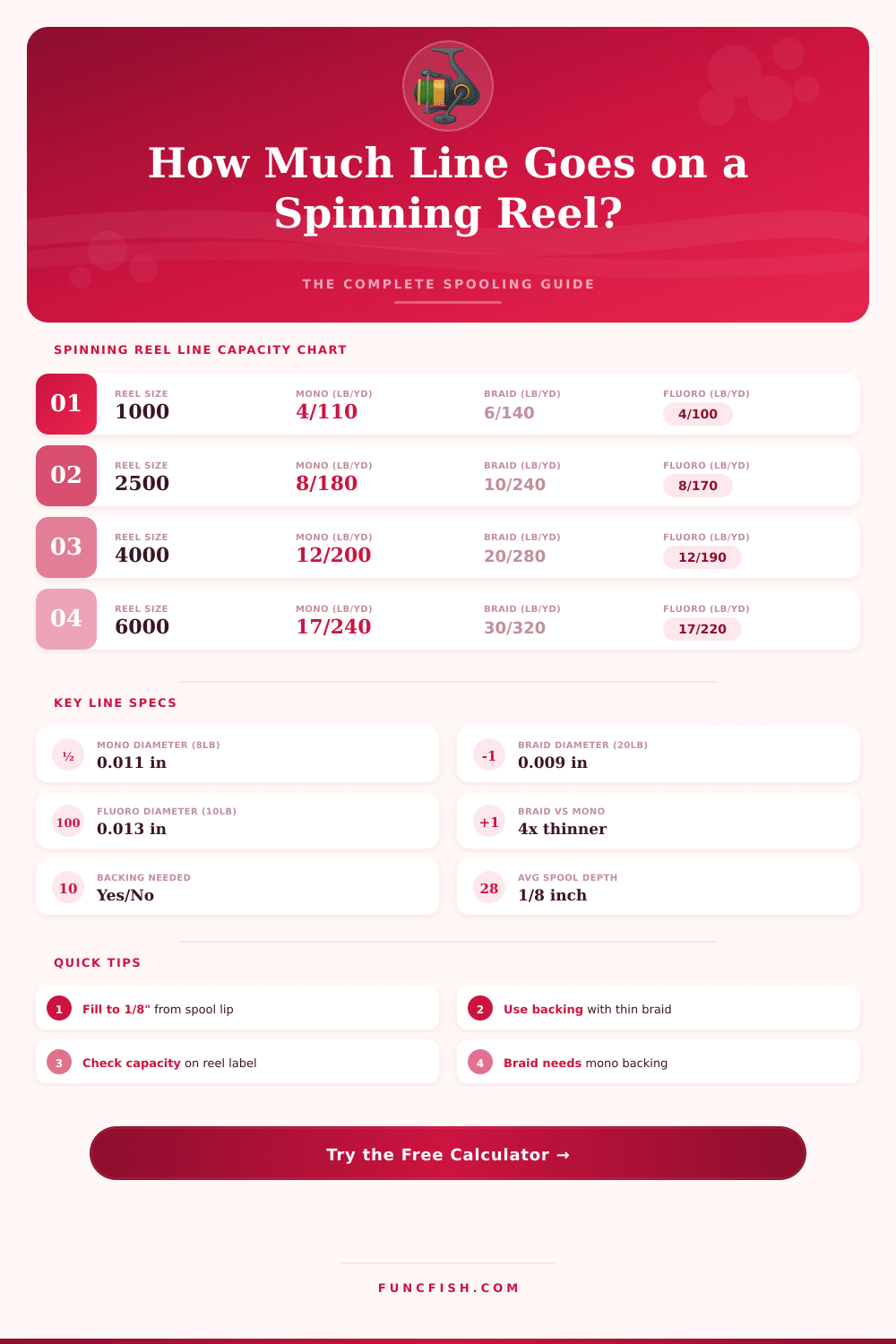
| Reel Size | Capacity (lb/yd) | Braid Equiv. | Fluoro Equiv. | Best Use |
|---|---|---|---|---|
| 500 | 2 lb / 80 yd | 6 lb / 100 yd | 2 lb / 75 yd | Panfish, nano-fishing |
| 1000 | 4 lb / 110 yd | 8 lb / 140 yd | 4 lb / 100 yd | Trout, crappie |
| 2000 | 6 lb / 150 yd | 10 lb / 200 yd | 6 lb / 140 yd | Light bass, trout |
| 2500 | 8 lb / 180 yd | 15 lb / 240 yd | 8 lb / 170 yd | Bass, walleye |
| 3000 | 10 lb / 200 yd | 20 lb / 260 yd | 10 lb / 185 yd | Bass, inshore |
| 4000 | 12 lb / 220 yd | 30 lb / 280 yd | 12 lb / 200 yd | Pike, salmon |
| 5000 | 17 lb / 260 yd | 40 lb / 300 yd | 15 lb / 240 yd | Surf, stripers |
| 6000 | 17 lb / 300 yd | 50 lb / 350 yd | 17 lb / 270 yd | Surf, offshore |
| 8000 | 20 lb / 340 yd | 65 lb / 400 yd | 20 lb / 310 yd | Big surf, offshore |
| Species | Avg Weight | Line Test | Reel Size | Line Type | Capacity Needed |
|---|---|---|---|---|---|
| Bluegill / Panfish | 0.25–1 lb | 2–4 lb | 500–1000 | Mono | 80–110 yd |
| Crappie | 0.5–2 lb | 4–6 lb | 1000–2000 | Mono / Fluoro | 100–150 yd |
| Trout (stream) | 0.5–3 lb | 4–8 lb | 1000–2500 | Mono / Fluoro | 110–180 yd |
| Largemouth Bass | 1–8 lb | 8–17 lb | 2500–4000 | Braid / Fluoro | 150–220 yd |
| Walleye | 1–10 lb | 8–12 lb | 2500–3000 | Fluoro / Braid | 150–200 yd |
| Pike / Muskie | 3–30 lb | 17–30 lb | 4000–6000 | Braid | 200–300 yd |
| Salmon / Steelhead | 5–30 lb | 12–20 lb | 3000–5000 | Fluoro / Braid | 200–280 yd |
| Striped Bass | 5–50 lb | 20–40 lb | 5000–8000 | Braid | 280–400 yd |
| Inshore (flounder, etc) | 1–10 lb | 10–20 lb | 3000–4000 | Braid + Leader | 200–250 yd |
| Line Strength | Mono Diameter | Braid Diameter | Fluoro Diameter | Diameter (mm) |
|---|---|---|---|---|
| 2 lb | 0.006" | 0.003" | 0.006" | 0.15 mm |
| 4 lb | 0.008" | 0.004" | 0.008" | 0.20 mm |
| 6 lb | 0.009" | 0.005" | 0.009" | 0.23 mm |
| 8 lb | 0.011" | 0.006" | 0.011" | 0.28 mm |
| 10 lb | 0.012" | 0.007" | 0.013" | 0.30 mm |
| 12 lb | 0.014" | 0.008" | 0.015" | 0.33 mm |
| 17 lb | 0.016" | 0.009" | 0.017" | 0.40 mm |
| 20 lb | 0.018" | 0.010" | 0.019" | 0.45 mm |
| 30 lb | 0.022" | 0.012" | 0.023" | 0.55 mm |
Braided line is slippery and will spin freely on a bare spool arbor. Add 20–50 yards of monofilament backing first, then connect your braid with a uni-to-uni knot. This prevents line slippage and saves money on expensive braid.
Overfilling causes wind knots and line loops during casting. Underfilling reduces casting distance by up to 30%. The ideal fill level is 95% — leaving about 1/8 inch gap from the spool lip. Check after spooling under tension for best results.
Choosing the right Line for Spinning Reel spools matters more than many folks think. Braided Line is the most ideal for use on those devices. It has little diameter, casts very well, is not too long, stays strong and very tough.
Progress in fluorocarbon and braided Line simplified the handling of Line on Spinning Reel spools much more than before.
How to Pick and Spool Line on a Spinning Reel
Single and fluorocarbon Line on Spinning Reel spools commonly cause twists and wind knots. Fluorocarbon works on Spinning Reel spools even so it costs more and can have problems with memory of the Line. Hence single, flexible Line widely works best.
Stren, Trilene XL and Ande are solid options. Trilene Big Game is not good and does not work well on Spinning Reel spools. Over time, even the best single Line starts to wind up especially when spools stay unused for months in winter.
For general use 10-pound braid works well. For basic fishing, 15 to 20-pound braid with fluorocarbon leader works well. Some people match the weight of the leader to that of the braid, for instance 10-pound braid with 10-pound leader.
Length of around 24 inches for the leader is good. For spools of 2000-series, use stick with 12-pound or more lightweight mono or fluorocarbon, because heavy Line takes the shape of the spool and becomes too hard to control.
Properly spooling the spool is key knowledge. Lay the spool of the Line on the ground, so that the Line exits left. If it exits right, it will twist.
Pass the Line through your fingers under the guide and apply strong pressure while you reel. When using a spooling station, ensure that the Line exits from the bottom side to avoid twists. For baitcasting spools, the spool flips, so the Line comes off the top instead.
Always close the bail by hand and pull the Line flat before you reel. Those two actions help more then any other step to stop tangles. Tangles almost always come because of carelessness.
Before every cast, keep the Line tight on the spool before opening the bail. After some casts, touch the spool. If it feels loose, do a cast, keep the Line tight and re-spool it on the spool.
Fill the spool right up to the edge of the lip for the best cast distance. Some Spinning Reel spools have rubber on the shaft to stop the braid from slipping. A knot for the shaft works to tie the Line to the spool.
Another trick is to roll two layers of electrical tape on the spool first to stop sliding. Some folks just wrap the Line over the spool, so it catches during casting. Braid that slips freely on the spool is acommon problem that is worth fixing before you reach the water.