🎣 Braided Fishing Line Lifespan Calculator
Estimate how long your braided line will last based on usage, conditions & line type
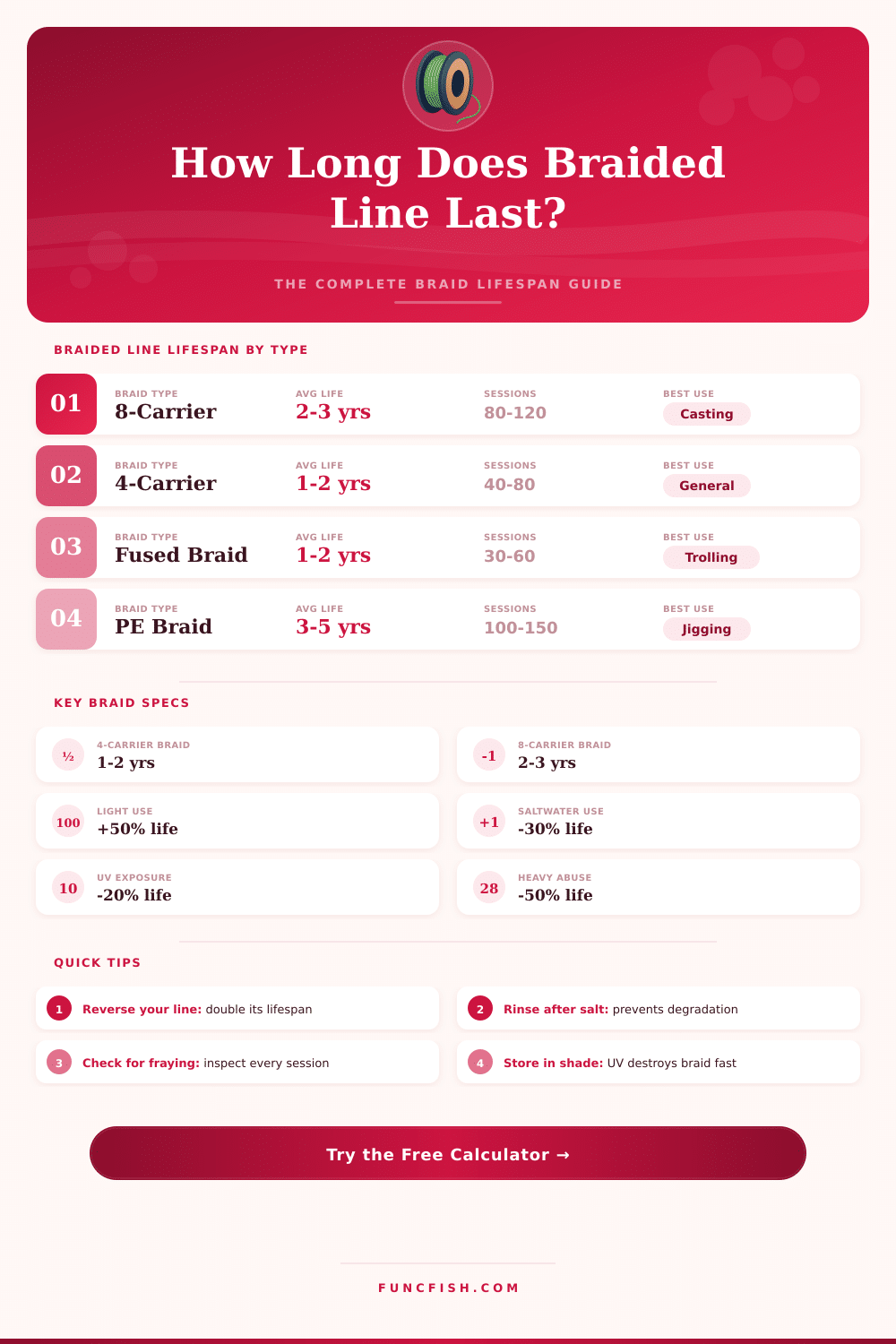
| Braid Type | Carriers | Base Lifespan | Sessions | Diameter vs Mono | Best Use |
|---|---|---|---|---|---|
| 4-Carrier Braid | 4 | 1–2 years | 40–80 | ~50% thinner | General freshwater |
| 8-Carrier Braid | 8 | 2–3 years | 80–120 | ~55% thinner | Casting, finesse |
| Fused / Bonded | Fused | 1–2 years | 30–60 | ~45% thinner | Trolling |
| PE Braid | 4–8 | 3–5 years | 100–150 | ~60% thinner | Jigging, casting |
| Dyneema Core | 8+ | 3–5 years | 100–160 | ~65% thinner | High-performance |
| Spectra Braid | 4–8 | 2–4 years | 80–140 | ~55% thinner | Offshore, surf |
| Co-polymer Superline | N/A | 1–2 years | 30–60 | ~30% thinner | Versatile |
| Hollow Core Braid | 8+ | 2–4 years | 80–140 | ~50% thinner | Offshore, topshot |
| Target Species | Typical Weight | Recommended Braid | Test Weight (lb) | Expected Lifespan |
|---|---|---|---|---|
| Largemouth Bass | 2–8 lb (0.9–3.6 kg) | 8-Carrier | 20–40 lb | 2–3 years |
| Rainbow Trout | 0.5–5 lb (0.2–2.3 kg) | 4-Carrier | 6–15 lb | 1–2 years |
| Striped Bass | 5–40 lb (2.3–18 kg) | 8-Carrier / Spectra | 30–65 lb | 2–3 years |
| Catfish | 5–50 lb (2.3–23 kg) | 8-Carrier | 40–80 lb | 1.5–2.5 years |
| Walleye | 1–10 lb (0.5–4.5 kg) | 4-Carrier | 10–20 lb | 1–2 years |
| Pike / Muskie | 5–30 lb (2.3–14 kg) | 8-Carrier | 30–65 lb | 2–3 years |
| Yellowfin Tuna | 20–200 lb (9–91 kg) | PE / Hollow Core | 65–130 lb | 2–4 years |
| Redfish / Snook | 2–15 lb (0.9–7 kg) | 8-Carrier / PE | 20–40 lb | 1.5–2.5 years |
| Panfish / Crappie | 0.25–2 lb (0.1–0.9 kg) | 4-Carrier | 4–10 lb | 1–2 years |
| Surf Species | 2–20 lb (0.9–9 kg) | Spectra / 8-Carrier | 20–50 lb | 1–2 years |
| Factor | Condition | Lifespan Impact | Notes |
|---|---|---|---|
| Water Type | Freshwater | Baseline (0%) | Least corrosive |
| Water Type | Brackish | −15% | Moderate salt exposure |
| Water Type | Saltwater | −30% | Rinse after every use |
| UV Exposure | Low / Shaded | Baseline (0%) | Proper storage |
| UV Exposure | High (tropical/desert) | −20% | UV degrades fibers |
| Usage | Light | +20% | Minimal abrasion |
| Usage | Moderate | Baseline (0%) | Typical fishing |
| Usage | Heavy | −35% | Rocks, timber, snags |
| Maintenance | Excellent | +25% | Rinse, inspect, lubricate |
| Maintenance | Good | +10% | Regular rinsing |
| Maintenance | Average | Baseline (0%) | Occasional care |
| Maintenance | Poor | −20% | Accelerated degradation |
| Line Reversal | Twice/year | +50% | Doubles usable surface |
| Line Reversal | Once/year | +25% | Good practice |
| Line Reversal | Never | Baseline (0%) | Only half the line used |
Braided line wears primarily at the tip. By reversing your spool (flipping the line end-for-end) once per season, you expose fresh line at the business end and can effectively double the functional lifespan of your braid. This is the single highest-impact maintenance action you can take.
Replace your braided line when you notice: (1) color fading significantly, which indicates UV damage to fibers; (2) visible fraying or flat/ribbon-like texture in the top 30–50 yards; or (3) slippage when knots are tied — this means the outer coating is compromised and breaking strength is reduced by up to 40%.
Braided Fishing Line is commonly chosen for various modes of fishing. It works well in saltwater as well as in freshwater. Anglers like it because of the high ratio between strength and diameter.
This way the line stays thin, yet very strong. Some kinds of Braided Fishing Line are around 75 percent more thin than monofilament with equal strength. Those smaller widths also allow longer casts.
Braided Fishing Line: Good Points and Bad Points
Zero stretch is another benefit of Braided Fishing Line. Because of that anglers feel more clearly the bite. This direct connection is useful during use of jigs plugs and lures.
Sensitivity matters especially for catching fish like fluke. But lack of stretch can slightly hinder. Some users complain that Braided Fishing Line too quickly catches hooks with reels, because it does not give very much.
Braided Fishing Line comes in versions with 4 or 8 threads. The 8-thread version has more material for weight and feels smoother. It works for gentle fishing.
Rather, 4-thread line helps to cut through weeds. Eight-thread can slpi as if silk, which makes it ideal for float fishing.
About color one must think, because it quickly fades. Green, brown and camo versions work well in murky water. Some anglers choose bright tones, to easily sea their line.
Fish apparently do not care about it at all. Bright lime green and bright yellow both well attract prey.
A common setup is made of Braided Fishing Line with a tied leader. Fluorocarbon leader protects against wear and is less visible under water than Braided Fishing Line. Monofilament leader helps, if absorbing shocks is the main issue.
Every leader stays less noticeable than the Braided Fishing Line itself. Mono also brings stretch, which matters when near fish make dangerous runs.
Braided Fishing Line surpasses in strength and abrasion resistance while fishing beside structures like reefs, bridges, stones, logs and shore. Even so, if it gets too tangled, handling it is hard and even small scrapes can break it. Light pound Braided Fishing Line gives a healthy ratio of reliability without too much tangling.
Braided Fishing Line can dig into the spool. A rod with 30-pound Braided Fishing Line on a baitcaster helps to avoid that. Because of its small width and flexibility, it also tangles in spool brakes.
Monofilament does not have such trouble. Both Braided Fishing Line and mono float, so they do not work for deep fishing. Fluorocarbon truly sinks, which makes it better for such methods.
However Braided Fishing Line lasts longer than mono andit keeps knots well.