🎣 Monofilament Fishing Line Lifespan Calculator
Estimate how long your fishing line will last based on line type, usage frequency, storage conditions, and environmental factors
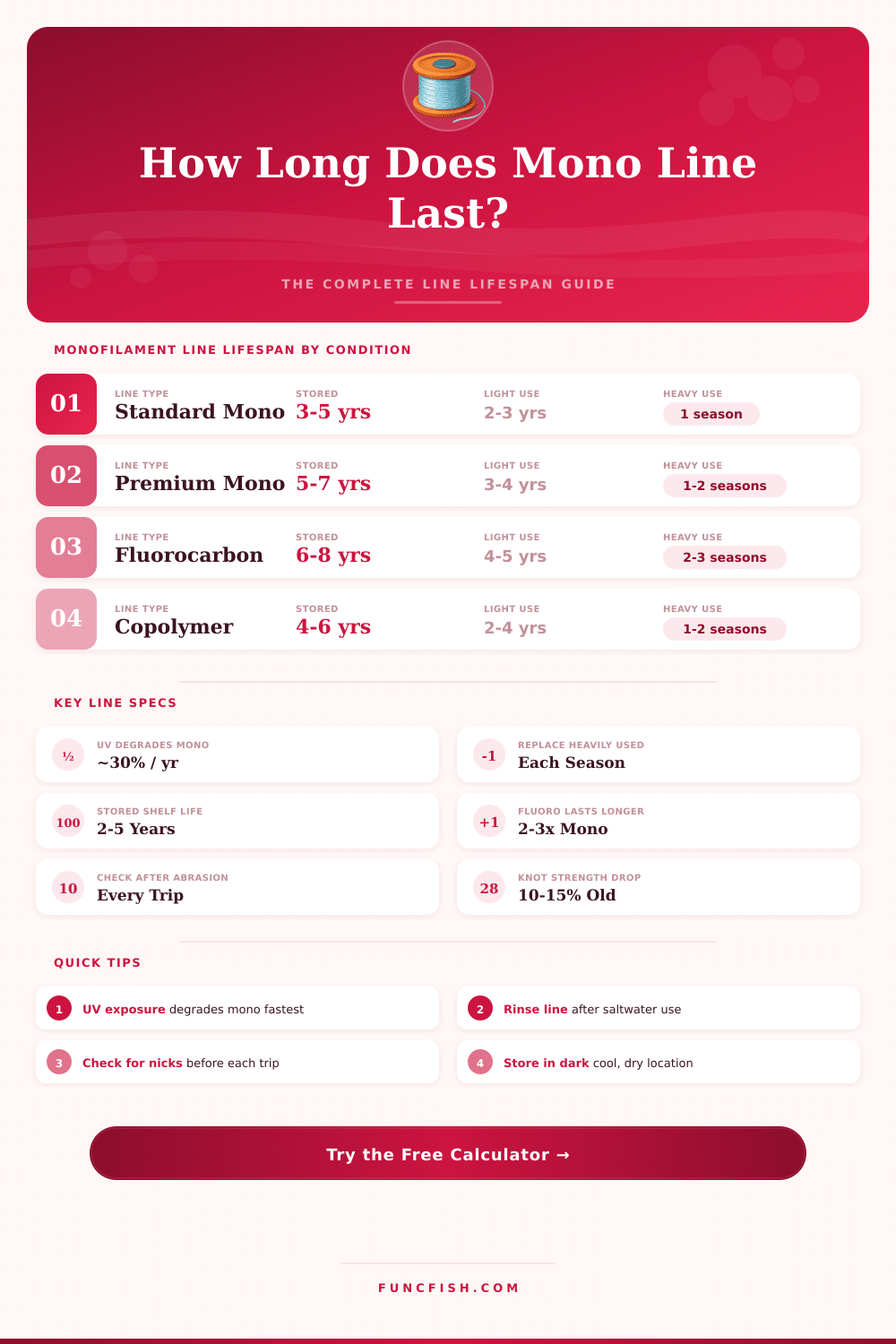
| Line Type | Test Range (lb) | Diameter Range (mm) | Stored Shelf Life | Active Lifespan | UV Resistance |
|---|---|---|---|---|---|
| Standard Monofilament | 2–30 lb | 0.15–0.55 mm | 2–4 years | 1–3 years | Low |
| Premium Monofilament | 4–80 lb | 0.20–0.80 mm | 3–5 years | 2–4 years | Medium |
| Ultralight Monofilament | 1–6 lb | 0.10–0.20 mm | 2–3 years | 1–2 years | Low |
| Heavy Monofilament | 20–200 lb | 0.40–1.20 mm | 3–6 years | 2–3 years | Medium |
| Fluorocarbon | 2–100 lb | 0.13–0.90 mm | 6–8 years | 3–5 years | Very High |
| Copolymer | 4–50 lb | 0.18–0.60 mm | 3–6 years | 2–4 years | Medium-High |
| Saltwater Mono | 10–130 lb | 0.30–1.10 mm | 2–4 years | 1–2 years | Medium |
| Clear / Low-Vis Mono | 2–20 lb | 0.13–0.45 mm | 2–4 years | 1–3 years | Low |
| Species | Typical Weight | Rec. Line Test (lb) | Rec. Line Test (kg) | Replace Every |
|---|---|---|---|---|
| Largemouth Bass | 1–8 lb (0.5–3.6 kg) | 8–17 lb | 3.6–7.7 kg | 1–2 seasons |
| Rainbow Trout | 0.5–5 lb (0.2–2.3 kg) | 4–8 lb | 1.8–3.6 kg | 1–2 seasons |
| Walleye | 1–10 lb (0.5–4.5 kg) | 6–12 lb | 2.7–5.4 kg | 1–2 seasons |
| Catfish (Channel) | 2–20 lb (0.9–9 kg) | 12–25 lb | 5.4–11.3 kg | 1 season |
| Striped Bass | 5–40 lb (2.3–18 kg) | 15–30 lb | 6.8–13.6 kg | 1 season |
| Northern Pike | 3–25 lb (1.4–11.3 kg) | 14–20 lb | 6.4–9.1 kg | 1 season |
| Bluegill / Panfish | 0.1–1 lb (0.04–0.45 kg) | 2–6 lb | 0.9–2.7 kg | 2–3 seasons |
| Offshore (Mahi/Tuna) | 10–100 lb (4.5–45 kg) | 20–80 lb | 9–36 kg | Every trip |
| Condition | Effect on Mono | Lifespan Impact | Action Required |
|---|---|---|---|
| UV / Sunlight | Polymer breakdown | –20–35% per year | Store in dark; replace yearly |
| Saltwater | Hydrolysis & corrosion | –30–50% lifespan | Rinse after every use |
| Heat (vehicle trunk) | Accelerated aging | –40–60% lifespan | Never store in hot spaces |
| Abrasion (rocks/cover) | Nicks & weak spots | Replace immediately | Check before every trip |
| Chemical exposure | Insect repellent/oils | –10–25% | Avoid contact; clean reel |
| Cold storage | Minimal if dry | Neutral / slight positive | Store in cool dry location |
| Humidity / moisture | Hydrolysis over time | –10–20% | Air dry before spooling away |
| Mechanical stress | Line memory & kinks | Varies | Check knot strength regularly |
Pull a 12-inch section of mono firmly between your hands. Fresh line stretches 15–30% before breaking. If it snaps with minimal stretch or feels stiff and brittle, it has degraded significantly and should be replaced immediately — regardless of age.
Even if your entire spool seems fine, the last 50–100 yards (45–90 m) near the reel spool see the most UV exposure and abrasion. Strip off the outer layer and flip your spool periodically to extend usable line life by up to 50% without re-spooling entirely.
Monofilament Fishing Line does not last forever. If you cast it often in the water or simply leave it collecting dust in the garage, it slowly breaks down no matter how you care. On the spool there is no expiration date, but the end always arrives.
No feeling is more frustrating than when your line snaps when you have a fish on the hook.
How Long Does Fishing Line Last?
The life of your line depends truly on the type that you use. The main three kinds are Monofilament Fishing Line, fluorocarbon and braid, that all differ in their durability. Braided line usually beats the others by a lot, we talk about several years, if you care for it well.
Monofilament Fishing Line and fluorocarbon do not last nearly as long. Most anglers change their line between six months and a year, although I knew folks that do that yearly. Here is what I saw work: use the same line for a year later turn it to a new spool for a new round.
That way you get more use from it.
About storage honestly it makes a big difference. Keep it indoors, away from direct sunshine, and your Monofilament Fishing Line stays strong for years. Quality Monofilament Fishing Line, stored right, can truly last decades without breaking.
Braid, kept in a sealed and dark place, loses almost nothing. But if you ignore care, those same lines quickly fial after some years. There is a big difference between truly good line and line that technically works but does not perform as before.
Sunshine and UV rays most quickly destroy your line. Monofilament Fishing Line especially cannot handle exposure too sun, it breaks down over time and gets something called line memory, where it curls in stiff coils. Pull out about twenty feet and check whether it stays curled up.
If yes, you must replace it.
Fluorocarbon is like Monofilament Fishing Line in lifespan, except that it is three to four times stronger. It is made from one solid strand of polyvinylidene fluoride. Most folks use it for leaders anyway, and because those commonly get changed, the lifespan rarely matters for fluorocarbon.
For braid, wash it after every fishing trip and protect it from sunshine, that way you will extend its life a lot. Top brands stay together more well than cheap ones, they do not fray as much and stay smooth, so you respool less often. Cheap versions can feel good at first, but soon become rough tangled mess after only a few times.
Watch for physical damage like loose fibers sticking out and fix them right away when you notice.
Fly lines follow similar rules. If you care well for them, they last four or five seasons without problems. Some fly lines even pass four hundred hours and still work.
Soak old fly line in warm soapy water, and often you restore new life to it. But when dark spots and cracks appear, that line is done. Some fly lines last truly longer than others.
Reliable brandscommonly pass five years without any problems.