🐟 Freshwater Fish Weight Calculator
Estimate fish weight from length & girth using species-specific formulas — imperial & metric
| Species | Length | Avg Girth | Est. Weight (lb) | Est. Weight (kg) | Formula Divisor |
|---|---|---|---|---|---|
| Largemouth Bass | 15 in / 38 cm | 11 in / 28 cm | 2.3 lb | 1.04 kg | 800 |
| Largemouth Bass | 18 in / 46 cm | 14 in / 36 cm | 4.4 lb | 2.00 kg | 800 |
| Largemouth Bass | 22 in / 56 cm | 17 in / 43 cm | 7.9 lb | 3.58 kg | 800 |
| Rainbow Trout | 18 in / 46 cm | 11 in / 28 cm | 2.7 lb | 1.22 kg | 800 |
| Rainbow Trout | 24 in / 61 cm | 14 in / 36 cm | 5.9 lb | 2.68 kg | 800 |
| Walleye | 20 in / 51 cm | 12 in / 30 cm | 3.6 lb | 1.63 kg | 800 |
| Walleye | 26 in / 66 cm | 15 in / 38 cm | 7.3 lb | 3.31 kg | 800 |
| Northern Pike | 28 in / 71 cm | 13 in / 33 cm | 5.3 lb | 2.40 kg | 900 |
| Northern Pike | 36 in / 91 cm | 17 in / 43 cm | 11.6 lb | 5.26 kg | 900 |
| Muskellunge | 40 in / 102 cm | 19 in / 48 cm | 16.1 lb | 7.30 kg | 900 |
| Channel Catfish | 24 in / 61 cm | 16 in / 41 cm | 8.8 lb | 3.99 kg | 700 |
| Common Carp | 28 in / 71 cm | 18 in / 46 cm | 13.1 lb | 5.94 kg | 690 |
| Species | Formula | Girth Ratio (% of length) | Typical Weight Range | World Record |
|---|---|---|---|---|
| Largemouth Bass | L x G² / 800 | ~75% | 1–8 lb (0.5–3.6 kg) | 22 lb 4 oz (10.1 kg) |
| Smallmouth Bass | L x G² / 800 | ~72% | 0.5–5 lb (0.2–2.3 kg) | 11 lb 15 oz (5.4 kg) |
| Rainbow Trout | L x G² / 800 | ~65% | 0.5–10 lb (0.2–4.5 kg) | 48 lb (21.8 kg) |
| Brown Trout | L x G² / 800 | ~65% | 0.5–12 lb (0.2–5.4 kg) | 41 lb 8 oz (18.8 kg) |
| Walleye | L x G² / 800 | ~65% | 1–10 lb (0.5–4.5 kg) | 25 lb (11.3 kg) |
| Northern Pike | L x G² / 900 | ~55% | 2–20 lb (0.9–9.1 kg) | 55 lb 1 oz (25.0 kg) |
| Muskellunge | L x G² / 900 | ~52% | 5–30 lb (2.3–13.6 kg) | 67 lb 8 oz (30.6 kg) |
| Channel Catfish | L x G² / 700 | ~78% | 1–20 lb (0.5–9.1 kg) | 58 lb (26.3 kg) |
| Flathead Catfish | L x G² / 700 | ~80% | 5–50 lb (2.3–22.7 kg) | 123 lb 9 oz (56.0 kg) |
| Crappie | L x G² / 1200 | ~60% | 0.25–2 lb (0.1–0.9 kg) | 5 lb 3 oz (2.4 kg) |
| Bluegill | L x G² / 1200 | ~62% | 0.1–1 lb (0.05–0.5 kg) | 4 lb 12 oz (2.2 kg) |
| Lake Trout | L x G² / 800 | ~68% | 2–20 lb (0.9–9.1 kg) | 102 lb (46.3 kg) |
| Common Carp | L x G² / 690 | ~75% | 5–30 lb (2.3–13.6 kg) | 105 lb (47.6 kg) |
| Species | 12 in (30 cm) | 18 in (46 cm) | 24 in (61 cm) | 30 in (76 cm) | 36 in (91 cm) |
|---|---|---|---|---|---|
| Largemouth Bass | 9.0 in | 13.5 in | 18.0 in | 22.5 in | — |
| Rainbow Trout | 7.8 in | 11.7 in | 15.6 in | 19.5 in | 23.4 in |
| Walleye | 7.8 in | 11.7 in | 15.6 in | 19.5 in | — |
| Northern Pike | 6.6 in | 9.9 in | 13.2 in | 16.5 in | 19.8 in |
| Muskellunge | 6.2 in | 9.4 in | 12.5 in | 15.6 in | 18.7 in |
| Channel Catfish | 9.4 in | 14.0 in | 18.7 in | 23.4 in | — |
Lead to crisp skin at fish commonly manifest hardly. If you lay fish on hot surface those tend to curl upward. That curve causes wrong cook and softness of the skin.
Use fish press help to settle that, because it keeps the bits flat and press them down. So the skin becomes crisp, during the flesh cook through everything. The pressure spreads equally above the whole piece.
How to Get Crispy Fish Skin and Weigh Fish
At first sight, such pressure looks like the tool for hamburgers.
Popular types come from stainless steel. It arrives soon in United States and Canada. Many folks compare them to little old iron blocks, those solid metal blocks with handle.
They weigh a lot for their size and one them easily wash.
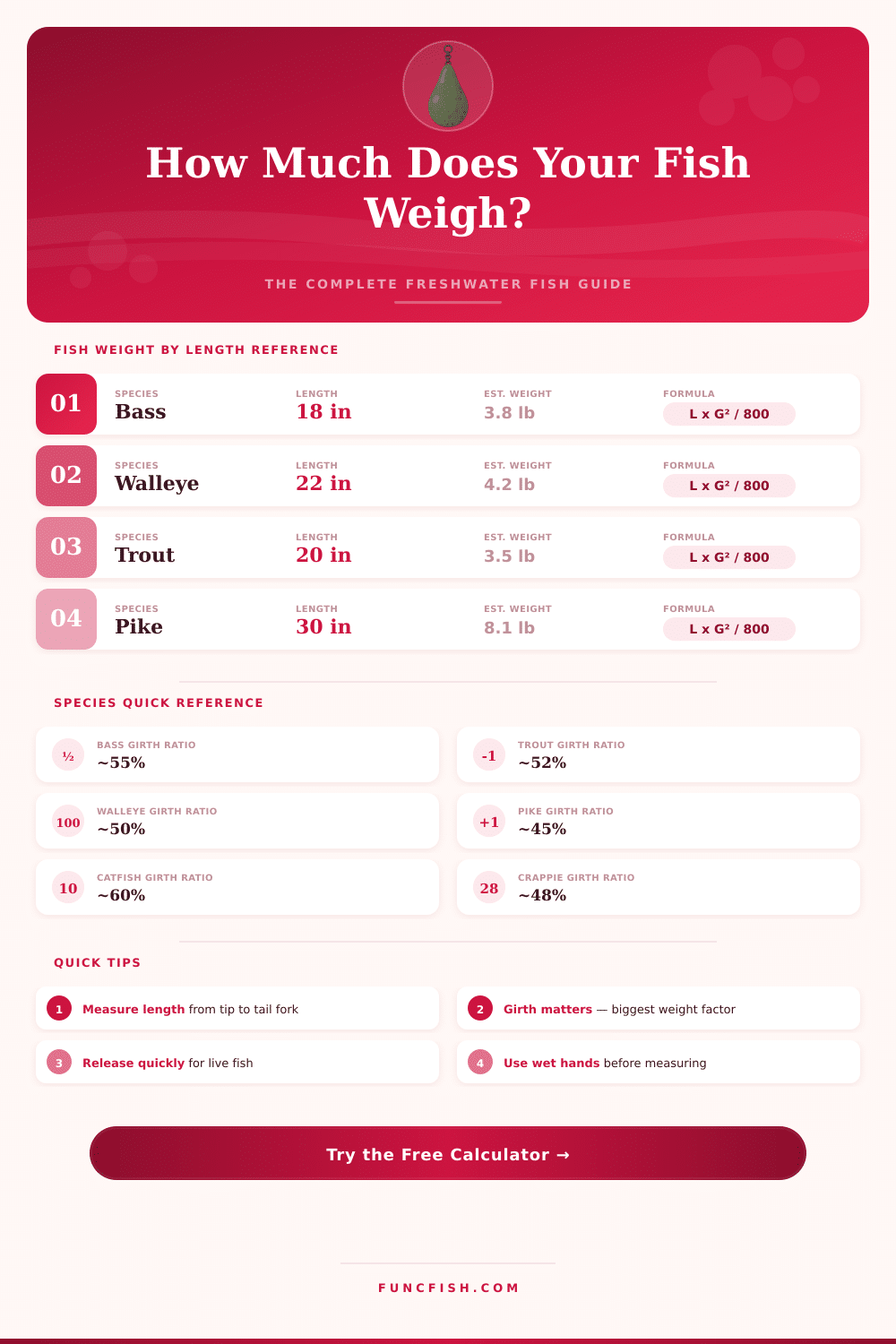
Estimate the weight of caught freshwater fish forms entirely other cause. Exists practical rule, that counts for trout and similar. One takes the girth of the fish, square it, later multiply by the length and divide by 800.
The girth and length are measured in inches, and the result one receives in pounds. When the fish, that you caught, seem fatter or more lightweight than usual, one can move the divider more high or more down. If the girth measure lacks, one sometimes uses default value of 0.58 times the length.
Even so those rules not always work. Long and slim fish can differ much from the calculation. For instance, slim pike long in 31 inches wood can calculate to 8.5 pounds according to the method, but actually it closely reach 3 or 4 pounds.
The biggest fish according to weight not always match to that according to length or reverse.
For truly weighing fish, portable hanging scales work well. Some models include lit LCD screen and hooks. Balance with lip grip for fishes form excellent option.
Simply hook the grip to the center of the bottom jaw. When the balance has only hooks, one can attach separate pair of lip grips, later dismiss their own weight.
Fishes lose weight after capture. Blood loss, vomit and waste all contribute. But usually the water loss matter most.
Fishes always bother to keep the right water balance in their bodies through regulation. Many promote length instead of weight, because length never shrinks, during weight can adjust upward or down.
During calorie tracking, if fish simply loses water during cook and no oil added, the whole calories in the bit stay around same. Simply share the weight of the raw fish. When one eats it during several days, one shares theraw weight by the number of days.