⚡ Boat Power to Weight Ratio Calculator
Calculate your boat's performance ratio, estimated top speed, and performance classification
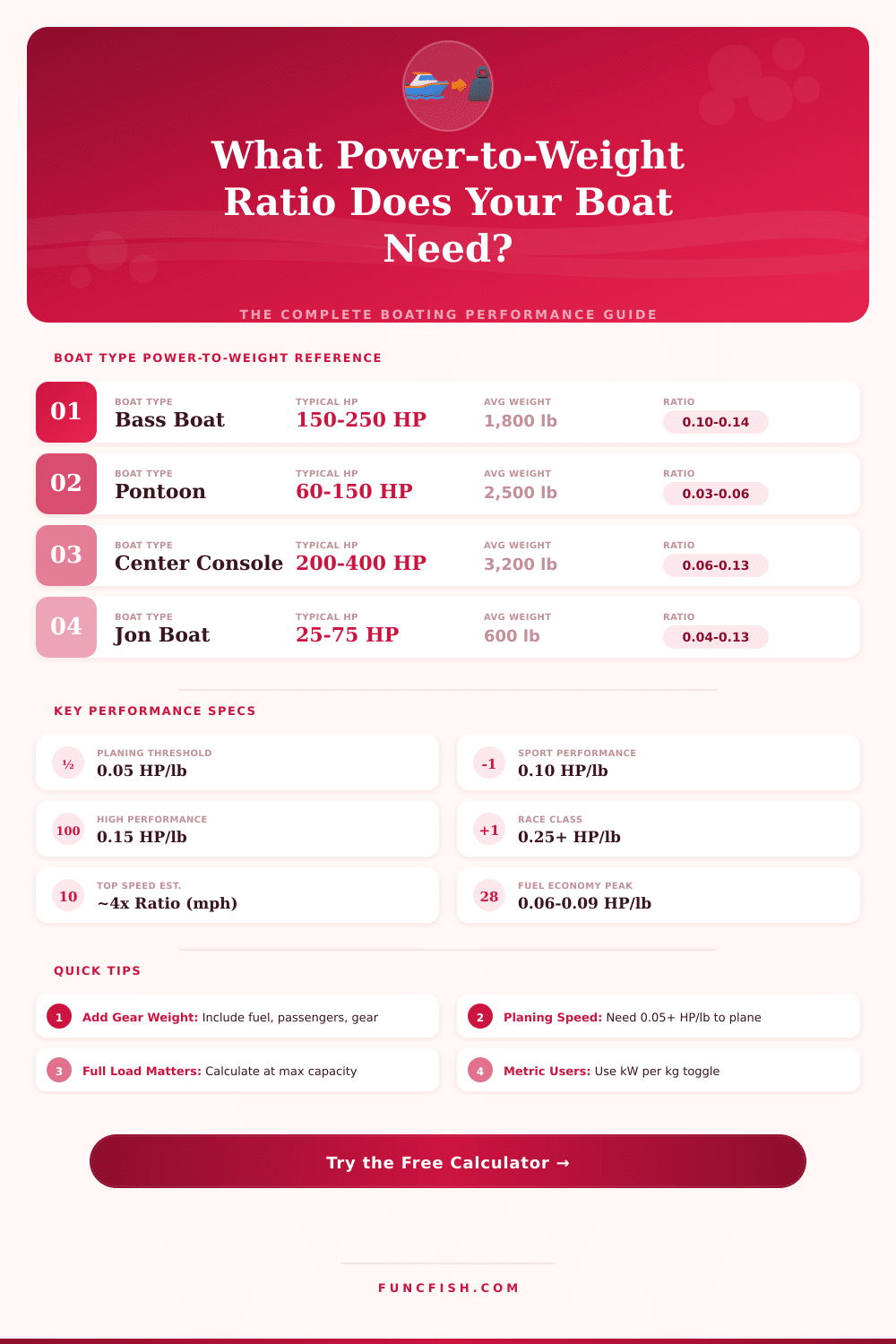
| Boat Type | Typical HP Range | Typical Weight (lb) | Ratio Range (HP/lb) | Est. Top Speed (mph) |
|---|---|---|---|---|
| Bass Boat | 150–250 HP | 1,500–2,200 lb | 0.08–0.14 | 60–75 mph |
| Pontoon Boat | 60–150 HP | 2,200–3,500 lb | 0.02–0.06 | 20–30 mph |
| Center Console (24ft) | 200–400 HP | 3,000–5,000 lb | 0.05–0.12 | 45–60 mph |
| Jon Boat (16ft) | 25–75 HP | 400–800 lb | 0.04–0.13 | 25–40 mph |
| Ski / Wake Boat | 300–400 HP | 4,500–6,000 lb | 0.05–0.09 | 40–55 mph |
| Walleye Boat (18ft) | 100–200 HP | 1,800–2,500 lb | 0.05–0.10 | 40–55 mph |
| Offshore Sportfish (30ft) | 400–800 HP | 12,000–20,000 lb | 0.03–0.06 | 30–45 mph |
| Performance Catamaran | 400–800 HP | 3,000–6,000 lb | 0.10–0.20 | 70–100 mph |
| Hull Type | Efficiency Factor | Best Conditions | Speed Impact |
|---|---|---|---|
| Deep-V (20°+) | 0.85–0.92 | Rough offshore water | –5 to –8% vs flat |
| Modified-V (12–19°) | 0.90–0.96 | Mixed conditions | Baseline |
| Flat Bottom | 0.95–1.00 | Calm inland waters | +3 to +6% vs mod-V |
| Catamaran / Tunnel | 1.05–1.20 | Calm, performance | +15 to +25% vs mod-V |
| Pontoon / Tritoon | 0.75–0.85 | Lakes, calm rivers | –10 to –20% vs mod-V |
| Engine Type | Typical Efficiency | Added Weight (lb) | Speed Advantage | Best Use |
|---|---|---|---|---|
| Single Outboard | Baseline | 300–600 lb | Baseline | Most recreational boats |
| Twin Outboard | +5–10% | 600–1,200 lb | +5–8% | Large center consoles |
| Inboard / Sterndrive | –3 to +3% | 700–1,000 lb | –2 to +2% | Ski, wake, cruisers |
| Jet Drive | –15 to –20% | 400–700 lb | –10 to –15% | Shallow water, safety |
| Electric Motor | 90–95% | 200–800 lb | Varies widely | Trolling, calm water |
The relation between power and weight in boats is a fairly easy idea. Consider for instance a 5,000-pound Boat fitted with a 300-horsepower engine. Share 300 by 5,000 and result is 0.06 horsepowers each pound.
This single figure tells you a lot about the heavy activity of the Boat.
How Boat Power and Weight Work
Common advice is made up of one horsepower for every 25 to 40 pounds of weight. That range allows clear freedom according to various situations, as the size of the Boat, its mass and the goals of usage. Horsepower itself is defined as a measure of energy, that matches to 550 foot-pounds per second.
In bigger and heavy boats you need more horsepowers to reach wanted results. Even so power does not affect the speed this directly, as one could assume. Elements as the length of the body, beam, form of the hull, mass of the engine, turns per minute of it and the system of rest all have a key role.
Hence people commonly ask about size and angle of rest, turns during cruise and time too plane.
About rests: the propeller truly alters the relation. One can choose rest, that strengthens the boost of the Boat, but limits the top speed. Or the other way, other type gives slow bump to reach high speed.
Most boats with good rest and good setup reach 90 to 100 percent of the stated horsepower.
A rule of thumb, that counts roughly, says 50 horsepowers each ton for boats with planing body. When for instance a 2,000-pound Boat must drag a skier at 36 miles per hour, it requires around 90 horsepowers, and a 120-horsepower diesel engine would provide good fuel saving for that task. A pontoon Boat meant for pleasant trips does not require so much energy as a speed Boat planned for water games.
Also the kind of Boat plays a role. Aluminum boats work with same or even fewer horsepowers than a similar size fiberglass model, and still offer better fuel saving. Catamarans usually beat both shallow-V and deep-V bodies regarding smooth ride and Power to Weight Ratio between speed and power.
In little boats the mass of the engine itself becomes more important. On a 16-foot Boat a difference of 50 pounds in engine weight is not something small. So on a 12-foot Boat, even 20 pounds can cause clear impact.
An outboard motor with 9.8 horsepowers, weighing about 80 pounds, was seen as good Power to Weight Ratio for atiny setup.
Doubling of horsepowers does not double the speed. A Boat with a 30-horsepower engine reached 27 miles per hour, while 60 horsepowers on the same body only hit 35 miles per hour. So only 8 miles more for double energy.