⛵ Boat Diesel Fuel Consumption Calculator
Estimate fuel usage by engine size, RPM, speed & trip distance — in gallons or liters
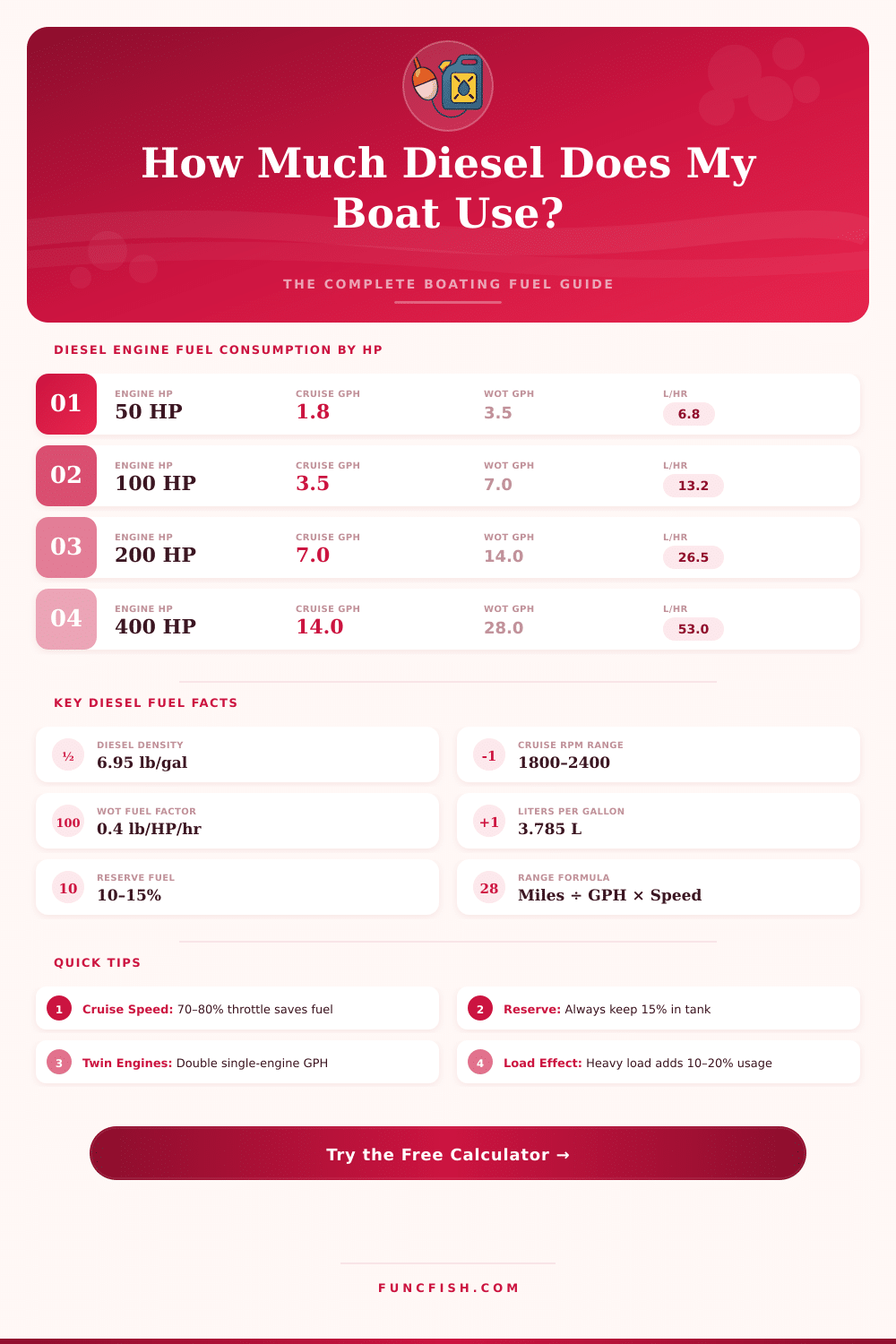
| Engine HP | 25% Throttle | 65% Cruise | 80% High | 100% WOT | L/hr (Cruise) |
|---|---|---|---|---|---|
| 50 HP | 0.7 GPH | 1.8 GPH | 2.8 GPH | 3.5 GPH | 6.8 L/hr |
| 75 HP | 1.0 GPH | 2.7 GPH | 4.2 GPH | 5.2 GPH | 10.2 L/hr |
| 100 HP | 1.4 GPH | 3.5 GPH | 5.6 GPH | 7.0 GPH | 13.2 L/hr |
| 150 HP | 2.1 GPH | 5.3 GPH | 8.4 GPH | 10.5 GPH | 20.1 L/hr |
| 200 HP | 2.8 GPH | 7.0 GPH | 11.2 GPH | 14.0 GPH | 26.5 L/hr |
| 300 HP | 4.2 GPH | 10.5 GPH | 16.8 GPH | 21.0 GPH | 39.7 L/hr |
| 400 HP | 5.6 GPH | 14.0 GPH | 22.4 GPH | 28.0 GPH | 53.0 L/hr |
| 600 HP | 8.4 GPH | 21.0 GPH | 33.6 GPH | 42.0 GPH | 79.5 L/hr |
| Boat Type | Typical HP | Cruise Speed | Avg GPH | Avg L/100km | Typical Range |
|---|---|---|---|---|---|
| Narrowboat / Canal | 20–40 HP | 4–6 kn | 1–2 GPH | 18–30 L/100km | 200+ miles |
| Sailing Auxiliary | 20–75 HP | 5–8 kn | 1–3 GPH | 20–45 L/100km | 300+ miles |
| Displacement Trawler | 100–250 HP | 8–12 kn | 3–8 GPH | 30–60 L/100km | 500+ miles |
| Day Boat / Center Console | 150–300 HP | 18–28 kn | 8–18 GPH | 50–90 L/100km | 150–300 mi |
| Sport Cruiser | 250–500 HP | 22–35 kn | 15–35 GPH | 70–120 L/100km | 200–400 mi |
| Charter Fishing Boat | 300–600 HP | 20–30 kn | 18–45 GPH | 80–150 L/100km | 250–500 mi |
| Twin Engine Express | 2x300–2x600 HP | 28–45 kn | 40–80 GPH | 140–280 L/100km | 200–400 mi |
| Large Motoryacht | 2x600–2x1500 HP | 15–30 kn | 80–200 GPH | 280–600 L/100km | 300–1000 mi |
| Condition | Beaufort Scale | Wave Height | Fuel Increase | Speed Impact |
|---|---|---|---|---|
| Calm / Flat | 0–1 | <0.1 m | 0% | Baseline |
| Light Chop | 2–3 | 0.1–0.6 m | +5% | –2 kn typical |
| Moderate Seas | 4–5 | 0.6–2.0 m | +12% | –4 kn typical |
| Rough Seas | 6–7 | 2.0–4.0 m | +22% | –8+ kn typical |
Boat fuel consumption does not follow a simple rule, it changes strongly based on the kind of boat you use, the power of the engines and how hard you push it. Boats come in very different shapes and sizes, unlike cars that almost always fit in similar weight classes Moreover, on the water there are no speed limits, so the conditions for use are really broad.
Strong four-stroke gas engines burn around 0.50 pounds of fuel each hour for every horsepower. Well maintained diesel engines use about 0.4 pounds each hour per horsepower. Gas engines spend around 30% of their power in liters each hour.
How Much Fuel Do Boats Use?
Take a 300 horsepower gas engine… That gives around 24.5 gallons each hour. Compare that with a 300 horsepower diesel with same specs: because diesel weighs around 7.2 pounds each gallon, it uses almost 16.6 galolns each hour.
That is a big difference.
For a fast and rough guess in typical usage? Around 10 gallons each hour for every 100 horsepower. Four-strokes with gas drop that to around 8 gallons each hour for 100 horsepower.
Two-stroke engines at full gas go to 10 gallons each hour for 100 horsepower.
Three main factors drive how much fuel the boat burns: the length of the hull, the weight and the target speed. A 35-foot diesel boat cruising at 6 knots consumes between 0.6 and 1.2 gallons each hour. If the boat is built heavy as a tank, it can spend much more.
A heavy ship requires the same engine force, but loses efficiency.
In higher speeds things become wild. At 15 knots you can reach 0.64 nautical miles each gallon, but at 25 knots that falls to 0.57. Even small extras of speed increase the consumption.
One boat that I piloted burned five times more fuel per mile at 20-25 knots than at 7 knots. Interesting: engines do not start to swallow fuel really until you pass 3000 RPMs. Simply keeping the pedal weak helps a lot to save fuel per mile.
An average boat burns around 4 gallons each hour. A little skiff on calm waters can use only some gallons. A big ship with several engines?
It spends ten times more. Even the state of the water matters, rough waves can dramatically increase the consumption.
Gas engines spend at least 33% more fuel than a similar diesel. Here it becomes worse: gas engines are bad when lightly loaded, sometimes burning twice as much as a moderately loaded diesel. The move from old two-stroke engines to modern four-strokes changed everything.
One owner swapped twin 150 two-strokes that reached 1.5 miles each gallon for twin 150 Honda four-strokes with 3 miles each gallon or more.
The best ways to save fuel are to choose the right prop, control the flow of fuel, use a good trim and reduce weight. The pitch of the prop is really the most important factor for consumption. Mixes with ethanol and with gas do not give as much power each gallon as pure gasoline, so with them you always have worse fuel economy.