🐟 Fish Fillet Yield Calculator
Estimate edible fillet weight from whole fish — calculate yield percentage, meat per fish, and how many fish you need
| Species | Typical Weight | Base Yield % | Skinless Yield % | Boneless Yield % | Avg Fillet (per lb whole) |
|---|---|---|---|---|---|
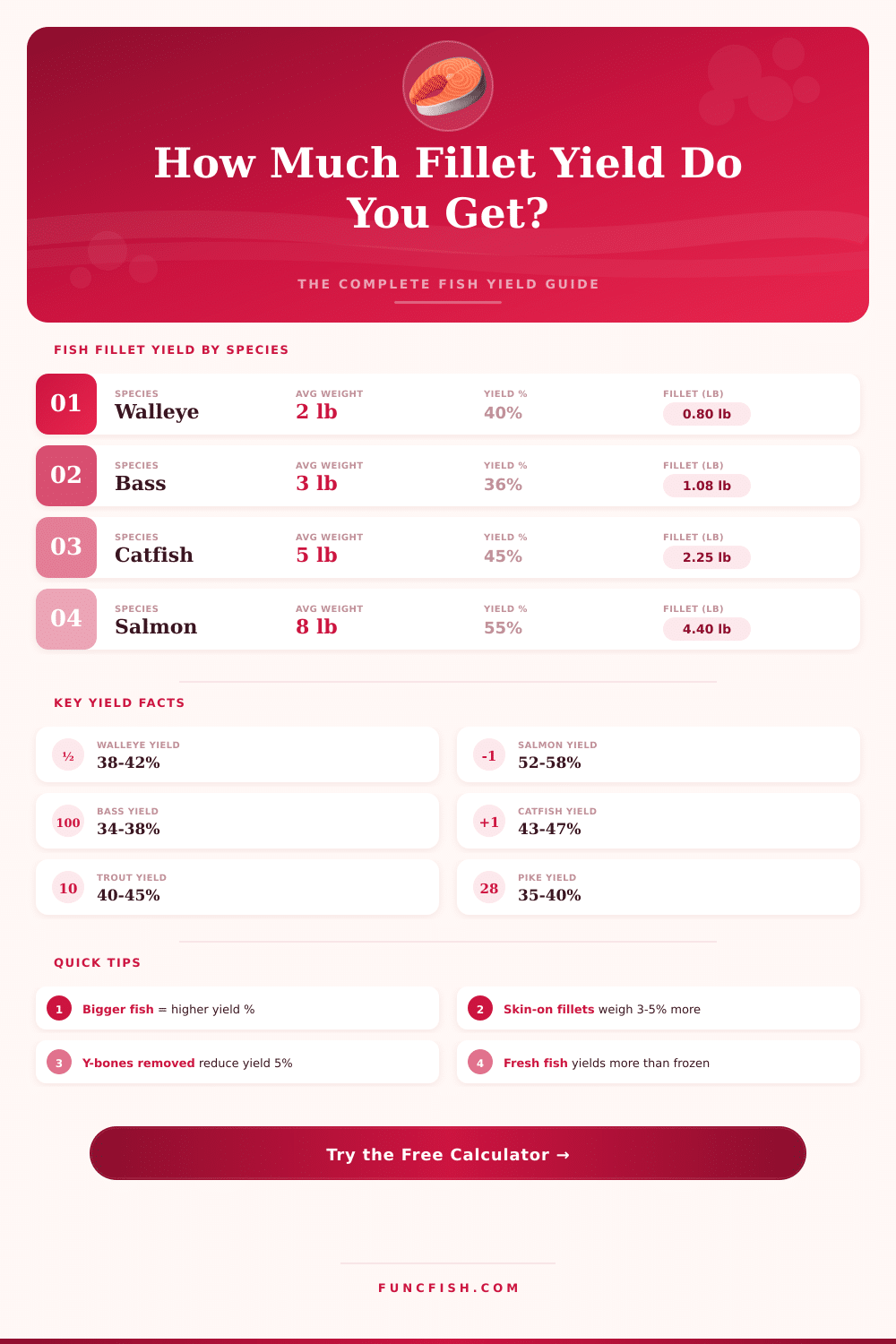
| Walleye | 1.5 – 4 lb | 38 – 42% | 35 – 39% | 32 – 36% | 0.40 lb |
| Largemouth Bass | 1 – 5 lb | 34 – 38% | 31 – 35% | 29 – 33% | 0.36 lb |
| Smallmouth Bass | 0.5 – 3 lb | 33 – 37% | 30 – 34% | 28 – 32% | 0.35 lb |
| Channel Catfish | 2 – 8 lb | 43 – 47% | 40 – 44% | 40 – 44% | 0.45 lb |
| Flathead Catfish | 5 – 20 lb | 45 – 50% | 42 – 47% | 42 – 47% | 0.47 lb |
| Atlantic Salmon | 6 – 12 lb | 52 – 58% | 48 – 54% | 46 – 52% | 0.55 lb |
| Chinook Salmon | 10 – 30 lb | 54 – 60% | 50 – 56% | 48 – 54% | 0.57 lb |
| Rainbow Trout | 0.5 – 5 lb | 40 – 45% | 37 – 42% | 35 – 40% | 0.42 lb |
| Brown Trout | 0.5 – 4 lb | 38 – 44% | 35 – 41% | 33 – 39% | 0.41 lb |
| Northern Pike | 2 – 10 lb | 35 – 40% | 32 – 37% | 26 – 32% | 0.37 lb |
| Muskellunge | 10 – 30 lb | 38 – 44% | 35 – 41% | 29 – 35% | 0.41 lb |
| Bluegill | 0.25 – 0.75 lb | 28 – 33% | 25 – 30% | 23 – 28% | 0.30 lb |
| Crappie | 0.5 – 1.5 lb | 33 – 38% | 30 – 35% | 28 – 33% | 0.35 lb |
| Yellow Perch | 0.25 – 0.75 lb | 30 – 35% | 27 – 32% | 25 – 30% | 0.32 lb |
| Striped Bass | 5 – 20 lb | 42 – 48% | 38 – 44% | 36 – 42% | 0.45 lb |
| Atlantic Cod | 3 – 15 lb | 48 – 53% | 44 – 49% | 42 – 47% | 0.50 lb |
| Flounder / Fluke | 0.5 – 5 lb | 35 – 42% | 32 – 39% | 30 – 37% | 0.38 lb |
| Red Snapper | 2 – 8 lb | 40 – 46% | 37 – 43% | 35 – 41% | 0.43 lb |
| Serving Size | Per Person (oz) | Per Person (g) | Fish Needed (3lb avg) | Fish Needed (5lb avg) | Ideal For |
|---|---|---|---|---|---|
| Light Portion | 4 oz | 113 g | 1 fish / 2 people | 1 fish / 3 people | Side dish or appetizer |
| Standard Meal | 6 oz | 170 g | 1 fish / 1.5 people | 1 fish / 2 people | Main dinner entree |
| Hearty Meal | 8 oz | 227 g | 1 fish / 1 person | 1 fish / 1.5 people | Hungry adults |
| Extra Large | 12 oz | 340 g | 2 fish / 1 person | 1 fish / 1 person | Anglers feast |
| Child Portion | 3 oz | 85 g | 1 fish / 2-3 children | 1 fish / 4 children | Kids under 12 |
Fish fillet yield is how much usable meat you get from whole fish It has big weight because it determines the real price of the fish. In business, the final cost depends mostly on the yield. Now people commonly use term “gross weight fillet” to hide the actual price of goods, billing the whole weight and calling the process a service.
Like this customers pay for the whole weight of the fish, but receive only the fillets.
How Much Fillet Meat You Get From a Fish
Different species deliver very different yields. Flat fish as fluke and halibut normally give 40 to 50 percent. Species as wahoo reach almost 60 percnt.
Salmon delivers around two thirds. For other fishes it is widely 50 percent, and for game fish in general you estimate commonly 50 percent. Crab is much lower, close to 25 percent.
Atlantic cod with head and guts give average 42 to 44 percent for skinless pin bone out fillets during non-spawning season. In spawning season it drops to close to 38 percent, even to 30 percent. Whole salmon with head but guts deliver 68 to 72 percent of skin-on fillets.
Gutted Atlantic salmon without head gives around 65 percent after filleting and skinning. If you remove the skin more deeply with brown fat, the amount drops to around 60 percent. Salmon with guts delivers roughly 50 percent of fillets.
Snapper are especially interesting. The numbers show around 45 percent for skin-on fillets from head-on fish, but snappers have big heads. That requires much scrap for every slice of fillet.
Also size affects. Yield of 20-pound fish rather than 21-pound with head starts with 5 percent difference for same species. Skinless fillets indeed give better recovery than skin-on.
Fillet from head-on fish of expert cutter should reach close to 70 percent. If the amount does not pass 60 percent, better buy pre-cut fillets.
Here fast cost sample. We take 20-pound wild striped bass. The fillet yield will be 20 times 0.33, so 6.6 pounds of fillet.
If the fish costs five dollars each pound, fillet costs out to around 21 dollars each pound. According to costs, buying fillets can be more profitable, if you do not know how to make money from bones and heads. The yield ultimately matches almost same price according to size.
Fillets deliver more usable meat from small to medium species, because you remove bones along the spine. Species as Mormyrus rume, Labeo senegalensis and Clarias gariepinus reach 55 percent or more from fillets.