⛵ Outboard Motor Fuel Consumption Calculator
Estimate fuel usage by engine size, speed, trip distance & conditions — imperial or metric
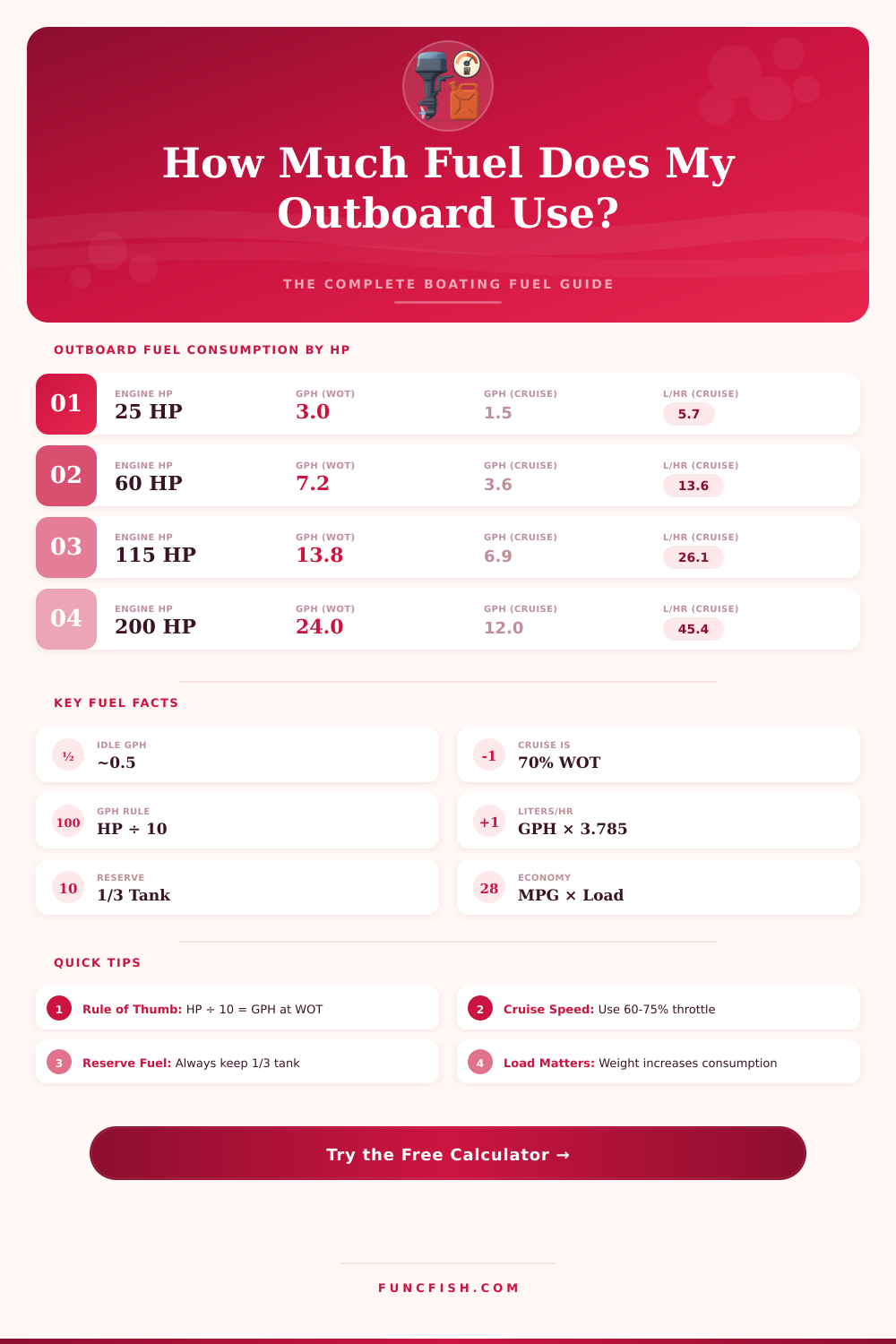
| Engine Size | GPH at WOT | GPH at Cruise (70%) | L/hr at Cruise | Avg MPG (Cruise) |
|---|---|---|---|---|
| 2.5 HP | 0.3 | 0.15 | 0.57 | 8–12 |
| 9.9 HP | 1.0 | 0.5 | 1.89 | 10–16 |
| 25 HP | 3.0 | 1.5 | 5.7 | 8–14 |
| 40 HP | 4.8 | 2.4 | 9.1 | 7–12 |
| 60 HP | 7.2 | 3.6 | 13.6 | 6–11 |
| 90 HP | 10.8 | 5.4 | 20.4 | 5–10 |
| 115 HP | 13.8 | 6.9 | 26.1 | 4–9 |
| 150 HP | 18.0 | 9.0 | 34.1 | 4–8 |
| 200 HP | 24.0 | 12.0 | 45.4 | 3–7 |
| 250 HP | 30.0 | 15.0 | 56.8 | 3–6 |
| 300 HP | 36.0 | 18.0 | 68.1 | 2–5 |
| 350 HP | 42.0 | 21.0 | 79.5 | 2–5 |
| Boat Type | Typical HP Range | Cruise Speed | Avg GPH (Cruise) | Typical MPG |
|---|---|---|---|---|
| Jon Boat / Dinghy | 5–25 HP | 10–18 mph | 0.5–2.5 | 7–15 |
| Bass Boat | 150–250 HP | 40–65 mph | 8–20 | 3–6 |
| Bay / Flats Boat | 90–150 HP | 30–45 mph | 5–12 | 4–8 |
| Center Console | 150–350 HP | 35–55 mph | 10–25 | 3–6 |
| Pontoon Boat | 60–150 HP | 18–30 mph | 4–10 | 3–6 |
| Offshore / Sport | 250–600 HP | 40–65 mph | 20–60 | 1.5–4 |
| Walleye / Multi-Species | 75–150 HP | 25–40 mph | 4–9 | 4–8 |
| Inflatable / RIB | 15–60 HP | 15–30 mph | 1.5–5 | 5–12 |
| Engine Technology | Relative Efficiency | Best For | Emission Level |
|---|---|---|---|
| Carbureted 2-Stroke | Baseline | Old/budget outboards | High |
| Direct Inject 2-Stroke (VST) | +30–40% | Weight-sensitive apps | Medium |
| Carbureted 4-Stroke | +20–30% | Small hp trolling | Low–Medium |
| EFI 4-Stroke | +40–50% | Most modern outboards | Low |
| DOHC EFI 4-Stroke | +50–60% | High performance | Very Low |
| Electric Motor | Best (no fuel) | Short range / quiet | Zero (local) |
| Diesel Outboard | +35–55% | Long-range cruising | Low–Medium |
Outboard Motor engines need the right fuel to operate well for years. All gas engines for ships are built to use fuel with maximum 10-percent ethanol safely. Most of them operate well with E10-gasoline even though that kind sometimes causes rust in the fuel tank and destroys parts of the fuel system.
Problems because of ethanol-mixed gasoline in Outboard Motor engines grew and became more common, because E10 now sells in more stores.
How to Choose Fuel for Outboard Motors
Octane does not really matter a lot, unless the engine is very high efficiency. Normal 87-octane and higher gasolines work for most Outboard Motor engines. Ethanol-free fuel stays a good choice, if it is available.
In some regions it sells as “rec gasoline” in 90 octane. Some users choose higher octane premium only because all locally available options carry up to 10-percent ethanol. E0-gasoline, without any ethanol, is gentle to the fuel tubes and seals.
It does not attract moisture or leave dirty residues, as E10 does. Ethanol itself dissolves well, so it loosens drit in the fuel system. That seems useful, but it creates its own troubles, drawing dirt and stuffing parts.
The mix of gasoline and ethanol does not give as much power as pure gasoline. Always worth checking the maker’s instructions in the manual before choosing the fuel. Whether to use average unleaded gasolines depends on the motor build, compression ratio and the maker’s advice.
Two-stroke Outboard Motor engines are quite common. For a two-stroke engine ethanol-free gasoline still works well, but it must mix with two-stroke oil. Most two-stroke Outboard Motor engines use a mix of 50:1.
That means around one quarter of oil for 12 gallons of gasoline. The best oil for water-cooled two-stroke Outboard Motor is one with TCW3-rating. Mixes with stuff like wax or sunflower oil simply do not work, even though some people claim that.
Fuel Consumption is another important concern. An Outboard Motor engine at fully opened throttle burns roughly about 10 percent of its rated horsepower per gallon in an hour. So a 250-horsepower Outboard Motor at full throttle consumes about 25 gallons each our.
At lower revolutions, the engine produces less power and burns less fuel. In most engines Fuel Consumption grows quickly after 4,000 RPM. Four-stroke Outboard Motor engines are more efficient than two-stroke.
Gas Outboard Motor engines also use less fuel than equally strong gas inboard engines, because those last ones have heavy transmissions, shafts and steering. Modern Outboard Motor engines greatly beat the old carbureted two-stroke models in fuel economy, easy starting, quiet running and smoothness.
Gasoline with ethanol, that sits in the tank a bit of time, can cause serious problems. Old fuel tubes that break apart inside, or a dirty fuel tank also create issues. Additives do not settle core problems with chemicals in gasoline andshould serve only as a final fix after good fuel care practices.