⛵ Boat HP Weight & Speed Calculator
Calculate the ideal horsepower for your boat weight and target speed — imperial & metric
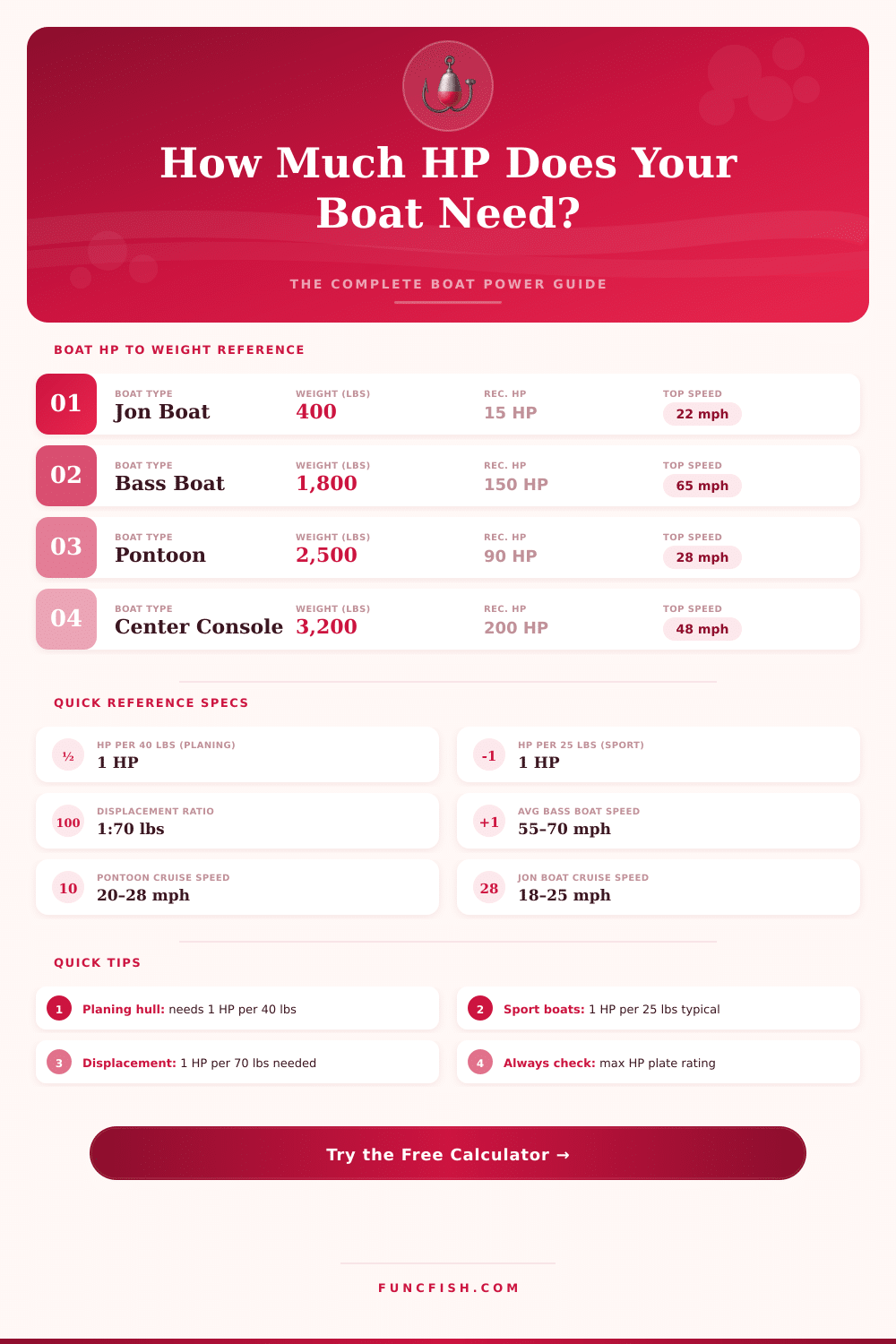
| Boat Type | Typical Weight (lb / kg) | Common HP Range | Cruise Speed (mph / km/h) | Top Speed (mph / km/h) |
|---|---|---|---|---|
| Jon Boat (12–16 ft) | 300–600 lb / 136–272 kg | 9.9–25 HP | 16–22 mph / 26–35 km/h | 25–35 mph / 40–56 km/h |
| Bass Boat (17–21 ft) | 1,400–2,200 lb / 635–998 kg | 115–250 HP | 45–55 mph / 72–88 km/h | 65–80 mph / 105–129 km/h |
| Pontoon (20–28 ft) | 2,000–3,500 lb / 907–1,587 kg | 60–150 HP | 20–28 mph / 32–45 km/h | 30–45 mph / 48–72 km/h |
| Center Console (18–26 ft) | 2,500–5,000 lb / 1,134–2,268 kg | 150–300 HP | 30–40 mph / 48–64 km/h | 50–70 mph / 80–113 km/h |
| Runabout / Bowrider (19–24 ft) | 2,800–4,500 lb / 1,270–2,041 kg | 150–350 HP | 35–50 mph / 56–80 km/h | 55–80 mph / 88–129 km/h |
| Ski / Wake Boat (20–24 ft) | 4,000–6,000 lb / 1,814–2,722 kg | 300–450 HP | 22–35 mph / 35–56 km/h | 50–75 mph / 80–121 km/h |
| Aluminum Fishing (14–18 ft) | 600–1,500 lb / 272–680 kg | 25–90 HP | 20–32 mph / 32–52 km/h | 35–50 mph / 56–80 km/h |
| Inflatable / RIB (10–16 ft) | 200–600 lb / 91–272 kg | 15–60 HP | 18–28 mph / 29–45 km/h | 30–45 mph / 48–72 km/h |
| Offshore Cruiser (25–45 ft) | 8,000–25,000 lb / 3,629–11,340 kg | 300–1,000+ HP | 25–38 mph / 40–61 km/h | 40–60 mph / 64–97 km/h |
| Hull Mode | HP per lb Ratio | Typical Use | Efficiency | Speed Range |
|---|---|---|---|---|
| Displacement | 1 HP per 70 lb (1 HP / 31.8 kg) | Cruising, offshore, sailboats | Very high fuel economy | 6–15 mph / 10–24 km/h |
| Planing | 1 HP per 40 lb (1 HP / 18.1 kg) | Fishing boats, pontoons | Good balance | 15–35 mph / 24–56 km/h |
| Sport | 1 HP per 25 lb (1 HP / 11.3 kg) | Bass boats, runabouts | Moderate | 35–60 mph / 56–97 km/h |
| Performance | 1 HP per 15 lb (1 HP / 6.8 kg) | Ski boats, race boats | Lower, high power use | 60–100+ mph / 97–161 km/h |
| Factor | Condition | HP Adjustment | Speed Impact |
|---|---|---|---|
| Passenger Load | Light (1 person) | +0% base HP | Baseline speed |
| Passenger Load | Moderate (2–3 persons) | +10% HP needed | –5 to –10% speed |
| Passenger Load | Full (4+ persons) | +20% HP needed | –15 to –20% speed |
| Passenger Load | Max rated capacity | +30% HP needed | –25 to –35% speed |
| Water Conditions | Calm / Flat | +0% | Best speed achieved |
| Water Conditions | Choppy / Light chop | +5% | –5% speed reduction |
| Water Conditions | Rough / Open water | +15% | –15% speed reduction |
| Water Conditions | Saltwater / Tidal | +8% | –8% speed reduction |
Horsepower is a unit of power, 550 foot-pounds per second to be precise. Many folks know it from boat and car engines, but the word comes from when James Watt tried to explain what his steam engines could do. Here the easiest way to understand it: one mechanical horsepower can lift 550 pounds one foot in one second
Here is the main question: how much horsepower does your boat need? The math I usually use is quite simple: for every 40 pounds of boat weight, plan one horsepower for smooth cruise at 20 mph on calm water. For a 4,000-pound boat that means 100 horsepower to reach that steady and comfortable speed.
How Much Horsepower Does Your Boat Need?
If you only sail on a small lake and do a bit of calm fishing, a smaller motor will work well. But when you struggle against strong currents or want more than 20 mph, then you require a strogner engine.
Many boaters use the rule of 25 to 40 pounds per horsepower. To estimate your need, simply divide the weight of your boat by 25 for the upper limit of the range or by 40 for the bottom. There is also other advice that circulates: the minimum horsepower should not be less than 75 percent of the maximum capacity for your boat.
This number mostly proves true.
Here is something that surprises: the horsepower rating has no relation to the speed of your boat. It does not matter. It deals only with weight, and that genuinely shocks folks when they learn it.
The difference between cruising on a calm lake and fighting rough coastal waves are huge. More severe conditions use more force only to stay in control. There are however downsides: bigger engines cost more initially, swallow fuel quickly and their care becomes expensive.
Rather, too little motors for the weight cause the boat to push water before it (you call that plowing). Stronger motors raise the bow higher thus reducing the drag.
The U.S. Coast Guard’s Federal Boat Safety Act of 1971 requires that boats under 20 feet with engines built after November 1972 have a capacity plate with limits for safe load and maximum horsepower. For boats above 20 feet that does not count. The formula in the rules boils down to: twice the length times the width of the transom, minus 90, matches your rated horsepower.
And here the warning: installing an engine bigger than the maker says can be illegal in some states.
Too big motors create other problems: too heavy a load on the back. Boats with a notched transom are especially vulnerable to water from that extra mass. The wise action is to take the maximum engine that your boat tolerates and add a fuel flow meter.
You always can turn the throttle for fuel economy, but you cannot add horsepower later when a wave comes or you must bear extra gear.