🧊 Ice Fishing Safety Calculator
Calculate safe ice thickness, load capacity, and safety ratings for ice fishing activities
| Activity | Min Thickness (Clear Ice) | Min Thickness (cm) | Max Safe Load | Safety Rating |
|---|---|---|---|---|
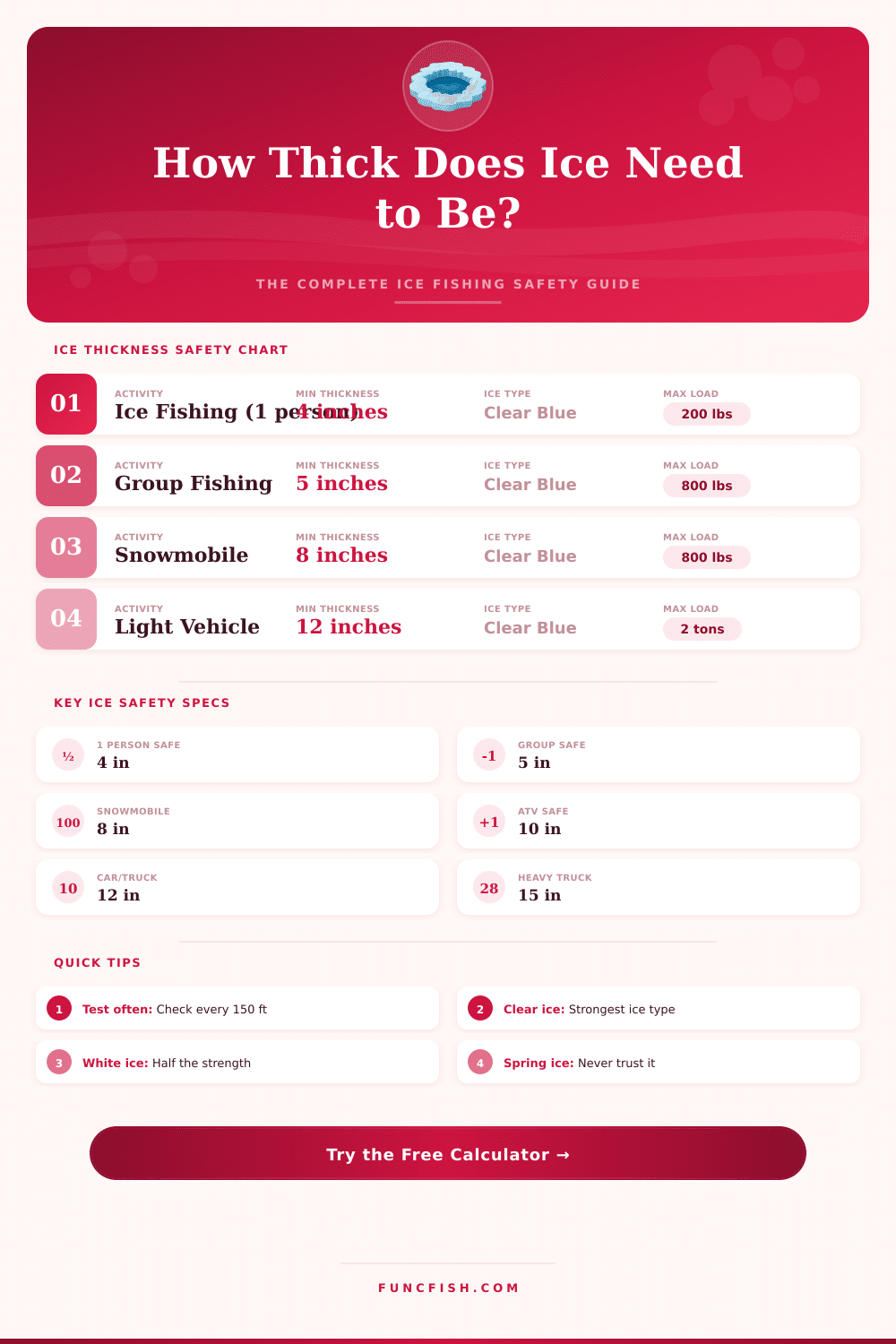
| Walking / Ice Testing | 3 inches | 7.6 cm | ~200 lbs | Caution |
| Solo Ice Fishing | 4 inches | 10.2 cm | ~250 lbs | Safe |
| Group Ice Fishing (3-4) | 5 inches | 12.7 cm | ~800 lbs | Safe |
| Ice Fishing Shanty | 6 inches | 15.2 cm | ~1,000 lbs | Safe |
| Snowmobile | 8 inches | 20.3 cm | ~1,200 lbs | Safe |
| ATV / UTV | 10 inches | 25.4 cm | ~1,500 lbs | Safe |
| Light Car / Truck | 12 inches | 30.5 cm | ~4,000 lbs | Safe |
| Heavy Truck / Equipment | 15+ inches | 38.1+ cm | ~8,000+ lbs | Plan Carefully |
| Ice Type | Color / Appearance | Relative Strength | Multiplier | Notes |
|---|---|---|---|---|
| Clear Blue Ice | Blue / transparent | 100% | 1.00 | Strongest — ideal conditions |
| Black Ice (new) | Dark / transparent | 100% | 1.00 | New clear ice, very strong |
| Layered / Refrozen | Mixed layers | 75% | 0.75 | Some delamination risk |
| White / Opaque Ice | White, milky | 50% | 0.50 | Air pockets reduce strength |
| Snow Ice | White, coarse | 40% | 0.40 | Snow compacted into ice |
| Slushy / Wet Ice | Gray, wet surface | 25% | 0.25 | Near-thaw conditions |
| Candle Ice | Vertical crystals | 10% | 0.10 | Spring ice — extremely dangerous |
| Honeycomb Ice | Porous, hollow | 5% | 0.05 | Avoid completely |
| Species / Scenario | Typical Anglers | Est. Total Load | Min Ice Needed | Equipment Notes |
|---|---|---|---|---|
| Perch / Panfish — Solo | 1 | 180–220 lbs | 4 in / 10 cm | Light rod, hand auger |
| Walleye — 2 Anglers | 2 | 350–450 lbs | 5 in / 13 cm | Medium rods, portable shelter |
| Trout — Solo | 1 | 200–280 lbs | 4 in / 10 cm | Tip-ups, medium rods |
| Pike — Group | 3 | 500–700 lbs | 5 in / 13 cm | Heavy tip-ups, gear sleds |
| Bass — 2 Anglers | 2 | 360–500 lbs | 5 in / 13 cm | Jig rods, electronics |
| Full Ice Hut + Family | 4 | 800–1,200 lbs | 6–8 in / 20 cm | Heater, shelter, gear sleds |
| Tournament Group | 6–10 | 1,200–2,000 lbs | 8–10 in / 25 cm | Multiple shelters, electronics |
| Drive-on Snowmobile | 1–2 + sled | 600–900 lbs | 8 in / 20 cm | Include gear and sled weight |
| Equipment Item | Weight (lbs) | Weight (kg) | Notes |
|---|---|---|---|
| Average Adult (dressed) | 180–220 lbs | 82–100 kg | Include winter gear weight |
| Gas-powered Auger | 25–40 lbs | 11–18 kg | Full fuel tank |
| Electric Auger | 18–30 lbs | 8–14 kg | Lithium battery included |
| Hand Auger | 5–10 lbs | 2–4.5 kg | Lightest option |
| Pop-up Ice Shelter (small) | 15–35 lbs | 7–16 kg | 1–2 person hub style |
| Flip-over Ice Shelter | 35–60 lbs | 16–27 kg | Includes sled base |
| Propane Heater + Fuel | 8–15 lbs | 3.6–7 kg | Full 1-lb cylinder |
| Gear Sled / Toboggan | 10–25 lbs | 4.5–11 kg | Loaded with gear |
| Fish Finder / Electronics | 3–8 lbs | 1.4–3.6 kg | Battery included |
| Tackle + Rods | 5–15 lbs | 2.3–7 kg | Multiple rod setups |
Ice fishing is dropping a line or spear through a hole in the frozen surface of a lake or pond to catch fish. Many do it under the open sky, but others set up shelter in heated camps, sometimes really nice, with bunks and all sorts of comforts. Originally it was only need for survival but now it evolved to something entirely different.
For many it became that one winter hobby, that keeps them in the game year-round.
Ice Fishing Basics: What You Need and How to Stay Safe
If you live for fishing or simply want to try something fresh, ice fishing genuinely attracts. It gives a chance to land many fish, and if you’re lucky, maybe finding a great trophy for the wall. But not everything is about the catch.
On the ice grows real community, and the whole experience has a calming feeling, until something strikes the line, when everything gets exciting quickly.
The main difference between ice and summer fishing comes down to two things: shelter against the open air. You can set up a shed or simply brave the elements with a slim cover above the hole. Some ice shelters are genuinely nice.
For instance, one guide’s shed, a six-by-twelve plywood cottage directly above a reef famous for walleye. Had two wooden benches facing off across a little table, with a propane heater on high flame to beat the cold. Walleye, once hooked, fight like crazy and cook up even beter.
In Missouri you don’t have to rest your rods when winter comes and ice covers everything. Bluegill, crappie and other panfish are fair game during the whole cold season. The charm of ice fishing?
Almost nothing is needed (no boat), no expensive gear. Simply take your pole, dress warm, bring an auger and something too sit on, and you’re set. Depending on the place and how harsh the winter gets, you can even drive right onto the ice.
When not, everything goes in a sled and gives good exercise.
Just like open water, structures and underwater spots matter a lot on ice. Grab a lake map or fire up a navigation app to get oriented. Finding good places based on those charts can make all the difference.
New York anglers, for instance, can stay busy during the whole winter targeting walleye, bluegill, crappie, big perch, northern pike, muskie, lake trout and sunfish. Brown trout deserve the effort, if you get the chance.
Here’s the thing with ice fishing, it is genuinely safe, if you use basic judgment. The risks come down to slipping on the surface or, worst case, breaking through. Watch for those dark, thin patches, because there hides the biggest danger.
Boring only if nothing bites. The second a fish is on the line, especially something aggressive, everythingturns to excitement.