🐟 Fish Fork Length to Standard Length Converter
Convert fork length (FL) to standard length (SL) and total length (TL) with species-specific ratios
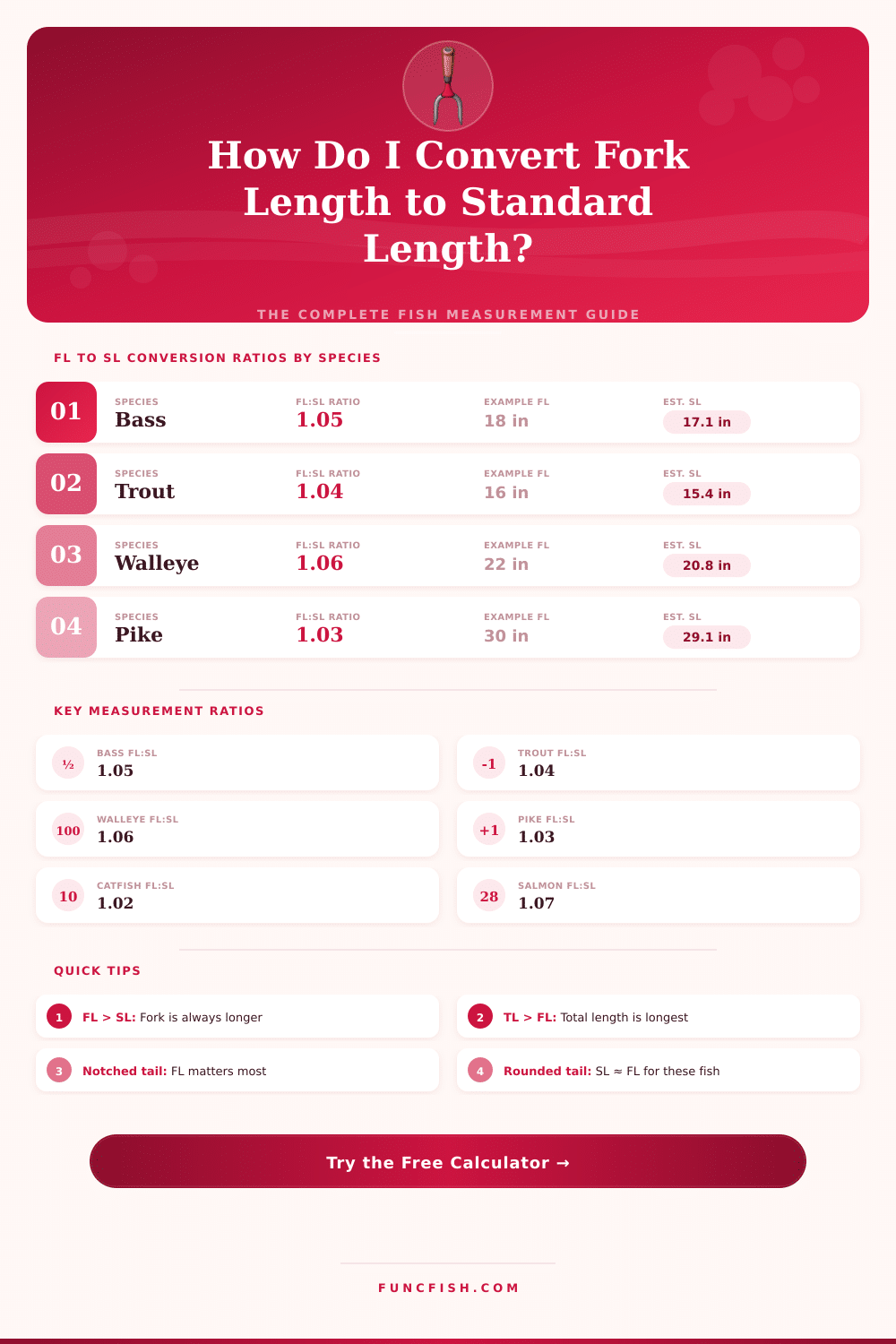
| Species | FL:SL Ratio | FL:TL Ratio | Tail Type | Typical FL Range | Typical FL Range (cm) |
|---|---|---|---|---|---|
| Largemouth Bass | 1.050 | 0.936 | Emarginate | 8–24 in | 20–61 cm |
| Smallmouth Bass | 1.048 | 0.940 | Emarginate | 6–20 in | 15–51 cm |
| Rainbow Trout | 1.040 | 0.902 | Forked | 6–30 in | 15–76 cm |
| Brook Trout | 1.038 | 0.905 | Forked | 4–18 in | 10–46 cm |
| Brown Trout | 1.042 | 0.900 | Forked | 6–32 in | 15–81 cm |
| Walleye | 1.060 | 0.915 | Forked | 10–30 in | 25–76 cm |
| Northern Pike | 1.030 | 0.955 | Forked | 12–48 in | 30–122 cm |
| Channel Catfish | 1.020 | 0.945 | Forked | 8–36 in | 20–91 cm |
| Chinook Salmon | 1.070 | 0.895 | Lunate | 18–48 in | 46–122 cm |
| Bluegill | 1.010 | 0.960 | Emarginate | 3–12 in | 8–30 cm |
| Striped Bass | 1.055 | 0.920 | Forked | 12–48 in | 30–122 cm |
| Generic | 1.045 | 0.920 | Varies | — | — |
| Species | Avg FL (in) | Avg FL (cm) | Est. SL (in) | Est. TL (in) | Typical Weight |
|---|---|---|---|---|---|
| Largemouth Bass | 14 | 35.6 | 13.3 | 14.9 | 2–4 lb |
| Rainbow Trout | 15 | 38.1 | 14.4 | 16.6 | 1.5–3 lb |
| Walleye | 18 | 45.7 | 17.0 | 19.7 | 2–5 lb |
| Northern Pike | 28 | 71.1 | 27.2 | 29.3 | 5–12 lb |
| Channel Catfish | 20 | 50.8 | 19.6 | 21.2 | 3–8 lb |
| Chinook Salmon | 36 | 91.4 | 33.6 | 40.2 | 15–30 lb |
| Bluegill | 7 | 17.8 | 6.9 | 7.3 | 0.3–0.8 lb |
| Striped Bass | 26 | 66.0 | 24.6 | 28.3 | 8–20 lb |
| Measurement | Definition | Start Point | End Point | Best Use |
|---|---|---|---|---|
| Standard Length (SL) | Tip of snout to end of vertebral column | Tip of snout / jaw | Hypural plate (base of tail) | Scientific research, taxonomy |
| Fork Length (FL) | Tip of snout to fork of tail | Tip of snout / jaw | Middle of tail fork | Fisheries surveys, management |
| Total Length (TL) | Tip of snout to end of longest tail ray | Tip of snout / jaw | Longest tail lobe tip | Recreational, regulations |
| Notch Length | Tip of snout to deepest notch of tail | Tip of snout / jaw | Deepest notch of caudal fin | Tuna / billfish records |
Fish length conversion deals with turning the length of fish into estimated weight or changing one type of length measure into another. You can well estimate the weight of most game fish species only from their length, usually the “fork length” that goes from the nose tip until the deepest spot of the V-shaped tail This way you can enjoy the catch of fish, exactly estimate its weight and later return it safely in the sea for a new day.
When you measure fish, the two main ways are standard length and total length. Standard length goes from the nose tip until the root of the tail, without the fins. Some conversions use total length divided by standard or by fork length.
How to Estimate Fish Weight from Length
If you measure other size, for instance head length, for all fish, then you do not need to change them to total length. More commonly you must mix them with total length and create a special convretion key.
There is a length-length table with relations for changing one type of length into another for more than 2,000 fish species. They come from various books or fish photographs. The relations always lead to centimeters and can base on regression.
The factors are dimensionless, so you can use feet, inches or centimeters.
You have several ways to estimate fish weight. Some use length together with girth. Thick fish most probably weighs more than average for its length, and slim less.
If girth is missing, you use a default of 0.58 times the length. Girth makes a big difference. For instance a fish of 38 inches with 20.25 inch girth weighed just a bit above 20 pounds.
Similarly long fish without that thickness weighed much less.
Fish weight calculators apply species-specific biological formulas from studies about fishing. You choose the species and type in the length in inches. Some calculators allow you to switch between imperial and metric units.
Weights appear in grams and pounds. Every conversion formula only intends to be a rough guide, not accurate weight. Length-weight-conversion will never be 100 percent.
For real assurance, weigh the fish yourself.
A practical trick is to measure parts of your body and note them. From finger tip to knuckle, later to wrist, then to elbow. That gives rough ratings for use in the field.
On a photograph you can use a compass to estimate the knuckle of the hand and later the fish. Measure fish with a closed mouth and squeezed tail, because pinching addslength.