🧊 Fish Freezer Space Calculator
Calculate exactly how much freezer space you need for your catch — by species, cut type, and quantity
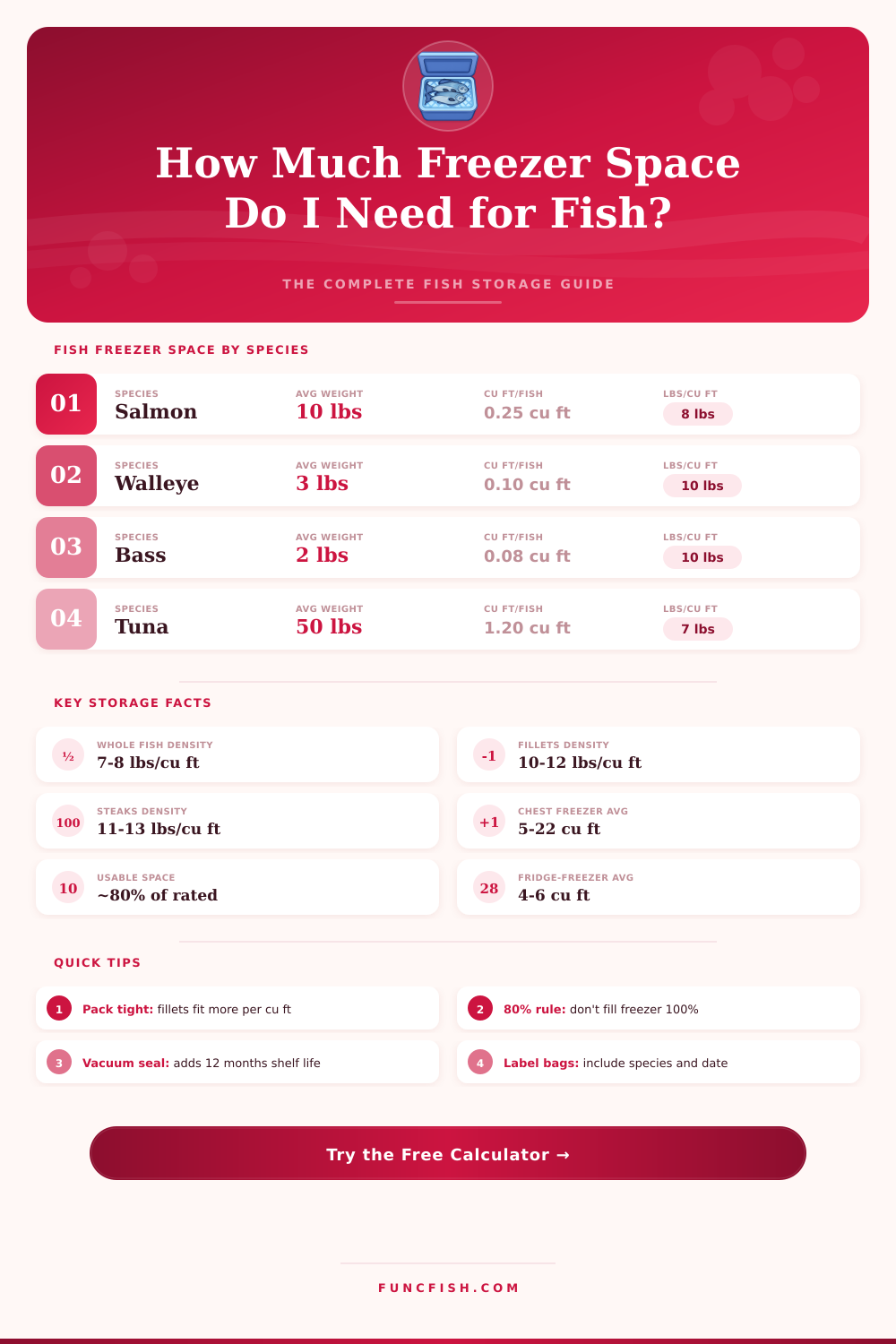
| Species | Avg Weight (lb / kg) | Fillet Yield % | Whole (lbs/cu ft) | Fillets (lbs/cu ft) |
|---|---|---|---|---|
| Salmon (Atlantic/Pacific) | 10 lb / 4.5 kg | 40–45% | 7.5 | 11 |
| Walleye | 3 lb / 1.4 kg | 40–44% | 8.0 | 11 |
| Largemouth Bass | 2 lb / 0.9 kg | 35–40% | 8.0 | 10 |
| Bluefin / Yellowfin Tuna | 50 lb / 22.7 kg | 45–55% | 7.0 | 12 |
| Rainbow / Brown Trout | 1.5 lb / 0.68 kg | 35–40% | 8.5 | 10 |
| Channel / Blue Catfish | 5 lb / 2.3 kg | 40–45% | 7.5 | 11 |
| Bluegill / Crappie (Panfish) | 0.5 lb / 0.23 kg | 25–30% | 9.0 | 10 |
| Striped Bass | 8 lb / 3.6 kg | 40–45% | 7.5 | 11 |
| Pacific Halibut | 40 lb / 18.1 kg | 50–55% | 7.0 | 12 |
| Northern Pike | 6 lb / 2.7 kg | 38–42% | 8.0 | 10 |
| Cut Type | Density (lbs / cu ft) | Density (kg / L) | Packaging Factor | Notes |
|---|---|---|---|---|
| Whole (ungutted) | 7–8 | 0.11–0.13 | 1.00x | Highest air gaps |
| Whole Gutted & Scaled | 8–9 | 0.13–0.14 | 1.10x | Better packing |
| Fillets (skin on/off) | 10–12 | 0.16–0.19 | 1.40x | Most efficient |
| Cross-cut Steaks | 11–13 | 0.18–0.21 | 1.50x | Very dense pack |
| Chunks / Portions | 10–11 | 0.16–0.18 | 1.35x | Good for small pieces |
| Catch (lbs fish) | Catch (kg fish) | Min Freezer Size (cu ft) | Recommended Freezer |
|---|---|---|---|
| Up to 20 lbs | Up to 9 kg | 2 cu ft | Mini or fridge-freezer |
| 20–50 lbs | 9–23 kg | 5 cu ft | Small chest / upright |
| 50–100 lbs | 23–45 kg | 9 cu ft | Mid-size chest freezer |
| 100–200 lbs | 45–91 kg | 16 cu ft | Large chest freezer |
| 200–400 lbs | 91–181 kg | 22+ cu ft | Commercial or two freezers |
| 400+ lbs | 181+ kg | 45+ cu ft | Walk-in commercial unit |
| Packaging Method | Space Overhead | Freezer Burn Protection | Shelf Life |
|---|---|---|---|
| Vacuum Sealed Bags | +5% | Excellent | 12–24 months |
| Zip-lock Freezer Bags | +10% | Good | 6–9 months |
| Butcher Paper / Foil | +12% | Moderate | 3–6 months |
| Rigid Plastic Containers | +25% | Good (with water) | 6–12 months |
| Loose / Unpackaged | +0% | Poor | 1–2 months |
Managing space in freezer for fish commonly is problem for many anglers. They a bit even receive free fish of others, because theirs freezers already are full. When space lacks, that can point that you do not eat enough fish.
You can arrange the capture in different ways, for instance by means of special little freezer only for fish, if you like to seize and prepare yourself. Some uses upright freezer for everyday foods and chest for big things as fish or meat. Chest freezers give more usable volume, but they involve a lot of floor space.
Simple Tips to Save Freezer Space for Fish
Moreover, you hardly dig from them.
For spare place, vacuum sealing well operate. Bags become flat, like this you stack them one on the another. Like this you release space that normally would fill water in the bags.
Vacuum closed packages even stand directly in the freezer. So you do not require rearrange everything for find place. If vacuum sealing lack, take plastic wrap, freezer paper either thick aluminum sheet for protect the fish.
Roll it flatly in plastic wrap either freezer paper. Do the packages flat during freezing and leave three inches of space above the fish for good closing. Double closing gives extra security.
It is helpful label the packages by means of kind of fish, date of capture or purchase, weight, limit of preservation and storage method.
Other mode is enclose fish fillets in ziplock bag with water, so that they freeze as iced brick. It helps against freezer burn during long preservation, but involves a lot of space. Use this resource only if water covers the fish entirely.
Do not add gallon of water only for fill the bag. Also cookie sheets with wax paper outside inhibits touch of fillets. Freeze them until they harden, later vacuum pack.
Clean fish ahead of time superbly help, because they then require fewer space in the freezer. For lean fish as cod, haddock, pollock, flounder or sole, it can last 6 until 12 months in airtight package in 0°F or less.