🐟 Fish Meal Yield Calculator
Calculate how much fish meal you'll get from raw fish — by species, processing method & moisture content
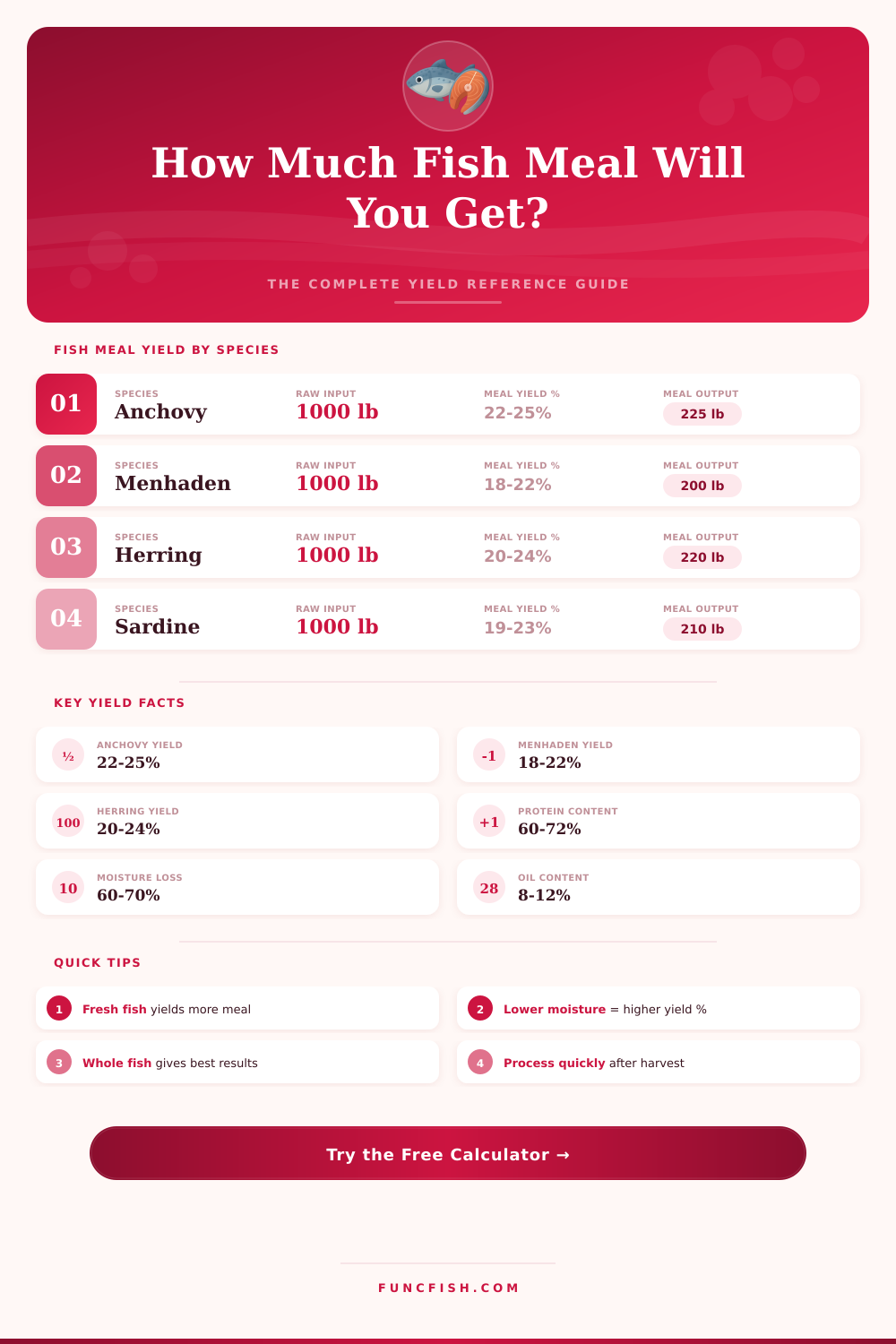
| Species | Raw Moisture (%) | Oil Content (%) | Typical Meal Yield (%) | Meal Protein (%) | Best Method |
|---|---|---|---|---|---|
| Anchovy | 70–72 | 4–7 | 22–25 | 65–72 | Wet Reduction |
| Menhaden | 68–72 | 6–12 | 18–22 | 60–68 | Wet Reduction |
| Herring | 65–70 | 8–15 | 20–24 | 68–72 | Flame Dried |
| Sardine | 65–70 | 5–10 | 19–23 | 64–70 | Wet Reduction |
| Pollock | 78–82 | 0.5–2 | 14–18 | 70–75 | Steam Dried |
| Salmon (byproduct) | 60–70 | 10–20 | 25–35 | 55–65 | Wet Reduction |
| Tuna (byproduct) | 65–72 | 3–8 | 20–28 | 60–68 | Steam Dried |
| Catfish | 75–80 | 3–6 | 14–19 | 60–67 | Sun Dried |
| Tilapia | 75–80 | 2–5 | 15–20 | 55–65 | Flame Dried |
| Mackerel | 65–70 | 10–18 | 18–23 | 62–70 | Wet Reduction |
| Method | Typical Efficiency | Meal Moisture (%) | Oil Recovery | Protein Retention | Best For |
|---|---|---|---|---|---|
| Wet Reduction | 90–95% | 8–10 | High (with press) | 90–95% | Oily pelagic fish |
| Steam Dried | 85–92% | 8–12 | Moderate | 88–93% | Lean white fish |
| Flame Dried | 82–90% | 10–14 | Low | 85–90% | Herring / high-oil |
| Sun Dried | 70–80% | 14–20 | Very low | 80–87% | Small-scale / tropical |
| Freeze Dried | 88–96% | 2–5 | Moderate | 95–98% | High-value specialty meal |
| Mechanical Press | 65–78% | 15–22 | High (main product) | 75–85% | Oil extraction primary |
| Grade | Protein (%) | Moisture (%) | Ash (%) | Typical Use |
|---|---|---|---|---|
| Super Prime (LT) | ≥70 | ≤8 | ≤12 | Aquaculture, premium feed |
| Prime | 65–70 | ≤10 | ≤13 | Salmon / shrimp feed |
| FAQ Standard | 60–65 | ≤12 | ≤15 | Poultry & swine feed |
| Low Grade | 50–60 | ≤14 | ≤18 | General animal feed |
| Rejected / Waste | <50 | >14 | >18 | Fertilizer / compost |
Fish meal is made up of fish addressed on land that you use for special organic dung or animal pulp. You prepare it by means of cook, pressure, drying and milling of the capture. The output of fish meal either fish oil from unit animal fish calls yield, that forms part of process that reduces the volume.
For instance, from fat fish you can receive around 21 percentages whole meal according to assumed composition, but practical tolls a bit depress that.
How Fish Meal Is Made and Used
For one ton of fish meal necesas four until five tons of fish. Annually you harvest around six millions of tons fish only for produce it. This performance seriously contribua to too-fishing and dangers for fishpopulacioj.
Some species eat more fish meal or fish oil according to weight than they self give in his final form. Even so akvokulturistoj use half metric ton wild fish for one metric ton farmed marŝaŭmo. So akvokulturo actually netas source of fish protein.
Fish meal and fish oil give excellent proportion omega-3-grasacidoj, phospholipids and minerals. They also have inherent aminacidojn. Those nourishments improve output and kreskvelon.
Dank to them akvokulturo permanently grew the need in fishproduktoj during the last 50 years. In akvokulturo fish meal delivers much protein. For species as galleries it can cover 40 percentages or more from the involved protein.
Alĝedevorantoj as otocincloj or shrimps favour low proteinkonton, similarly to that in kelpo either alĝomanĝo.
Fish meal well serve also in garden. Green vegetables as spinako, callus and lettuce likes the nitrogen from it. Tomatoes, peproj and cucumbers give more fruits during regular nutrition.
Radikaj plants included of rabuloj, ĉiboloj and carrots grow strongly thanks to the phosphorus in fish meal. Even canine nourishment commonly has it as feature for instance from menhaden. It helps pliriĉigi the proteinkan output in whole multnivelaj akvokultursistemoj that mixes nutritious paŝtaĵakvokulturon with ekstraktiva akvokulturo.