⚓ Prop Slip Calculator
Calculate propeller slip percentage, theoretical vs. actual speed, and efficiency for any boat & engine combination
| Prop Type | Typical Slip % | Best Application | Efficiency | Pitch Range |
|---|---|---|---|---|
| Aluminum 3-Blade | 10-15% | General fishing, budget | Good | 10-24" |
| Stainless 3-Blade | 6-10% | Performance outboard | Very Good | 12-26" |
| Stainless 4-Blade | 5-9% | Hole shot, heavy loads | Excellent | 12-24" |
| Aluminum 4-Blade | 9-14% | Pontoon, heavy boats | Good | 10-20" |
| Cupped Stainless | 4-8% | Speed, performance | Excellent | 14-26" |
| Cleaver (Race) | 2-5% | High-speed racing | Max Speed | 16-30" |
| Nibral (Offshore) | 7-12% | Saltwater offshore | Very Good | 16-28" |
| Composite/Plastic | 15-25% | Small motors, trolling | Fair | 8-14" |
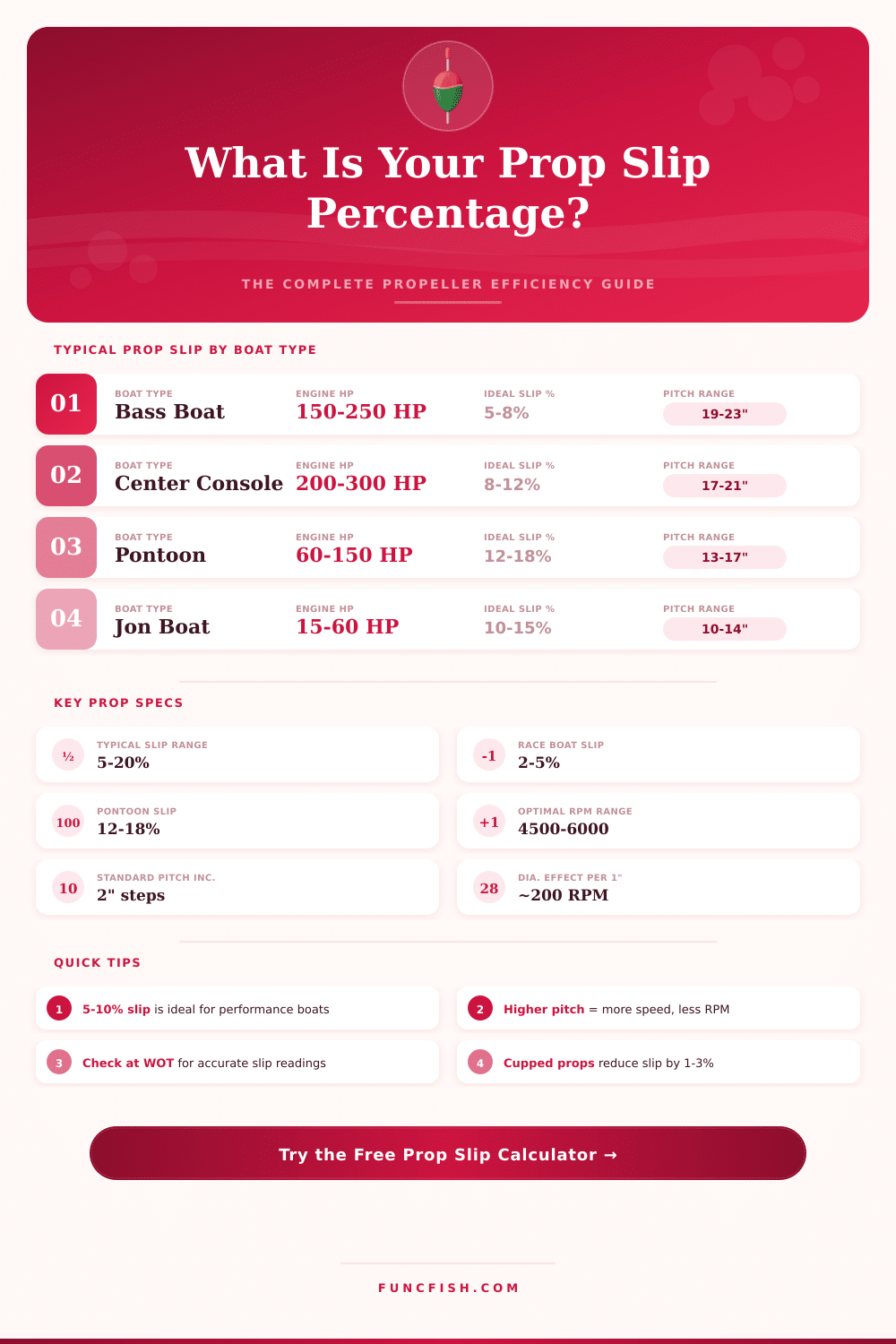
| Boat Type | HP Range | Ideal Slip % | Prop Pitch Range | Target WOT RPM |
|---|---|---|---|---|
| Bass Boat | 150-250 HP | 5-8% | 19-23" | 5000-6000 |
| Center Console | 150-400 HP | 8-12% | 17-21" | 4500-6000 |
| Pontoon Boat | 60-150 HP | 12-18% | 13-17" | 4800-5800 |
| Jon Boat | 15-60 HP | 10-15% | 10-14" | 4500-5500 |
| Ski / Wake Boat | 300-400 HP | 5-9% | 18-22" | 4200-5200 |
| Offshore Sport | 300-600 HP | 8-14% | 16-22" | 4500-5500 |
| Inshore Flats | 90-150 HP | 6-10% | 17-21" | 5000-6200 |
| Race Boat | 300+ HP | 2-5% | 20-34" | 6000-8000 |
| Kayak Motor | 1-5 HP | 15-25% | 6-10" | 4000-5000 |
| Walleye / Troller | 60-150 HP | 8-14% | 13-19" | 4800-5600 |
| Pitch Change | Speed Effect | RPM Effect |
|---|---|---|
| +2" pitch | +3 to 4 MPH | -200 to -400 RPM |
| -2" pitch | -3 to 4 MPH | +200 to +400 RPM |
| +1" diameter | -0.5 MPH | -150 to -200 RPM |
| 3-blade to 4-blade | -1 to 2 MPH | +150 to +300 RPM |
| Al to Stainless | +2 to 4 MPH | Improves efficiency |
| Adding cup | +1 to 2 MPH | -100 to -200 RPM |
| Slip % | Rating | Typical Cause |
|---|---|---|
| 0-5% | Race-level | Optimized setup |
| 5-10% | Excellent | Performance boat |
| 10-15% | Good | Standard fishing |
| 15-20% | Average | Heavy load / pontoon |
| 20-25% | Below Avg | Wrong prop / worn |
| 25%+ | Poor | Replace/resize prop |
| Gear Ratio | Prop Rotation per 1000 RPM | Best Prop Pitch | Application |
|---|---|---|---|
| 1.0:1 | 1000 RPM | 12-14" | Direct drive inboard |
| 1.36:1 | 735 RPM | 14-17" | Small outboard |
| 1.5:1 | 667 RPM | 15-19" | Mid-range outboard |
| 1.64:1 | 610 RPM | 17-23" | Standard outboard |
| 1.75:1 | 571 RPM | 19-25" | Large outboard |
| 1.85:1 | 541 RPM | 20-26" | High-torque engines |
| 2.0:1 | 500 RPM | 22-28" | Trolling motors |
Prop slip is one of those words that sounds bad but is actually quite normal. It shows the difference between the real distance that the propeller travels forward through water and the theoretical distance according to the angle of attack of the propeller blades. The theoretical distance depends on the prop pitch.
For instance, a propeller with 21-inch pitch could move 21 inches during one revolution through soft material. In water it never reaches that distance
What Is Prop Slip and How It Affects Boats
Prop slip does not measure the efficiency of propeller. It simply comes from the needed angle of attack of the blades. Think of it as the energy that the spinning propeller wastes because it does not move the boat forward as well as it could.
Because water is not solid, propeller never gets 100 percent traction. Zero percent slip would be like full traction with tires that do not spin. Such a thing simply does not happen in water.
Heavier boats cause more slipp than in light boats. Water spills around the propeller. Hence, if propeller has 17-inch physical pitch for one revolution, the boat moves only 15 inches.
Many factors affect the slip of propeller: the real pitch, the state of propeller, the form of the hull, the condition of the bottom, extra weight, weight distribution, engine position, engine angle and trim, jack plate assembly and the speed of the boat.
Four-blade propeller usually have less slip than three-blade. Four blades do not require much cup, because two of them are in water always. Maximum speed depends on various things as gear ratio, propeller, RPM and most chiefly enough horsepower to push the boat.
The best way to lower slip is to use a more efficient hull. Good setback and balance also helps. If the trim is not smooth, the propeller can not push everything forward.
Less slip does not come necessarily from stainless propeller. One boat had stainless propeller with almost 27 percent slip, but change to a different model gave big improvement. Check the tach for accuracy and that the bottom is clean and smooth, without holes or bumps, especially near the transom.
Some slip values are normal. Between 10 and 20 percent happen commonly, although some boats have more. 16 percent slip is excellent for certain hull types.
Full displacement boats can have 33 percent slip in low RPM until 50 percent in full gas. Slip always exists; only matter how many percentages.