
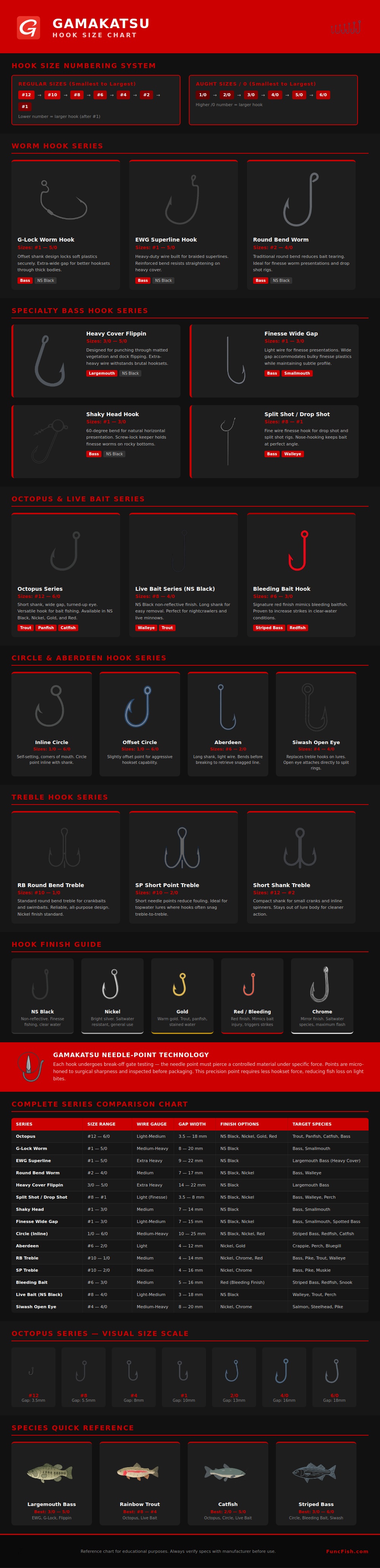
Hook size selection require knowledge of the fish species and the bait you use. Hooks isnt all the same size when selecting hooks for fishing gear. You must choose the size of the hook based on the type of fish and the bait you are using to catch the fish.
Using the proper size of hook will enable you to catch more fish. The proper size of hook will ensure that the hook can penetrate the mouths of the fish. Using a hook size chart will help to avoid guesswork in the selection of the proper hook size.
How to Choose the Right Fishing Hook
Hook sizes uses a specific numbering system. The numbers for small hooks is high. As the size of the hooks increases, the number decrease.
For large sizes, the system change to aught sizes. For aught sizes, the higher the number, the larger the size of the hook. For example, a person using a size 12 hook will catch small panfish because a size 12 hook is small and will not tear the mouths of a panfish.
However, for a bass or a catfish, the person will use an aught sized hook so that the hook is large enough to match the thick jaws of those fish species. Worm hooks are used for bait when fishing for bass. Offset shank worm hooks are used to hold soft plastic baits.
For bulky baits, such as a Senko bait, a wide-gap worm hook will allow the bait to penetrate the bait. If a person is using braided lines, a heavy worm hook will allow the line to handle the force of large bass. Extra-wide gap superline worm hooks also have thicker wires so that the bass will not straighten the hook when they bite on the worm.
Round bend worm hooks can be used for finesse fishing because they will help keep the worm intact on a drop-shot rig. Bass fishing specialty hooks use different thicknesses of wire and different bend angles. For example, flipping rig will use heavy wire hooks so that the hook can take the set of the bass in thick vegetation.
For shaky head rigs, the bend of the hook will be at 60 degree so that the worm will hover over the rocks. For drop shot rigs, fine wire hooks will allow the bait to be nosed into the mouth of the bass at eye level. Additionally, a finesse wide gap hook will be small enough to enter the mouth of a smallmouth bass without overpowering the fishs subtlely bite.
For fishing with live bait, the type of hook also vary. For example, octopus hooks have short shanks with turned up eyes so that the hook can hide inside minnows and nightcrawlers. These hooks can also come in a non-reflective black finish so that the hook can be less visible in the water to fish.
Some fishing hooks are also made with a red color to mimic the color of wounded prey so that predatory fish will attack the bait. Circle hooks are self-setting in the corner of the fish mouth so that the fish will be easier to catch and release back into the water. Other than the size and type of hook, you must also consider the finish of the hook.
For clear lakes with good visibility of the fish, black finishes is used to ensure the hook is less visible for the fish. For saltwater fishing, the fish will have to battle strong salt so the nickel or chrome finish will be more resilient to the salt in the water. For stained water with a high amount of visibility for panfish, gold finish hooks are used to provide a different visual appearance for the panfish.
For predatory fish, a red finish on the hook will provoke a kill because it will mimic the color of blood. Treble hooks are used for crankbaits and topwater lures. Round bend treble hooks can be used for general fishing purposes.
However, short point treble hooks are used for topwater lures because the bent point will prevent the lure from fouling on underwater object. Compact shank treble hooks allow the lure to swim in a straight path in the water. Additionally, needle point treble hooks will pierce the fish with less force.
When choosing a hook, there are tradeoffs between some features and other features of the hook. For example, if a person uses a large gap hook, the hook can hold a large bait but may hook a small fish in the gut. Similarly, if a person uses a heavy wire hook, it will hold up better when reeling in a large fish but may feel more sluggishly when fishing in the current in the water.
To choose a hook, the person should start with the target species of fish. Then, they should choose a hook size based on the bait being used. Then, they can adjust the hook for the water and cover where they will be fishing.
People who use the same size of hook every time will likely lose fish. Thus, they should of vary the sizes of the hook that they use so that they can have the correct hook size for each situation.