🦞 Yabby Out-of-Water Survival Time Calculator
Estimate how long your live yabbies will survive out of water based on temperature, humidity, container type & more
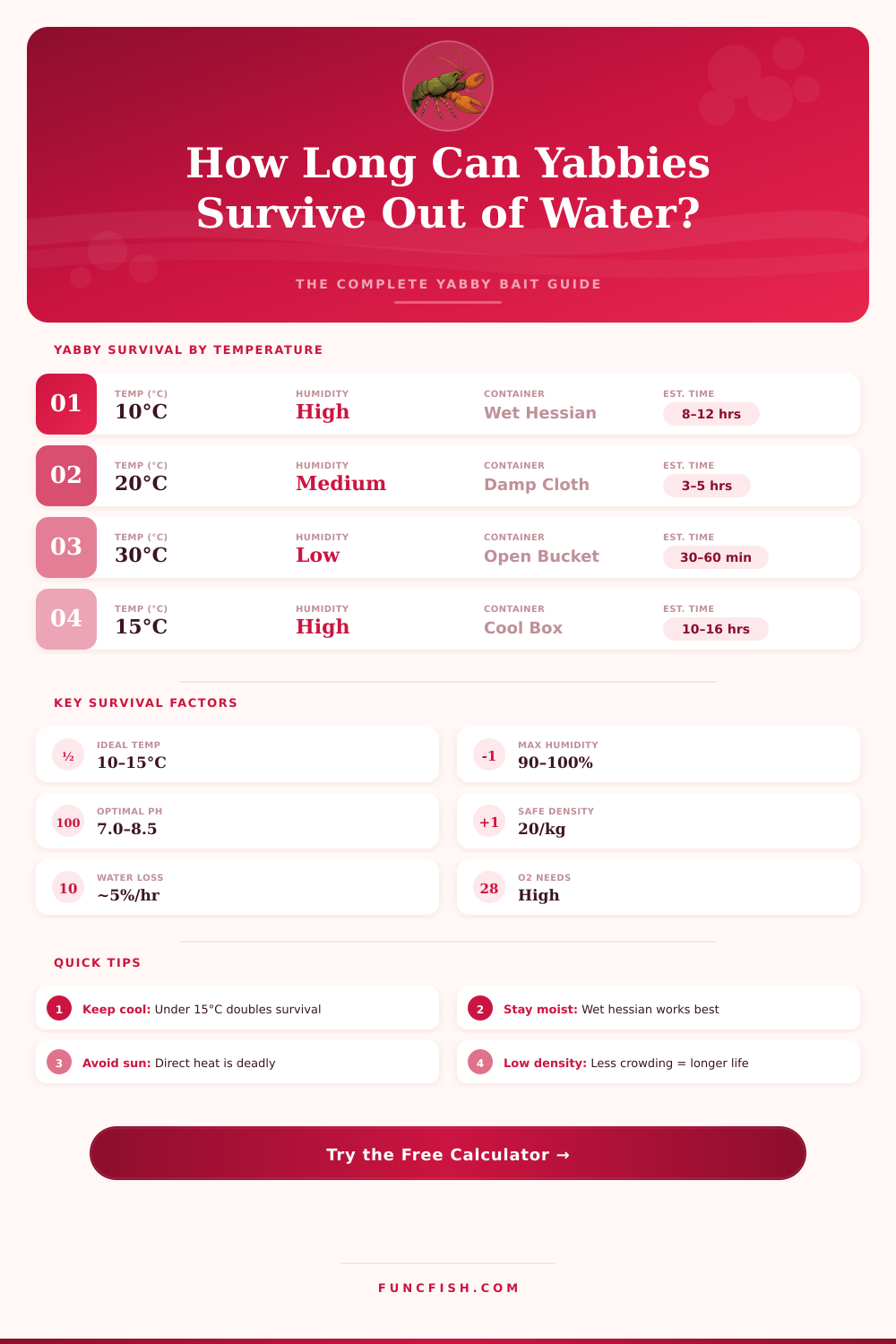
| Temp (°C) | Temp (°F) | Humidity Level | Est. Survival (Good Container) | Est. Survival (Poor Container) | Risk Level |
|---|---|---|---|---|---|
| 0–8 | 32–46 | Any | 16–24 hrs | 8–14 hrs | Very Low |
| 9–14 | 48–57 | High (>70%) | 10–16 hrs | 5–9 hrs | Low |
| 15–20 | 59–68 | Medium (50–70%) | 5–10 hrs | 2–5 hrs | Moderate |
| 21–26 | 70–79 | Low (<50%) | 2–5 hrs | 45–90 min | High |
| 27–32 | 81–90 | Low (<40%) | 45–120 min | 20–45 min | Very High |
| 33+ | 91+ | Any | 20–60 min | 10–25 min | Critical |
| Target Species | Ideal Yabby Size | Hook Size | Recommended Storage | Max Bait Trip Duration |
|---|---|---|---|---|
| Murray Cod | 40–80g (large) | 2/0–4/0 | Cool Box + Ice Pack | 6–8 hrs |
| Golden Perch (Yellowbelly) | 20–50g (medium) | 1/0–2/0 | Wet Hessian | 4–6 hrs |
| Australian Bass | 15–35g (small–med) | 1–1/0 | Damp Cloth / Hessian | 3–5 hrs |
| Bream | 10–25g (small) | 4–1 | Cool Box | 4–8 hrs |
| Barramundi | 30–70g (medium–large) | 2/0–5/0 | Aerated Live Well | 8–12 hrs |
| Flathead | 20–45g (medium) | 1/0–3/0 | Wet Hessian | 3–5 hrs |
| Snapper | 25–60g (medium–large) | 2/0–4/0 | Cool Box | 4–6 hrs |
| Redfin Perch | 8–20g (small) | 6–2 | Damp Cloth | 2–4 hrs |
| Humidity Level | % Range | Moisture Factor | Survival Multiplier | Notes |
|---|---|---|---|---|
| Very High | 85–100% | 1.0 (Optimal) | x2.0 | Near-saturated air; gill function near normal |
| High | 70–84% | 0.85 | x1.5 | Good moisture retention; minimal dehydration |
| Medium | 50–69% | 0.65 | x1.0 (baseline) | Moderate moisture loss; supplement with damp material |
| Low | 30–49% | 0.45 | x0.6 | Rapid dehydration; keep well moistened |
| Very Low | <30% | 0.25 | x0.3 | Critical desiccation risk; use sealed container |
Yabbies are an type of freshwater crayfish that must remain moist to survive while they are out of the water. Yabbies use gills to breathe; the gills requires moisture in order to perform this function for the yabby. If a yabbys gills becomes dry, the yabby will not be able to breathe, and the yabby will experience stress as a result of this condition.
Many factors influences how long a yabby can remain out of the water before the yabby begins to die. These factors includes the species of the yabby, the temperature of the water that the yabby lived in, the temperature of the air around the yabby, the humidity of the air, and the way that the persons who is moving or keeping the yabbies handle the yabby. The species of the yabby may have different tolerance for being out of the water.
How long can yabbies stay out of the water?
For instance, common yabbies may have more tolerance for being out of the water then other species of yabbies. Additionally, the physical state of the yabby may effect the survival of the yabby. For instance, a soft shell yabby is one whose shell is newly shed, and it may not have as much tolerance for being out of the water as a yabby with a hardened shell.
Finally, the size of the yabby may also have an effect; the larger the yabby, the more moisture that may evaporate from its shell. The temperature of the water that the yabbies lived in may effect how long the yabby can remain out of the water. For instance, if the water contained the yabby was between 16 and 24 degrees C, the yabby may be able to remain out of the water for a longer time than if the water were warm.
Warm water makes the yabbys metabolism increase, which increase the amount of oxygen that the yabby need. An increased need for oxygen dries out the gills of the yabby. The temperature of the air may also effect the amount of time that the yabby can remain out of the water.
If the temperature of the water and the air are drastically different from one another, the yabby’s body may experience shock as it attempt to adjust to the different temperatures. The humidity of the air may also play a role in the amount of time that the yabby can remain out of the water. For instance, if the humidity is above 75%, the moisture will remain on the shell of the yabby.
However, if the humidity is below 40%, the air will quickly draw moisture away from the yabbys body. Thus, low humidity levels will decrease the amount of time that a yabby can remain out of the water. The equipment and methods used to handle the yabby may also effect the lifespan of the yabby.
For instance, if a person use wet hands to hold the yabby, the moisture from the persons hands will help to keep the yabby moist. However, if a person use a dry net to hold the yabby, the net may abrade the gills of the yabby. Additionally, if a person places the yabby into a damp tub, the yabby may survive longer than if it was placed into a hot metal tray.
Finally, if the yabby is transported to a shaded area, the yabbys body will not be exposed to the sunlight, which will prevent the sunlight from evaporating the moisture from the body of the yabby. Finally, a person can monitor the well-being of the yabby. For instance, if the yabby clamps its tail or if the antennae of the yabby are limp, those are indication of distress in the yabby.
In these cases, the yabby should of been returned to water immediate. To ensure the survival of the yabby, only 60% of the total time that the yabby can remain out of the water should be spent out of the water. If the moisture is maintained and if the yabby is exposed to shade, the amount of time that the yabby can remain out of the water will increases.
It is actualy alot of work to keep them alive, but they are beautifull to look at. If your looking for a pet, yabbies is a good choice. Youll need to make sure they dont get too dry, as teh heat can be a problem.
You cant just leave them on a table. The moddern way to keep them is in a tank, which is more comfortabley for them.