
Dry fly fishing require a person to understand the size of the insect that are present in the water. A person must use a fly of an appropriate size because if the size of the fly dont match the size of the insects in the water, then the trout will not eat the dry fly. The trout visual measures the size of the food by the silhouette of the food and the length of the food in the water.
Therefore, the size of the hook is one of the critical component of dry fly fishing. If the size of the fly is too large, the trout will think that it is food for another fish. If the size of the dry fly is too small, the trout will not be able to see the fly in the water.
Match Dry Fly Size to Insects and Water
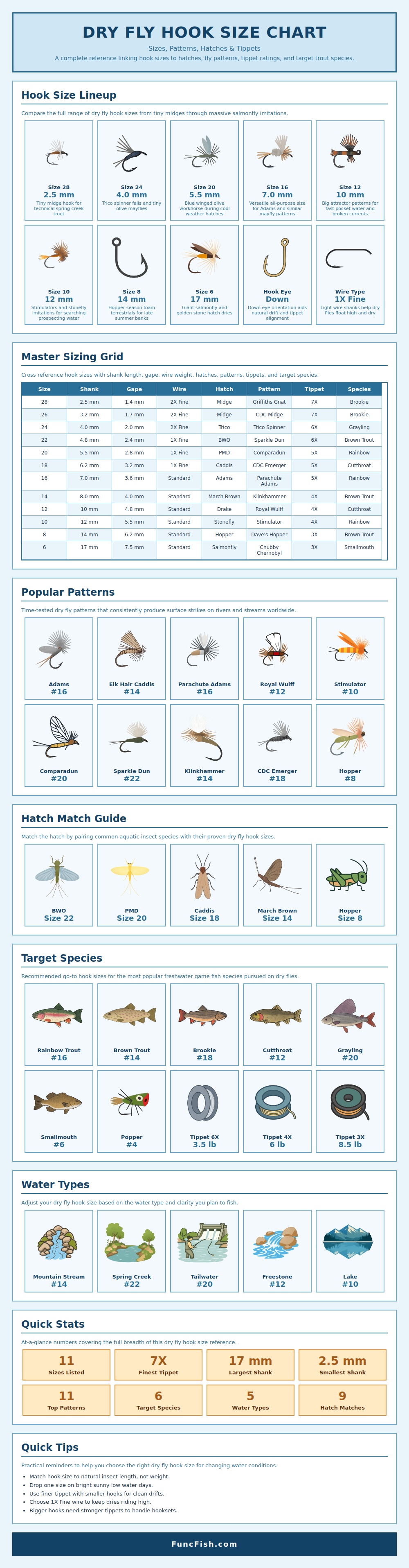
A person can use a reference chart to determine the size of the hook that should be used for the dry fly in relation to the specific insect that are hatching in the water. A reference chart will provide information about the size of the hook needed for specific scenario. For instance, it may be necessary to use a size 28 hook for a hatch of small midges, since a size 28 hook mimics the size of tiny insect.
Additionally, if a person is fishing for stoneflies, which are relatively large insect, a size 12 hook may be necessary because a size 12 hook will provide enough strength to hold the fish. The weight of the wire that is used in the dry fly will affect how the dry fly will sit in the water. If the dry fly include fine wire, it will allow the dry fly to remain on the surface of the water.
Additionally, fine wire will allow for the hackle of the dry fly to flare. The heavier wire that may be use in large dry flies is strong enough to hold the fish that may strike the dry fly. Additionally, the size of the dry flys hook will dictate the strength of the tippet that is used in the dry fly.
For instance, if a person is fishing for tiny midges, the tippet should be 7X to remain thin. However, if a person is fishing for salmonflies, the tippet should be 3X to ensure that it is strong enough to hold the weight of the fish. The type of water in which a person is fishing will change the size of the dry fly that should be used.
For instance, spring creek typically require small dry flies, such as a size 22 dry fly. This is because spring creeks have technical condition in the water. However, freestone river may require larger dry flies, such as a size 12 attractor dry fly.
This is because freestone rivers have choppy water in many instance. Additionally, if the water in which a person is fishing is sunny and low in the water, smaller dry flies should be used. Fish in these types of waters dont want to eat food that has a bulky silhouette.
However, if the waters are windy, larger dry flies should be used because they are easy for the fish to see. Additionally, using larger dry flies will increase the hook up ratio of dry flies that are cast into the water. Many dry fly pattern mimic the physical feature of the insects in the water.
For instance, a Parachute Adams dry fly in size 16 mimics the life of a Blue Winged Olive fly. The white post on a Parachute Adams dry fly allow it to remain visible in the water. An Elk Hair Caddis dry fly in size 14 is typically use in areas where currents are strong in the water.
The deer hair on an Elk Hair Caddis dry fly allow it to trap bubbles in the water. A Chubby Chernobyl dry fly in size 6 is a large dry fly. Additionally, a size 6 dry fly is typically use when fishing for salmonfly hatches.
A person should match the length of the shank of the dry fly to the length of the insect in the water. Thus, matching the length of the insect to the dry fly shank will increase the number of times that the fish will strike at the dry fly. The size of the tippet for the dry fly is also critical to dry fly fishing.
The size of the tippet should match the size of the hook of the dry fly. A person should use 6X tippet for a size 24 Trico dry fly because the 6X tippet is thin enough to remain less noticeable to the fish. Additionally, a person should use 3X tippet for a hopper dry fly because the 3X tippet is strong enough to hold the weight of a large fish.
Thus, if the incorrect size of tippet is used, the dry fly will drag through the water and not exhibit a natural drift of the dry fly. A person, therefore, must select the size of the hook for the dry fly and the size of the tippet for the dry fly to ensure that the dry fly exhibit the physical feature of the natural insects in the water. You should of matched the size of the hook to the insect more accurately.
It is actualy much harder than it looks. The size of the insects and there features matters alot when you are out on the water. One wouldnt want to miss a strike becuase of a bad choice.
Its important to be carefull with your equipment. Most beginner fisher dont realize how much the water types matters. You will recieve better results if you use the right gear.
One might think the size of fly is the only thing, but the weight of wire is just as important. The flys silhouette will be seen by the fish if you do it right. This is more better than using a fly that is too big.
A person should be more mindful of the insect size. The trout will be attracted by the fly if it looks real.