🎣 Split Shot Calculator
Find the exact split shot size & weight for your fishing depth, current, and target species
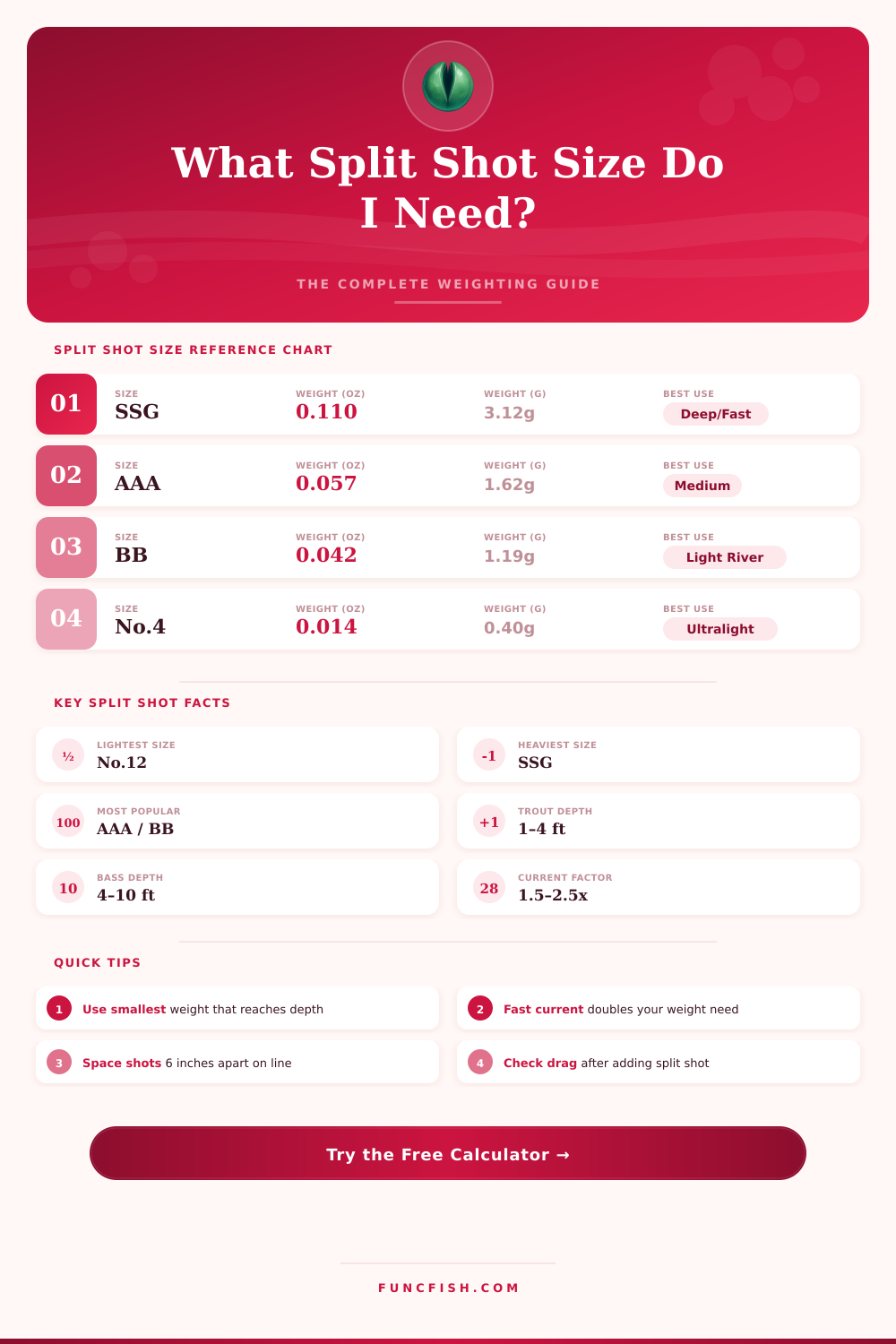
| Size | Weight (oz) | Weight (g) | Diameter (mm) | Typical Use |
|---|---|---|---|---|
| SSG (Swan) | 0.110 | 3.12 | 5.9 | Deep fast rivers, heavy bait |
| AAA | 0.057 | 1.62 | 4.4 | Medium rivers, carp rigs |
| BB | 0.042 | 1.19 | 4.0 | River fishing, light current |
| No.1 | 0.028 | 0.79 | 3.5 | Moderate rivers, bass |
| No.4 | 0.014 | 0.40 | 2.9 | Still water, light current |
| No.6 | 0.009 | 0.26 | 2.4 | Light float fishing, trout |
| No.8 | 0.006 | 0.17 | 2.0 | Ultralight, panfish |
| No.10 | 0.004 | 0.11 | 1.7 | Fly nymphing, tiny baits |
| No.12 | 0.003 | 0.08 | 1.4 | Lightest fly tippet use |
| Species | Typical Weight | Recommended Size | Line Test | Notes |
|---|---|---|---|---|
| Rainbow Trout | 0.5–5 lb | No.6 – BB | 4–8 lb | Use smallest effective size |
| Brown Trout | 1–8 lb | No.4 – AAA | 6–10 lb | Match current speed |
| Largemouth Bass | 1–10 lb | No.1 – BB | 8–17 lb | Carolina rig depth control |
| Smallmouth Bass | 0.5–5 lb | No.4 – No.1 | 6–12 lb | Fast river use AAA |
| Walleye | 1–12 lb | BB – AAA | 8–14 lb | Bottom bouncing rivers |
| Crappie | 0.25–3 lb | No.8 – No.4 | 4–8 lb | Light pressure near docks |
| Panfish / Bluegill | 0.1–1 lb | No.10 – No.6 | 2–6 lb | Ultralight finesse |
| Catfish | 2–30+ lb | SSG – AAA | 15–30 lb | Heavy bottom anchor |
| Steelhead | 3–15 lb | AAA – SSG | 10–20 lb | Fast drift rivers |
| Pompano | 0.5–3 lb | No.1 – BB | 8–12 lb | Surf tidal current |
| Material | Density (g/cm³) | vs. Lead Size | Non-Toxic | Best For |
|---|---|---|---|---|
| Lead | 11.34 | Baseline | No | Traditional, banned in some areas |
| Tungsten | 19.30 | Use 0.6x size | Yes | Deep fast water, minimal profile |
| Steel | 7.87 | Use 1.4x size | Yes | Eco budgets, medium use |
| Bismuth | 9.78 | Use 1.15x size | Yes | Non-toxic alternative |
| Tin | 7.30 | Use 1.55x size | Yes | Light applications |
| Brass | 8.50 | Use 1.33x size | Yes | General eco use |
| Clay | 1.80 | Use 6.0x size | Yes | Ultralight, dissolves naturally |
Split shot rig are tools that are used in coarse fishing. Split shot rig allows a person to adjust the weight of the fishing rig while on the bank. If a person does not balance the components of the split shot rig correct, then the bait will not sit properly in the water.
Additionally, the bait may drift in the water either to quick or too slowly. A person must calculate the correct amount of shot to use based off the type of water, the type of fish in the water, and the capacity of the float. If a person does not make precise calculations with the amount of shot to use, then a person wont be able to see the bite on the bait.
How to Use a Split Shot Rig
The capacity of the float determine the total weight that a float can support while showing a portion of that float above the water. A person must balance the capacity of the float with the depth and flow of the water. If a person puts too little shot on a line, the float will rise above the water too quick and spook the fish.
Additionally, if a person puts too many shot on a fishing line, the float will sink completely under the water and will not display the bites on the bait. In calm waters, a person can use bulk shot to place on the fishing line close to the base of float. Additionally, a person can use droppers to place on the line further than the hook.
The bulk will allow the fishing rig to sink quick to the bottom of the water, while the droppers will allow the bait to remain in the water column. The depth and flow of the water will allow a person to understand where to place the split shot. In shallow waters, the shot should be placed low on the fishing line to allow the bait to quickly sink to the bottom of the water column.
However, in deep water, a person should place the split shot along the fishing line. Additionally, if the water has a fast flow, a person must add more weight to the rig to ensure that the water flow does not pull the rig. The length of the hook will also change with the type of fish that a person is targeting.
There is different sizes of shot that are used for different purpose within the split shot rig. For example, dust shot is the lightest type of shot and is used for delicate droppers. Additionally, SSG shot is the heaviest type of shot and is used for anchoring the fishing rig to the bottom of the water column.
Additionally, a person can use different sizes of shot to create a specific pattern for the split shot rig. For example, a person can use No. 4 shot for bulk shot and No. 10 shot for droppers. If a person puts too much weight in the droppers of the split shot rig, then the float will not rise when a fish bite on the bait.
Additionally, if a person uses too light of shot, the float will lay flat under the water and will not display the bite on the bait. If the float is too high in the split shot rig, then a person should of added more shot to the dropper. If the float sink flat on the fishing line, a person should remove the smallest piece of shot from the line.
If the float does not move when a fish bites at the bait, then the bulk shot should be further from the hook. A person should test the split shot rig on the bank where they are fishing. If the sink rate of the split shot rig is too fast, a person should spread the shot out on the line.
However, if the float does not show up correct in the water, a person should add more bulk shot to the fishing rig. Proper shotting of a split shot rig will allow a person to present their bait correct into the water. Additionally, proper shotting will ensure that the float correctly displays the movement of the fish in the water.