🎣 Fishing Float Calculator
Find the perfect float size, buoyancy rating, and depth setting for any fishing rig
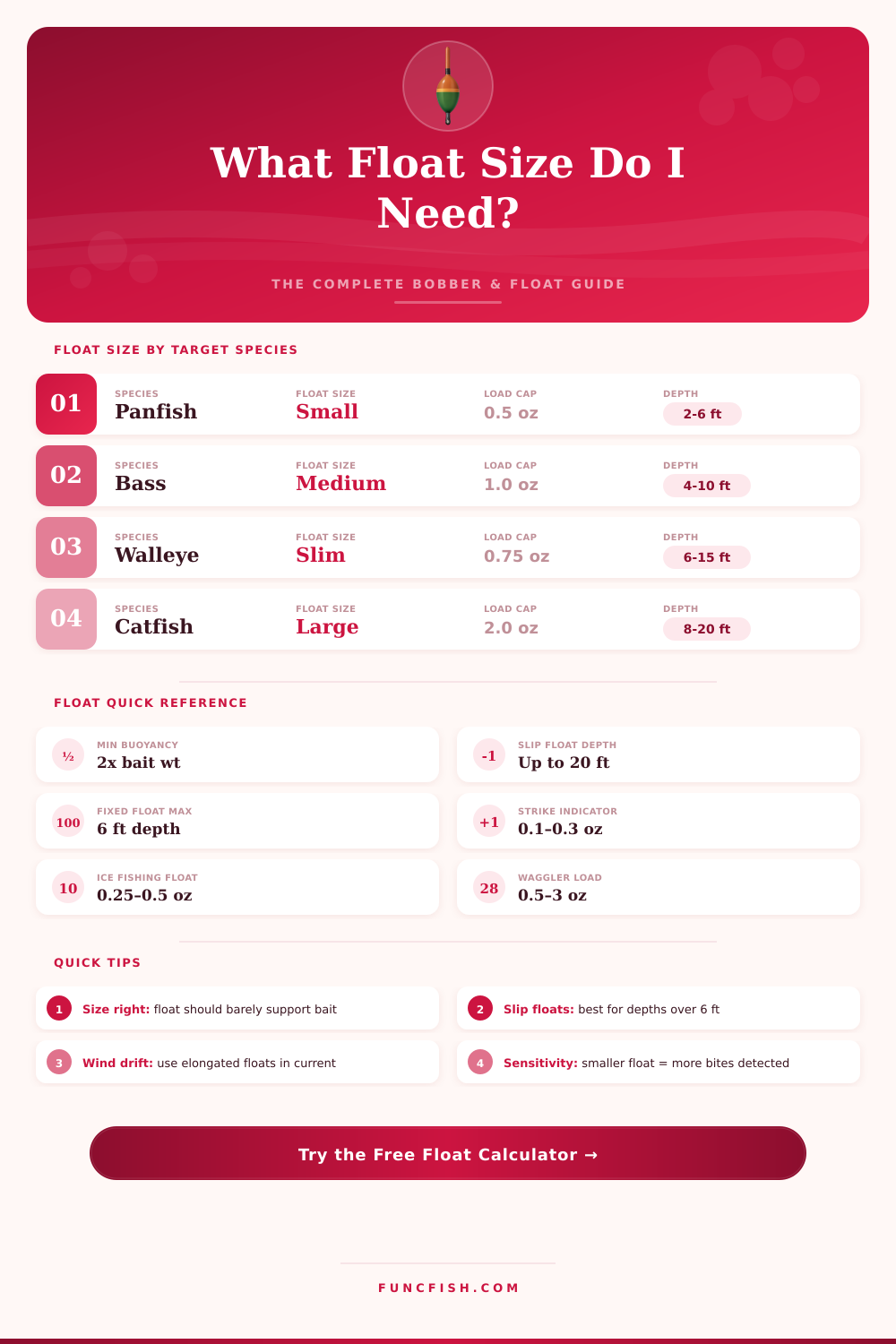
| Species | Float Type | Load Capacity (oz) | Load Capacity (g) | Rec. Depth (ft) | Line Test (lb) |
|---|---|---|---|---|---|
| Bluegill / Sunfish | Fixed Round / Strike | 0.25–0.5 | 7–14 | 2–6 | 4–6 |
| Crappie | Slip / Fixed | 0.25–0.75 | 7–21 | 4–12 | 4–8 |
| Largemouth Bass | Slip / Popping Cork | 0.5–1.5 | 14–43 | 4–12 | 10–17 |
| Smallmouth Bass | Slip / Cigar | 0.5–1.0 | 14–28 | 4–10 | 8–14 |
| Rainbow Trout | Waggler / Strike Ind. | 0.1–0.5 | 3–14 | 2–8 | 4–8 |
| Walleye | Slip Float | 0.5–1.0 | 14–28 | 8–20 | 8–12 |
| Channel Catfish | Fixed / Slip | 1.0–2.0 | 28–57 | 4–12 | 14–20 |
| Carp | Waggler / Slip | 0.75–3.0 | 21–85 | 6–15 | 10–17 |
| Northern Pike | Cigar / Slip | 1.5–4.0 | 43–113 | 3–10 | 17–30 |
| Muskie | Cigar / Large Slip | 3.0–6.0 | 85–170 | 3–8 | 30–50 |
| Float Diameter / Size | Approx. Load (oz) | Approx. Load (g) | Best Use | Water Type |
|---|---|---|---|---|
| 3/4 inch (19mm) | 0.1–0.2 | 3–6 | Ultra-light / Fly | Still / Slow |
| 1 inch (25mm) | 0.25–0.35 | 7–10 | Panfish / Light | Still |
| 1.25 inch (32mm) | 0.5–0.6 | 14–17 | Panfish / Trout | Still / Light current |
| 1.5 inch (38mm) | 0.75–1.0 | 21–28 | Bass / Walleye | Still / Moderate |
| 2 inch (51mm) | 1.25–1.75 | 35–50 | Bass / Catfish | Any |
| 2.5 inch (64mm) | 2.0–3.0 | 57–85 | Catfish / Pike | Any |
| 3 inch (76mm) | 3.0–5.0 | 85–142 | Large Live Bait | Any |
| Bait Type | Typical Weight (oz) | Typical Weight (g) | Hook Size Range | Float Multiplier |
|---|---|---|---|---|
| Waxworm / Maggot | 0.01–0.05 | 0.3–1.4 | #10–#14 | 2.0–2.5x |
| Fly / Nymph | 0.02–0.1 | 0.6–2.8 | #6–#16 | 2.0x |
| Salmon Egg / PowerBait | 0.05–0.15 | 1.4–4.3 | #8–#12 | 2.0–2.5x |
| Live Worm (half) | 0.1–0.2 | 2.8–5.7 | #6–#10 | 2.5x |
| Full Nightcrawler | 0.2–0.4 | 5.7–11.3 | #2–#8 | 2.0–2.5x |
| Small Minnow (2–3 in) | 0.2–0.4 | 5.7–11.3 | #4–#8 | 2.5–3.0x |
| Leech | 0.25–0.5 | 7.1–14.2 | #4–#8 | 2.0–2.5x |
| Cut Bait (chunk) | 0.5–1.5 | 14–43 | #1–#4 | 2.0x |
| Large Minnow (4–6 in) | 0.5–1.0 | 14–28 | #1/0–#3/0 | 3.0x |
| Sucker / Large Live Bait | 1.0–3.0 | 28–85 | #3/0–#5/0 | 3.0–3.5x |
Float fishing require that you find a balance between the buoyancy of the float and the weight of the fishing rig. A fishing rig consist of the float, weight (shot), the leader, and the bait on the hook. If the weight of the fishing rig are more than the buoyancy of the float, the float will submerge in the water.
If the buoyancy of the float is more than the weight of the fishing rig, the float will sit too high in the water. The two variable that you must balance are the buoyancy of the float and the weight of the bait and tackle attached to the float in order for the float to sit at a correct level in the water. The buoyancy of a float is the force that keep the float upright in the water.
How to Set Up a Float Fishing Rig
The buoyancy of the float must be strong enough to overcome the weight of the shot and the bait attach to the float. Furthermore, the buoyancy of the float must be strong enough to overcome the effect of the environment around the fishing spot. For instance, if the float does not have enough buoyancy to fight against the force of the wind or the current acting upon the float, the float will submerge into the water and become impossible to see.
If a float has too much buoyancy, however, it may be too difficult for the float to sink to the desired depth in the water, and the float may cause the bait to move in an unnatural way. The speed of the current and the wind will change the way that the float move in the water. In areas of the water where there is no current (like a pond), thin float can be used because there is no force acting upon the float.
In areas of the water where there is a current (like a river), different type of floats are required because the force of the current will act upon the float. Thin floats should not be used in areas of strong current because the strong current will pull the float underwater. Instead, stick floats should be used in areas of moving water because stick floats are able to slice through the water without the current pulling them underwater.
Additionally, if the area where you are fishing is exposed to the wind, oval-bodied float should be used in these locations because they are more stable in choppy water than thin floats are. The type of fish that you are fishing for will affect the type of float that you use. For instance, if you are fishing for trout, which live in areas of moving water, you should use stick floats so that the fish can see the bait.
If you are fishing for walleye, which live in deeper waters, you should use slip floats. The reason that stick floats are an option when fishing for species that live in deep water is that the bait can be allowed to sink to the bottom without being impacted by the water column above. The type of depth at which fish live will also impact the type of float needed for those fish.
Other variable to consider when setting up your float fishing rig are the placement of the shot on the fishing rig and the length of the leader attached to the float. If the shot is placed close to the hook, the bait will quickly sink to the bottom of the water column. Such a setup may not be ideal in areas of current.
If the shot is distributed along the fishing line, the bait will move in a more natural movement through the water. Additionally, the length of the leader determine the distance between the float and the bait. If you are fishing near structures on the bottoms of lakes and rivers, a short leader will allow the bait to closely approach these structures.
A long leader will allow the bait to move natural in currents caused by tidal movements. The type of fishing line will also impact the type of bait and floats that you use when float fishing. For instance, monofilament fishing line have some stretch to it.
Braided fishing line, on the other hand, has very little stretch to it. Therefore, if you use braided line, precision in the placement of the shot and the float is require. Finally, before you begin to fish with your float fishing rig, you should cast the line and observe how the float settle into the water.
If the float lists (leans) to one side or the other, or if it sinks to the bottom of the water column too quick, you should add more buoyancy to the float or remove some of the weight from the fishing rig. If the float remains too high in the water and the bait does not appear to sink to the desired depth, you should add more shot to the fishing rig or use a float that has less buoyancy than the one that you are currently using. Through adjusting the weight and the buoyancy of your float fishing rig, you can ensure that your rig settles into the correct depth of the water for the type of fish that you are trying to catch.