🐟 Popping Cork Calculator
Find your ideal cork size, leader length, hook size & line weight for any inshore target species
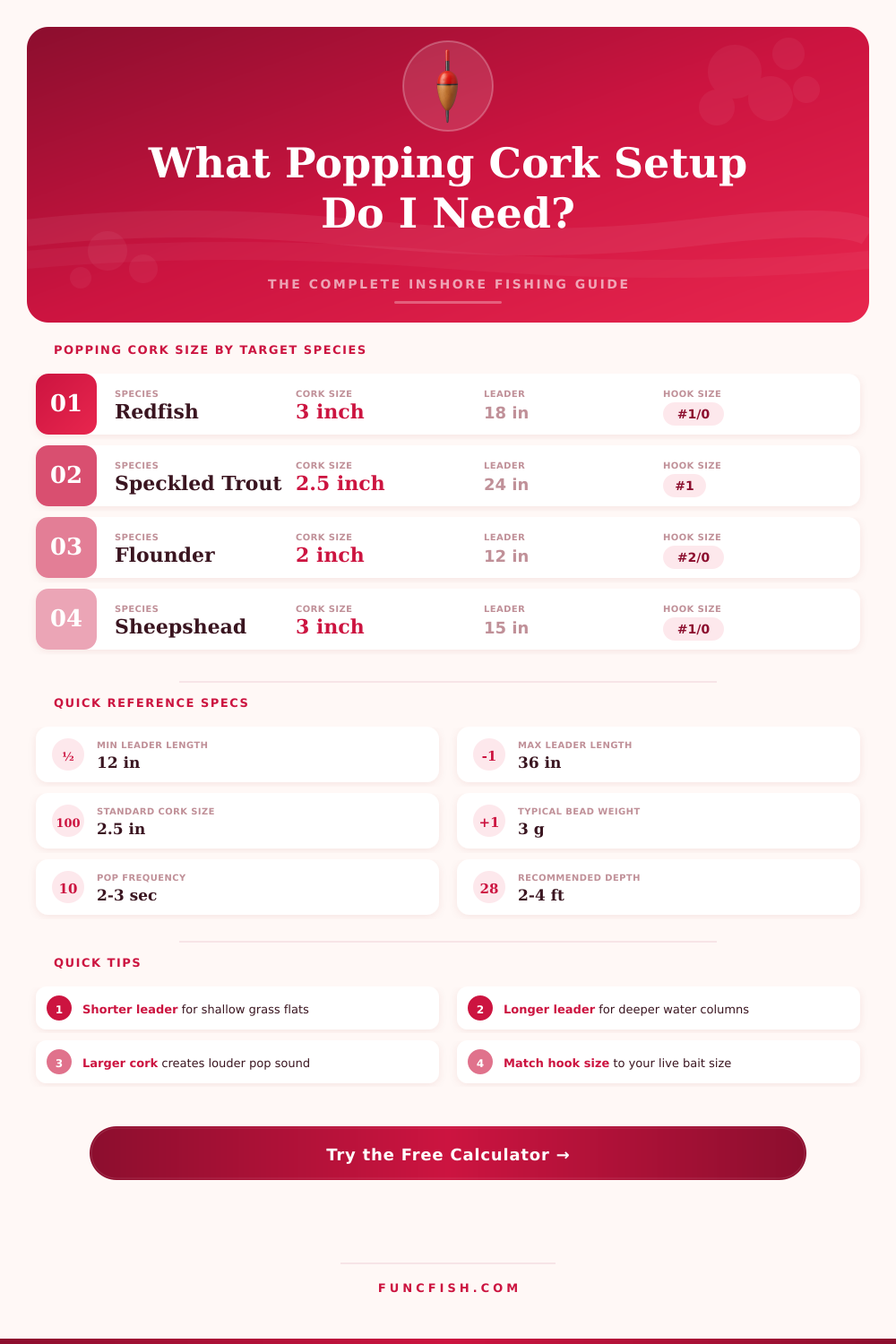
| Species | Typical Weight | Cork Size (in) | Leader Length (in) | Hook Size | Line Weight |
|---|---|---|---|---|---|
| Redfish | 2–15 lb | 2.5–3" | 15–24" | #1/0–#3/0 | 15–30 lb |
| Speckled Trout | 1–6 lb | 2–2.5" | 18–30" | #1–#2/0 | 12–20 lb |
| Flounder | 0.5–5 lb | 1.5–2.5" | 10–18" | #1–#2/0 | 12–20 lb |
| Sheepshead | 1–8 lb | 2.5–3" | 12–18" | #1/0–#2/0 | 15–25 lb |
| Snook | 3–20 lb | 3–3.5" | 24–36" | #2/0–#4/0 | 20–40 lb |
| Pompano | 0.5–3 lb | 1.5–2.5" | 15–24" | #1–#2/0 | 10–17 lb |
| Black Drum | 2–30 lb | 3–4" | 12–20" | #2/0–#4/0 | 20–40 lb |
| Striped Bass | 2–40 lb | 3–4" | 30–48" | #3/0–#5/0 | 25–50 lb |
| Crappie | 0.25–3 lb | 1–1.5" | 12–24" | #4–#8 | 4–10 lb |
| Water Depth | Depth (cm) | Recommended Leader | Leader (cm) | Notes |
|---|---|---|---|---|
| 1–2 ft | 30–60 cm | 10–14 in | 25–36 cm | Short leader, bait just off bottom |
| 2–3 ft | 60–90 cm | 14–20 in | 36–51 cm | Standard inshore setup |
| 3–5 ft | 90–150 cm | 18–28 in | 46–71 cm | Most common range |
| 5–8 ft | 150–244 cm | 24–36 in | 61–91 cm | Mid-column presentation |
| 8–12 ft | 244–365 cm | 30–48 in | 76–122 cm | Longer leader near structure |
| Cork Diameter | Diameter (cm) | Max Cast (ft) | Max Cast (m) | Best Conditions |
|---|---|---|---|---|
| 1 in | 2.5 cm | 30–40 ft | 9–12 m | Calm, finesse, panfish |
| 1.5 in | 3.8 cm | 40–55 ft | 12–17 m | Light wind, light tackle |
| 2 in | 5.1 cm | 50–65 ft | 15–20 m | Moderate wind, standard |
| 2.5 in | 6.4 cm | 60–80 ft | 18–24 m | Most versatile size |
| 3 in | 7.6 cm | 70–90 ft | 21–27 m | Wind, larger bait, distance |
| 3.5 in | 8.9 cm | 75–100 ft | 23–30 m | Heavy wind, big game |
A popping cork is a fishing tool that is used to float the bait and to make a sound. The sound that the popping cork make mimics the sound of a distressed baitfish that attracts the fish to the bait. You must make sure you select the correct popping cork for your fishing rig, as using the incorrect popping cork can lead to the rig getting tangled or drifting uselessly in the fishing area.
Several environmental factor will affect the selection of the popping cork. These factors include the water depth, water current, wind, and the size of the bait. The depth of the water will affect the weight that must suspend the bait beneath the popping cork.
How to Choose and Set Up a Popping Cork
The current in the water will affect the strength of the popping cork that is used as the strong current might stretch the fishing line in the direction of the current. The wind will affect the popping cork as the wind can push the fishing boat and the line. If the fishing area features strong winds, you will require a stronger popping cork.
The size of the bait will also affect the popping cork as large bait like mullets will create more drag in the water than smaller bait like shrimp. A popping cork load calculator can be used to calculate the appropriate strength of popping cork that should of been used with the bait, as well as to determine whether a standard popping cork or a rattle popping cork is necessary when using dirty water. The sound that the popping cork makes can differ according to the fish species being targeted.
For instance, trout that live in flats will be attracted to a popping cork that makes a soft sound with a longer pause between sounds. Redfish that live in grassy areas will be attracted to a popping cork that makes a sharper sound with a clacker popping cork. Snook fish will require a longer leader so that the bait does not prematurely pop the popping cork.
If the water features muddy bottoms, the angler should make the cadence of the popping cork louder to attract the fish. However, if the water is clear of mud, the popping cork should have a longer and more subtle cadence to match the visibility of the water. The length of the leader that is attached to the bait is another critical aspect of the fishing rig.
If the leader is too short, the bait will not reach the desired location in the water. If the leader is too long, the water current may bend the leader into the weeds. The length of the leader should allow the bait to land on the bottom of the water.
The type of fishing line that is used will also impact the fishing rig. For instance, if using monofilament line, the pops made by the popping cork may be lessened. Braided line will transmit the popping cork sounds crisp throughout the water.
The weight of the jig that is attached to the bait should match the strength of the popping cork. For calm, shallow waters, a light jig will work best. However, if the water features a current or tarpon fish, a heavier jig will be required for the bait to move through the water and stay in place.
If the jig is too heavy, the bait will stop moving in the water. Using too light of a jig will make the bait flutter too wildly in the water. The cadence of the popping cork is the number of seconds that there is between popping the cork.
For clear water, use a longer cadence. For murky water, use a short cadence so that the popping cork maintains contact with the fish in the water. Some of the mistakes when setting up the fishing rig may occur if the angler does not take into consideration the environment in which they are fishing.
For instance, if the current in the water increases, a standard popping cork may lay flat on the water. In this instance, a clacker popping cork may be a better option. If the area features strong winds, the angler will require a larger popping cork before they even adjusts the jig weight.
The strength of gear that is used will also affect the fishing rig when the angler is targeting specific fish species. For instance, trout gear may break when used to catch tarpon. Some of the best options for fishermen may be to use the presets that are made available for different types of fishing rigs.
These presets allow the angler to input various data about the fishing environment and the bait that is to be used. The preset will output a popping cork and leader recommendation. If the output suggests a low fit score, the angler must adjust the choice of popping cork and leader.
Finally, the angler will need to test the fishing rig to ensure that the popping cork stands tall on the water and the baits remains suspended at the desired depth.