🎣 High-Low Rig Calculator
Calculate ideal hook spacing, dropper lengths, sinker weight & leader specs for your bottom fishing setup
| Rig Component | Imperial | Metric | Notes |
|---|---|---|---|
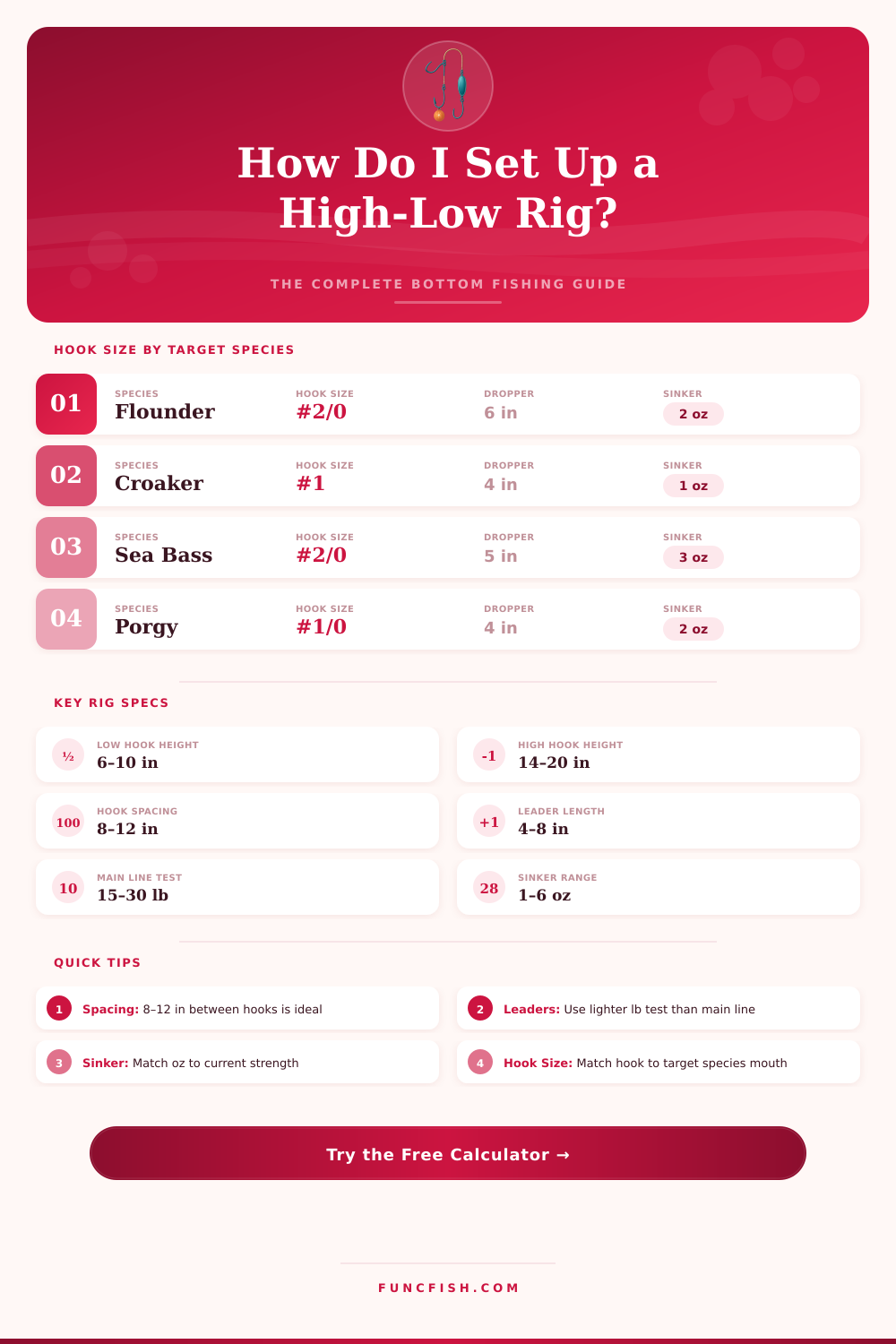
| Low Hook Height (from sinker) | 6 – 10 in | 15 – 25 cm | Just above bottom structure |
| High Hook Height (from sinker) | 14 – 22 in | 35 – 56 cm | Mid-water column |
| Hook Spacing (between hooks) | 8 – 12 in | 20 – 30 cm | Prevents tangle |
| Dropper / Branch Length | 4 – 8 in | 10 – 20 cm | Shorter in current |
| Total Rig Length | 24 – 36 in | 61 – 91 cm | From sinker to top swivel |
| Leader to Main Line Ratio | 70–80% of main | 70–80% of main | Break off at leader, not main |
| Species | Typical Weight | Rec. Hook Size | Sinker (oz) | Leader Test |
|---|---|---|---|---|
| Flounder | 1–5 lb (0.5–2.3 kg) | #1 – 2/0 | 1–3 oz | 15–20 lb |
| Croaker / Drum | 0.5–3 lb (0.2–1.4 kg) | #1 – 1/0 | 1–2 oz | 10–15 lb |
| Sea Bass | 1–6 lb (0.5–2.7 kg) | #2/0 – 3/0 | 2–4 oz | 15–20 lb |
| Porgy / Scup | 0.5–2 lb (0.2–0.9 kg) | #1/0 – 2/0 | 2–3 oz | 10–15 lb |
| Redfish | 3–12 lb (1.4–5.4 kg) | #2/0 – 4/0 | 3–5 oz | 20–30 lb |
| Catfish | 2–20 lb (0.9–9 kg) | #2/0 – 5/0 | 2–4 oz | 20–30 lb |
| Whiting / Kingfish | 0.5–2 lb (0.2–0.9 kg) | #1 – 2 | 1–3 oz | 10–15 lb |
| Striped Bass | 5–30 lb (2.3–13.6 kg) | #3/0 – 6/0 | 3–6 oz | 25–40 lb |
| Yellow Perch | 0.25–1 lb (0.1–0.45 kg) | #6 – #1 | 0.5–1 oz | 6–10 lb |
| Snapper | 2–15 lb (0.9–6.8 kg) | #2/0 – 4/0 | 3–6 oz | 20–30 lb |
| Line Type | Stretch | Visibility | Abrasion Resistance | Best Use |
|---|---|---|---|---|
| Monofilament | 15–30% | Medium | Good | General bottom fishing |
| Braided Line | <5% | High | Excellent | Deep water, strong current |
| Fluorocarbon | 5–10% | Very Low | Excellent | Clear water leader |
| Copolymer | 10–20% | Low–Med | Very Good | Surf, general use |
Always keep at least 8 inches (20 cm) between hooks to prevent tangling during casts and retrieves. In strong current, increase spacing to 12–14 inches (30–36 cm) and shorten dropper lengths to reduce spin and twist.
Use pyramid sinkers in surf conditions for better sand grip, and bank/egg sinkers in boat or pier situations where you want some drift. Add 1 oz per knot of current speed as a starting point. For depths over 40 ft (12 m), increase sinker weight by 50% to maintain bottom contact.
A high-low rig is a type of fishing rig that use a double drop to allow for two bait to work in separate lanes over the bottom. This type of fishing rig will increase the chances of catching a fish due to the fact that there are two baits in the water. However, if matched with wrong conditions in the water, the high-low rig will become entangled in the bottom or the baits wont effectively attract fish.
The conditions of the water will play a key role in how the high-low rig will function in the water. In areas where there is a strong surge or current in the water, the sinker should be one that will firm plant itself to the bottom of the water so that it dont roll. In more calm waters, the snoods can be longer.
How to Set Up a High-Low Rig
Strong currents will cause the snoods to tighten. Additionally, if there is a strong current, the hooks will sweep into each other if not properly managed. If the water is stained or not clear of debris, the high-low rig should be constructed in a compact fashion.
If the water is clear, the baits will flutter further out into the water. The type of bottom in the water will play a key role in what type of sinker to use. For sand bottoms, egg sinkers will glide on the sand.
For rubble or rocky bottoms, the egg sinker will snag on the rock. For shells, you should use gripper or specific sinker shapes so that the shells wont shred the trace line. For weed bed, the top snoods should be longer to keep the hooks clear of the stems of the weeds.
The type of bait to be used with a high-low rig will impact the type of hook to use with the rig. For slim bait like sandworms, fine-wire hook should be used. For larger baits like pilchard or crab, there should be wider gap between the hooks for the bait to have space to move.
Additionally, if using live bait, circle hooks will rotate on the drop to catch the live bait. Baitholders will grip the soft bait strip to avoid them from tearing off the hook. The specific location where the high-low rig is to be fished will play a role in the construction of that high-low rig.
For example, for surf beaches, heavy surf star are used to ensure the surf does not sweep the high-low rig away. On a surf beach, the snoods should be seven to ten inch apart. For pier fishing, the sinkers are lighter and the top branches of the snoods are shorter.
For jetty fishing, people use pyramid sinkers and circle hooks since the jetties may contain rock abrasion and surge. For boat fishing, traces can be longer. For areas where kayak fishing will occur, the high-low rig should be compact so that it will not get entangled with the kayaks paddle.
The material of the trace line used in a high-low rig can impact the rigs success. Fluorocarbon is good for use near shells since it resists abrasion more better than other types of fishing line. For common fishing line, monofilament will be used, but sharp edge in the bottom can damage it.
For cutting through currents, braided fishing line can be used. However, abrasion leader will be needed since rocks in the bottom can cut braided fishing line. The assembly of the high-low rig requires the creation of a loop in the mainline of the fishing line.
The sinker drop should be crimp first, followed by the use of uni-knots to connect the snoods of the baits at calculated lengths. Prior to setting the high-low rig into the water, you should check the sharpness of the hooks by feeling the point of the hook with the thumb. If the high-low rig becomes snagged on the bottom, the bottom snood should be yanked to remove the rig from the bottom since the bottom snood will pop out more easy than the sinker.
If the high-low rig is balanced to the type of surge in the water and the type of bottom in the area where it will be fished, the high-low rig will function in the water correct, increasing the chances of catching fish with the rig.