🎣 Paternoster Rig Calculator
Calculate hook spacing, dropper length, sinker weight & total leader length for your bottom fishing rig
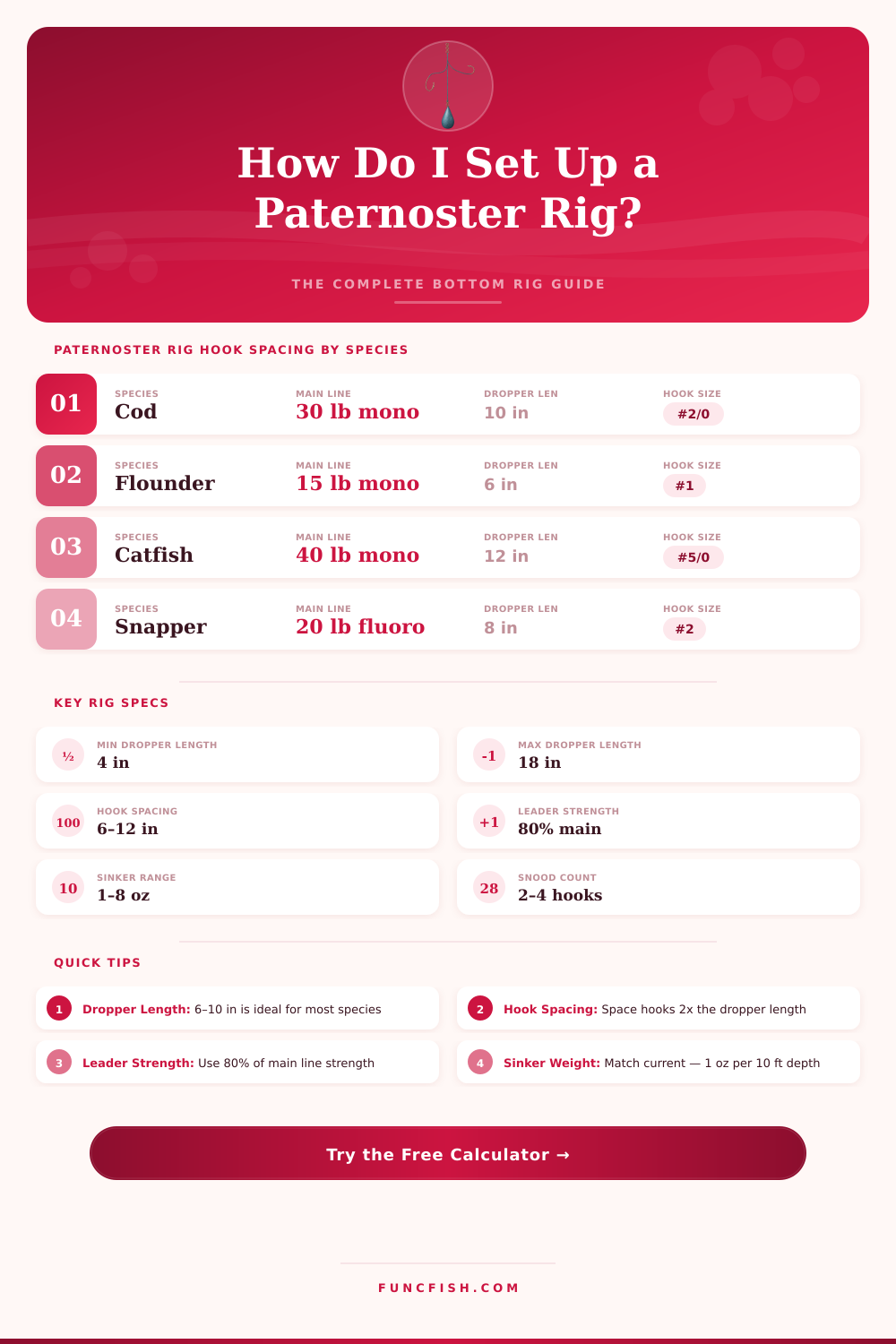
| Species | Main Line | Dropper Length | Hook Size | Sinker (oz) | No. Hooks |
|---|---|---|---|---|---|
| Cod | 25–35 lb mono | 8–12 in (20–30 cm) | 2/0 – 4/0 | 3–6 | 2–3 |
| Flounder | 12–17 lb mono | 5–8 in (13–20 cm) | #1 – 1/0 | 1–3 | 2 |
| Catfish | 30–50 lb mono | 10–15 in (25–38 cm) | 5/0 – 8/0 | 2–6 | 2–3 |
| Red Snapper | 17–25 lb fluoro | 7–10 in (18–25 cm) | #2 – 2/0 | 2–5 | 2–3 |
| Striped Bass | 15–20 lb mono | 6–9 in (15–23 cm) | 1/0 – 3/0 | 2–4 | 2–3 |
| Whiting | 10–15 lb mono | 4–6 in (10–15 cm) | #4 – #1 | 1–2 | 2–4 |
| Sea Bream | 8–12 lb mono | 4–7 in (10–18 cm) | #6 – #2 | 1–2 | 2–3 |
| Haddock | 17–25 lb mono | 8–10 in (20–25 cm) | #1 – 2/0 | 3–6 | 2–3 |
| Walleye | 10–14 lb fluoro | 5–8 in (13–20 cm) | #4 – #1 | 0.5–2 | 1–2 |
| Pike | 25–35 lb wire/braid | 8–12 in (20–30 cm) | 4/0 – 6/0 | 2–5 | 2 |
| Line Type | Diameter | Stretch | Abrasion Resistance | Best Use | Break Strength |
|---|---|---|---|---|---|
| Monofilament | 0.28–0.55mm | 15–30% | Good | All-round paternoster | 10–40 lb |
| Fluorocarbon | 0.25–0.45mm | 5–10% | Very Good | Clear water leaders | 10–30 lb |
| Braided Line | 0.12–0.30mm | <5% | Moderate | Deep water / sensitivity | 15–80 lb |
| Wire (7-strand) | 0.30–0.60mm | <1% | Excellent | Pike / sharp-toothed fish | 20–60 lb |
| Coated Wire | 0.35–0.65mm | <2% | Excellent | Toothy species leaders | 20–50 lb |
| Dacron | 0.30–0.50mm | Good | Offshore / heavy rigs | 20–80 lb |
| Condition | Depth (ft) | Depth (m) | Sinker (oz) | Sinker (g) | Notes |
|---|---|---|---|---|---|
| Still / Lake | 5–15 | 1.5–4.5 | 0.5–1.5 | 14–43 | Light sinker OK |
| Still / Lake | 15–40 | 4.5–12 | 1–3 | 28–85 | Standard sinker |
| Light Current | 5–20 | 1.5–6 | 1–2 | 28–57 | Add 25% over still |
| Moderate Current | 10–30 | 3–9 | 2–4 | 57–113 | Add 50% over still |
| Strong Current | 10–40 | 3–12 | 4–8 | 113–227 | Add 100% over still |
| Offshore Deep | 60–200 | 18–61 | 6–16 | 170–454 | Current + depth |
A paternoster rig consist of a sinker, a top leader, and droppers that holds the baits. Anglers use a paternoster rig to present the baits to the fish that lives near the bottom. The rig work best when the sinker holds the paternoster rig in place and the droppers lift the baits above the bottom.
If the paternoster rig’s spacing are incorrect, the rig might tangle or the bottom will smother the baits. You must find the right balance between the sinker and dropper lengths for the paternoster rig to function correct. The sinker’s weight is essential to hold the paternoster rig against the current and depth of the water.
How to Set Up a Paternoster Rig
Using a sinker that is too heavy will bury the baits into the bottom of the water. Using one that is too light will cause the paternoster rig to not hold the rig in place and drift with the tide. The lengths of the droppers is essential to determine how far each bait is from the bottom of the water.
The top leader keep the hooks from crowding the sinker and helps to lay the paternoster rig flat on the bottom of the water. The species of fish requires different configuration of paternoster rigs. For example, bream require short droppers because they use smaller baits like prawns and worms.
However, trevally and catfish requires firmer setups because they use larger baits like cut bait and squid strips. Depending on the type of bottom of the water also will affect the paternoster rig. For example, a sand bottom will require a lighter sinker than a rocky or reef bottom, which will require bank sinkers.
Using larger baits will require more space for the baits to not get buried in the bottom of the water. For instance, a slim worm will work best with 6 to 8-inch droppers. However, using a large piece of crab bait will require more lift so it doesnt get buried in the mud.
A tool will calculate the components of the paternoster rig. The tool will calculate the sinker, dropper, and top leader lengths. Additionally, the tool will take into account the line class that will be used for the paternoster rig.
Using a heavier line class will provide more strength for snagging areas but will make the line more rigid. If the anglers set the parameters for fishing for perch in a harbor with sand flats and light current the paternoster rig will come to 1 to 2 ounce ball sinkers and 10 inch droppers. A score will be given for the rig to ensure it is balanced.
A score of 80 and above mean the paternoster rig is in harmony. Below 60 means it is a mismatch for the fish. There are adjustments that can be made to the paternoster rig.
For instance, if the bottom is smothering the baits then the droppers can be shortened. If the current in which the anglers is casting the paternoster rig in is strong the droppers will naturaly tighten. For rough bottoms break out sinkers or bank sinkers will increase the grip of the sinker on the bottom.
Using bank sinkers a longer top leader should be used. Additionally, if the baits are too bulky for the paternoster rig they can be trimmed or the hook style change. Some common mistakes with paternoster rigs include not considering the changes in the current in which the anglers is fishing because this could cause the droppers to tangle.
Another mistake is to ignore the bulk of the bait. This could cause issue when the bait is too large for the space between the baits and the bottom. Additionally, the anglers must test the top leader to make sure it is long enough for the baits so the sinker doesnt tangle the hooks.
Using reference tables will help anglers understand the different shape of sinkers. For instance, torpedo sinkers will cut through the current but ball sinkers are better for soft sand bottoms. Another way to determine if the paternoster rig is balanced is by watching the rod tip.
A steady pulse indicate the paternoster rig is balanced but wild bounces mean there is too much weight or too many droppers on the paternoster rig. Using paternoster rigs in estuaries should start with a conservative setup because the tides change frequent in these areas. If the paternoster rig is dialed in correct each bait will hover separately in the strike zone when fishing with this rig.