🐟 Mooching Rig Calculator
Calculate sinker weight, leader length, hook spacing & line strength for salmon mooching rigs
| Species | Typical Weight | Rec. Main Line | Rec. Leader | Hook Size | Depth Range |
|---|---|---|---|---|---|
| Chinook (King) | 15–60 lb (6.8–27 kg) | 25–40 lb | 20–30 lb | 3/0–5/0 | 40–150+ ft |
| Coho (Silver) | 6–20 lb (2.7–9 kg) | 15–25 lb | 12–20 lb | 1/0–3/0 | 20–80 ft |
| Pink Salmon | 3–8 lb (1.4–3.6 kg) | 10–17 lb | 8–15 lb | 1–2/0 | 15–60 ft |
| Sockeye (Red) | 5–15 lb (2.3–6.8 kg) | 15–20 lb | 12–17 lb | 1–2/0 | 20–80 ft |
| Chum (Dog) | 7–25 lb (3.2–11 kg) | 17–30 lb | 15–25 lb | 2/0–4/0 | 20–80 ft |
| Steelhead | 5–20 lb (2.3–9 kg) | 15–25 lb | 12–20 lb | 1–3/0 | 15–70 ft |
| Pacific Halibut | 20–200+ lb | 40–80 lb | 30–60 lb | 5/0–9/0 | 80–300 ft |
| Bait Type | Typical Length | Hook Spacing | Leader Length | Action | Best For |
|---|---|---|---|---|---|
| Whole Herring | 4–7 in (10–18 cm) | Bait length – 1 in | 4–6 ft | Slow roll | Chinook, Coho |
| Cut Plug Herring | 3–6 in (8–15 cm) | 2–3 in fixed | 3–5 ft | Tight spin | Chinook, Coho |
| Whole Anchovy | 3–5 in (8–13 cm) | 2.5–3.5 in | 3–5 ft | Erratic roll | Coho, Sockeye |
| Sardine | 4–8 in (10–20 cm) | 3–5 in | 4–6 ft | Slow roll | Chinook, Halibut |
| Sand Lance | 3–6 in (8–15 cm) | 2–3 in | 3–4 ft | Natural drift | Coho, Pink |
| Squid | 4–8 in (10–20 cm) | 3–5 in | 4–6 ft | Fluttering | Halibut, Chinook |
| Artificial Bait | 3–5 in (8–13 cm) | Per lure design | 2–4 ft | Variable | All species |
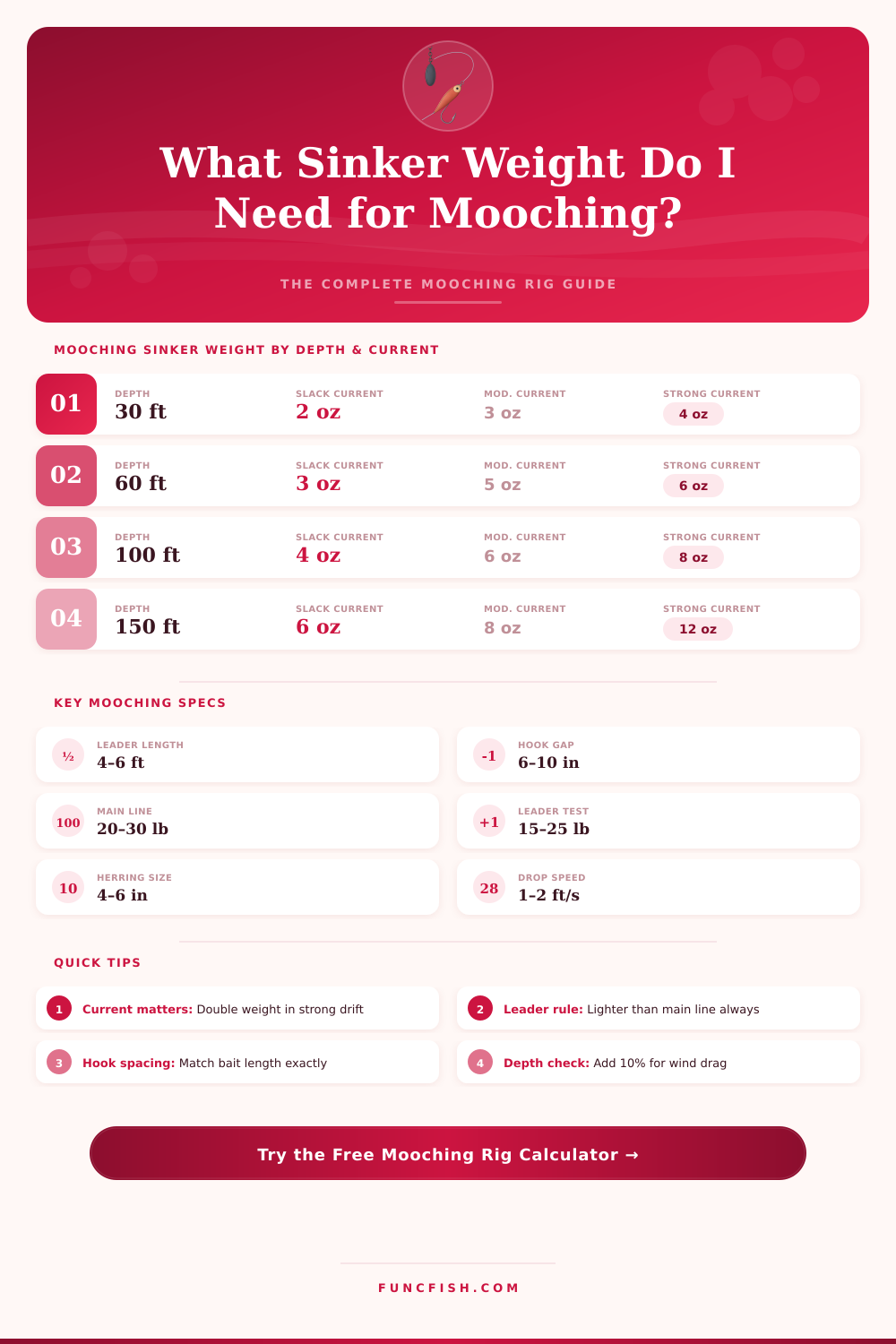
| Current | 30 ft Depth | 60 ft Depth | 100 ft Depth | 150 ft Depth | Metric Equiv. |
|---|---|---|---|---|---|
| Slack | 1–2 oz | 2–3 oz | 3–4 oz | 4–6 oz | 28–170 g |
| Light | 2–3 oz | 3–4 oz | 4–5 oz | 5–7 oz | 57–198 g |
| Moderate | 3–4 oz | 4–6 oz | 6–8 oz | 8–10 oz | 85–284 g |
| Strong | 4–6 oz | 6–8 oz | 8–12 oz | 12–16 oz | 113–454 g |
| Very Strong | 6–8 oz | 8–12 oz | 12–16 oz | 16–24 oz | 170–680 g |
Mooching are a fishing method for salmon that involve allowing the current and the boat to move a baited fish through the water. Finding the right balances for the fishing rig is critical for mooching success. The sinker for mooching lines must be light enough so that the bait dont drift too deep into the water.
However, if the sinker is too light, the bait will not remain in a proper depth. Using too much weight with the sinker will make the sinker feel like dead weight attached to the fishing line and will make it hard for fisherman to feel when the salmon bite. The strength of the current are another primary factor in determining the weight that should be incorporated into the mooching fishing rig.
How to Set Up a Mooching Rig for Salmon
If the current in the fishing spot is slack, then a light sinker weighing two ounce can be used. If the tide is more strong, a heavier sinker is required to allow the sinker to “punch” through the water current. If the sinker is not heavy enough for strong tides, the fishing rig will balloon out in the water and the bait will drift in a manner that will make mooching difficultly.
The length of the leader for mooching lines and the spacing of the droppers also depend on the condition of the water. If mooching in calm bays with no tide, then the leader should be longer to allow the bait to swing in a wide arc. For channels that experience strong currents, the leader should be shorter so mooching fisherman can fight the lift of the fishing line caused by the strong currents.
Additionally, the spacing of the droppers must also be managed proper so that the hook will not tangle with the main lead of the fishing line. If the spacing of the droppers is not managed proper, the drag of the bait will pull the fishing line sideways, creating tangling of the line. Different species of salmon requires different configurations of fishing rigs.
Coho salmon prefer bait that rolls in the middle of the water column, so using a compact fishing rig for this species will entice the fish to bite. Chinook salmon live in deeper waters, so using a heavier fishing rig that maintains contact with the sea floor will ensure that the salmon will be caught. For sockeye salmon, using a finesse fishing rig will allow the bait to remain cautiously in shallow waters while still enticing the salmon to consume the bait.
The environment in which you are fishing also play a role in the configuration of the fishing rig. If the water is clear, using a longer fishing line will allow the bait to remain hidden from the view of the salmon. In stained waters, shorter fishing lines will work because the salmon are less wary of the fishing line.
The effects of the wind on the water’s surface also affect the fishing rig. If the wind is lifting the fishing rig, adding more weight to the sinker will help keep the bait at the desired depth. Another factor to consider is the fishing rod angle to ensure that the rig is balanced proper.
If the rod angle is too vertical, it means that the sinker is too light for the bait, and you should add more weight. If the angle is too flat, the sinker is too heavy for the bait, so a light sinker should be used. By monitoring the rod angle and the weight of the sinker, you ensure that the bait move in a helix in the water due to the movement of the current.