🔱 Speargun Shaft Calculator
Find the ideal shaft diameter, length, and material for your spearfishing setup
| Material | Tensile Strength | Weight (per 100cm @ 7mm) | Corrosion Resistance | Best Application |
|---|---|---|---|---|
| Stainless Steel 316 | 485 MPa | ~298g | Excellent | General reef & coastal |
| Hardened Stainless | 690 MPa | ~305g | Good | High-impact reef |
| Carbon Steel (Tempered) | 900 MPa | ~302g | Moderate | Big game / pelagic |
| Inconel Alloy | 620 MPa | ~340g | Superior | Saltwater big game |
| Titanium Alloy (Grade 5) | 950 MPa | ~175g | Outstanding | Ultra-deep / bluewater |
| Spring Steel | 1100 MPa | ~308g | Low (needs coating) | Maximum penetration |
| Duplex Stainless | 620 MPa | ~310g | Superior | Deep reef / wreck |
| Carbon Fiber Core | 700 MPa | ~140g | Excellent | Distance shooting |
| Species | Typical Weight | Recommended Dia. | Min Shaft Length | Suggested Material |
|---|---|---|---|---|
| Small Reef Fish (Wrasse, Damsel) | 0.3–1.5 kg / 0.7–3.3 lb | 6mm / 0.24 in | 60cm / 24 in | Stainless 316 |
| Snapper (various) | 1–8 kg / 2–18 lb | 7mm / 0.28 in | 90cm / 35 in | Stainless 316 |
| Grouper | 5–20 kg / 11–44 lb | 7.5–8mm | 100cm / 39 in | Hardened Stainless |
| Mahi-Mahi (Dorado) | 5–25 kg / 11–55 lb | 8mm / 0.31 in | 110cm / 43 in | Carbon Tempered |
| Wahoo | 10–45 kg / 22–99 lb | 8.5–9mm | 130cm / 51 in | Carbon / Titanium |
| Yellowfin Tuna | 20–100 kg / 44–220 lb | 9mm / 0.35 in | 150cm / 59 in | Titanium / Carbon |
| Amberjack | 5–30 kg / 11–66 lb | 8.5–9mm | 120cm / 47 in | Carbon Tempered |
| Cobia | 5–35 kg / 11–77 lb | 8–9mm | 130cm / 51 in | Carbon / Inconel |
| Marlin / Sailfish | 50–200 kg / 110–440 lb | 9.5mm / 0.37 in | 160cm / 63 in | Titanium / Spring Steel |
| Gun Barrel Length | Recommended Shaft Length | Overhang (front) | Overhang (rear) | Visibility Range |
|---|---|---|---|---|
| 60cm / 24 in | 90–95cm / 35–37 in | 20cm / 8 in | 10–15cm / 4–6 in | 1–2m |
| 75cm / 30 in | 105–110cm / 41–43 in | 20cm / 8 in | 10–15cm | 1.5–2.5m |
| 90cm / 35 in | 120–125cm / 47–49 in | 20–25cm / 8–10 in | 10–15cm | 2–3m |
| 110cm / 43 in | 145–150cm / 57–59 in | 25cm / 10 in | 10–15cm | 3–4m |
| 130cm / 51 in | 165–170cm / 65–67 in | 25–30cm / 10–12 in | 10–15cm | 3.5–5m |
| 150cm / 59 in | 185–195cm / 73–77 in | 30cm / 12 in | 10–15cm | 4–6m |
A speargun shaft must be correctly matched to an speargun and the rubber bands. If the shaft are not correctly matched, the speargun will cause the shaft to bending or flex during flight. If the shaft flexes too much during flight, the shaft will not be able to travel in a straight lines to its target.
To achieve accuracy with a speargun, the lengths, diameter, and mass of the shaft must be balanced. The length of the shaft is dependent upon the length of the barrel for the speargun and the distance at which the fishes will be targeted. The length of the shaft should extend past a muzzle of the speargun barrel by 30 centimeters.
How to Choose the Right Speargun Shaft
Using a shaft that is too long may cause the tail of the shaft to bend when launch from the speargun. Using a shaft that is too short may prevent the speargun from being able to hit the fish at the desired distance. If hunting for fish in caves, using a shorter shaft will provide more control over the speargun shaft.
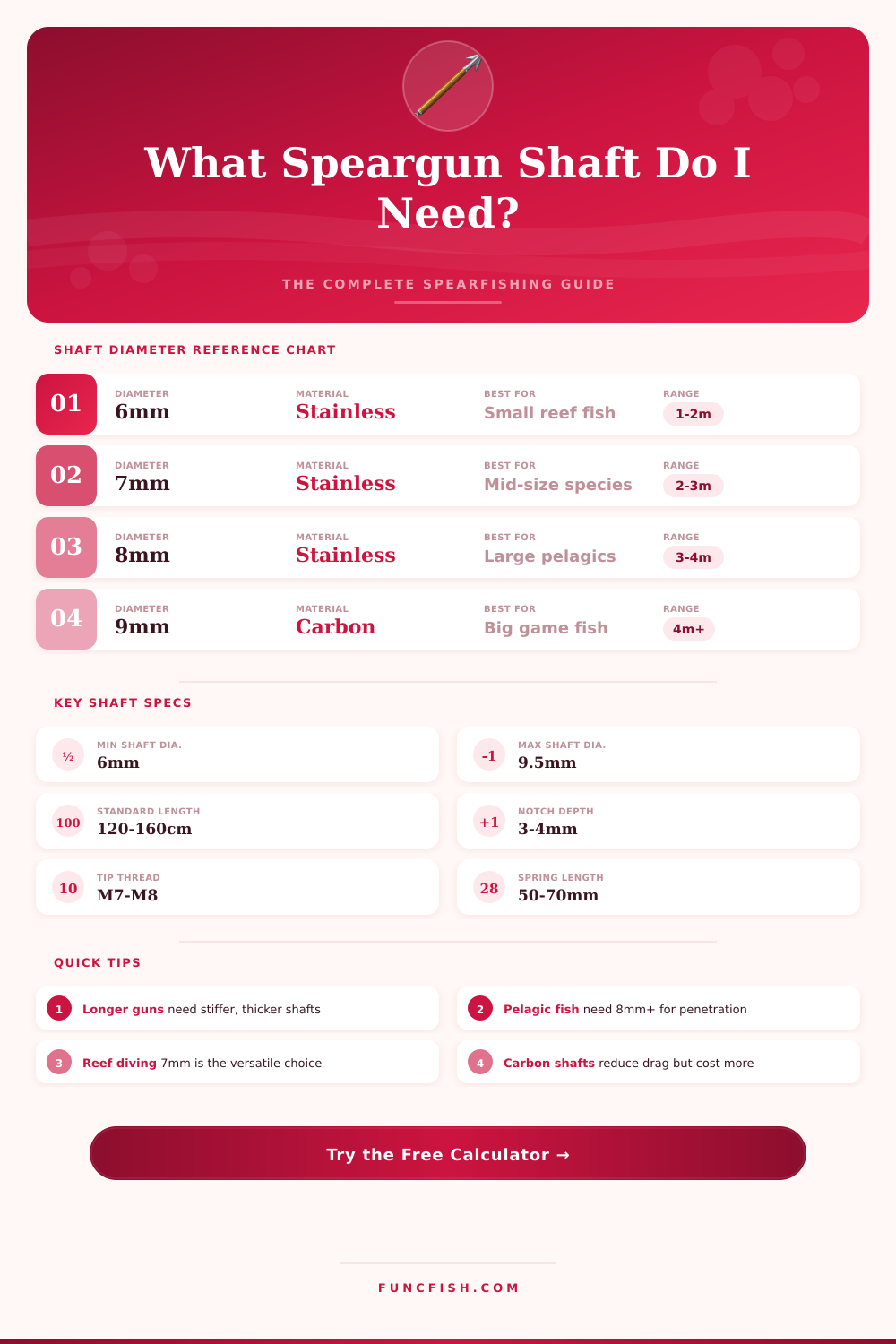
However, using a speargun to hunt for fish in open water will require a shaft that are longer to provide the reach necessary to hit the fish. The diameter of the speargun shaft is dependent upon the power of the rubber bands for the speargun. If the shaft is to be thin, such as 6.5 millimeter shafts, the shaft will travel more easily through the reefs where fish lives.
Additionally, 6.5 millimeter shafts is best for spearguns with one or two rubber bands. To hunt for large fish, the diameter of the speargun shaft should be more thick, such as 7 millimeter shafts or thicker. Using more rubber bands to provide the power to shoot the speargun will require more power to be transfer to the shaft.
Large fish require more power to be speared. Using a thicker shaft will allow the speargun to absorb more power from the rubber bands without bending the speargun shaft. The type of track for the shaft can also impact the diameter of the shaft.
Using open rail tracks will allow the speargun shaft to move slightly within the speargun. Using a shaft with open rail tracks will require a shaft with a thicker diameter. For enclosed tracks, the shaft will be held more tightly within the speargun.
Using enclosed tracks will allow for the shaft to have a thinner diameter. The rubber bands for the speargun will determine the force that the speargun shaft will absorb. If using heavy rubber bands for the speargun but using a shaft that is too light, the shaft will fishtail when launched from the speargun.
The shaft must absorb the tension from the rubber bands without flexing or bending in midair. The stretch of the rubber bands will determine the force that the speargun shaft will absorb. Matching the rubber bands with the speargun shaft will allow for the shaft to remain stably during flight.
The environment in which the speargun will be used and the type of fish that will be targeted will dictate the type of shaft that is used for the speargun. If hunting for fish in reefs and clear water, a light shaft can be used. The fish in reefs do not require as much penetration by the shaft.
However, to hunt for large fish in deep water, a long and heavy shaft will be required to fight against the water currents and to penetrate the scales of the large fish. Additionally, the type of tip for the speargun shaft will change the mass of the shaft. Using a flopper tip for the shaft will add very little mass to the shaft.
Using a slip tip for the shaft will add more mass to the shaft. Using a slip tip will require the shaft to have a stiff shaft to maintain its trajectory. Many people makes mistakes when choosing the shaft for their speargun.
Many may choose a shaft that is very long but uses not enough rubber bands for the speargun to provide enough force for the shaft to travel in a straight line to its target. Using very heavy rubber bands on a thin shaft will result in the thin shaft bowing under the rubber bands’ tension. To avoid these types of mistakes, test the speargun in open water to ensure that the shaft vibrates or flies straight.
There are a few different preset combinations for the shaft, the diameter, the length of the barrel, and the rubber bands that can be used for the speargun. For individuals who will be hunting for fish in reefs, using a 6.5 millimeter shaft on a 90-centimeter barrel with two 14-millimeter rubber bands may be best for accuracy. For those who will be hunting for large fish in the ocean, a 7.5 millimeter shaft or a thicker shaft with three 16-millimeter rubber bands may be the best option.
For those who use a heavy shaft, the vibrations from the rubber bands will be reduce. However, using a heavy shaft will slow the speargun reload process. Using a light speargun shaft will allow the speargun to be reloaded more quickly.
However, if the rubber bands for the speargun are too powerful, the light shaft will lose accuracy when aim at the target.