⛵ Boat Trailer Turning Radius Calculator
Calculate minimum turning clearance for any boat trailer setup — single or tandem axle, any hitch configuration
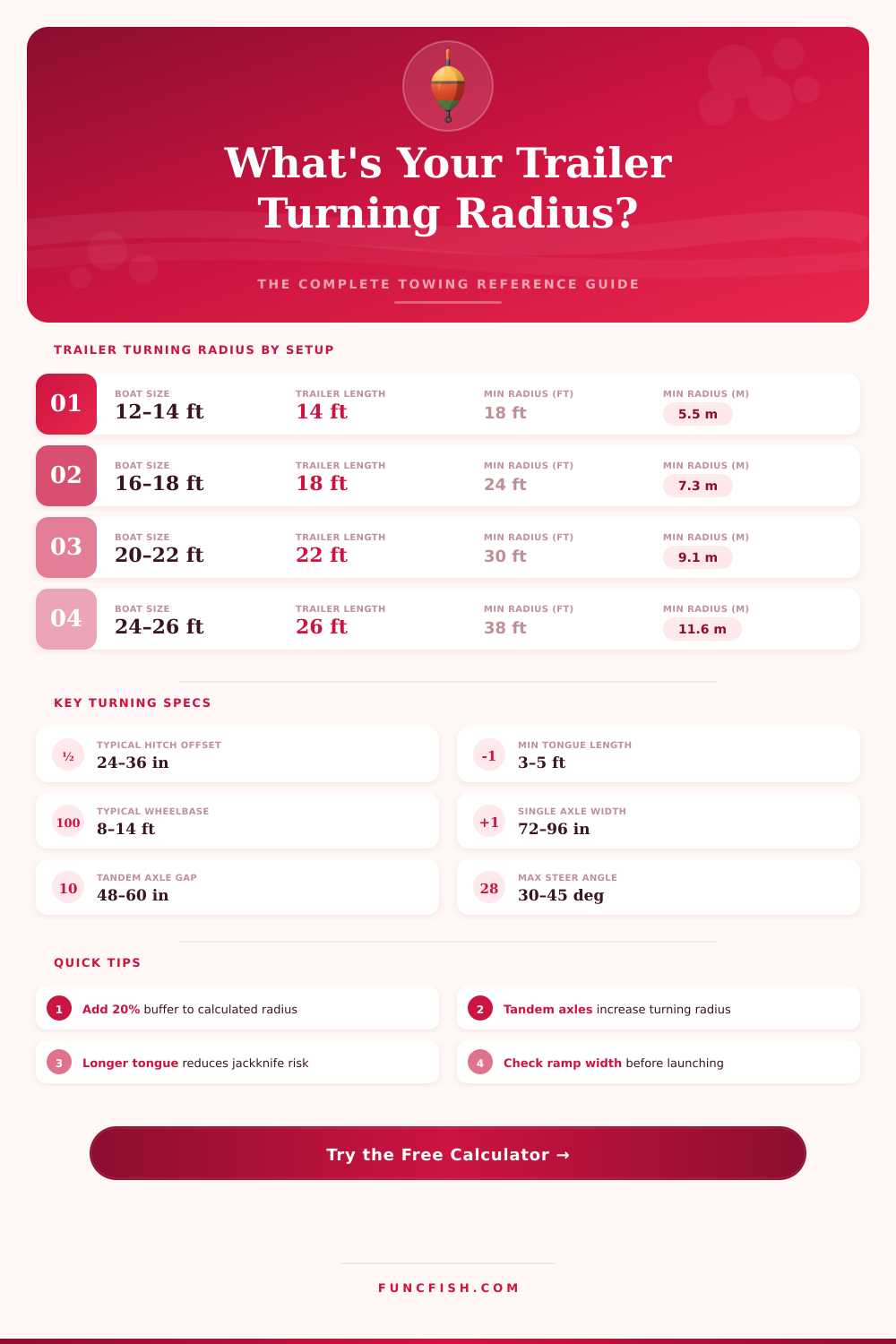
| Boat Length | Trailer Length | Min Radius (ft) | Min Radius (m) | Axle Type |
|---|---|---|---|---|
| 10–12 ft | 12–14 ft | 16–20 ft | 4.9–6.1 m | Single |
| 14–16 ft | 16–18 ft | 20–25 ft | 6.1–7.6 m | Single |
| 18–20 ft | 20–22 ft | 25–30 ft | 7.6–9.1 m | Single/Tandem |
| 20–22 ft | 22–24 ft | 28–34 ft | 8.5–10.4 m | Tandem |
| 22–24 ft | 24–26 ft | 32–38 ft | 9.8–11.6 m | Tandem |
| 25–28 ft | 27–30 ft | 38–46 ft | 11.6–14.0 m | Tandem/Triple |
| 28+ ft | 30+ ft | 45+ ft | 13.7+ m | Triple |
| Trailer Style | Typical Width | Tongue Length | Turning Factor | Best For |
|---|---|---|---|---|
| Standard Bunk | 66–80 in | 3–4.5 ft | 1.0x (baseline) | Most powerboats |
| Roller Trailer | 60–76 in | 3–4 ft | 1.0x | V-hull, deep-V |
| Float-On | 72–96 in | 4–6 ft | 1.05x | Pontoon, flat-bottom |
| PWC / Jet Ski | 48–60 in | 2–3 ft | 0.9x | Personal watercraft |
| Catamaran | 84–108 in | 4–6 ft | 1.10x | Multi-hull boats |
| Gooseneck | 72–96 in | 6–10 ft | 0.85x | Large/heavy vessels |
| Enclosed Trailer | 72–96 in | 4–5 ft | 1.08x | Specialty/racing boats |
| Flatbed Custom | 72–102 in | 3–5 ft | 1.05x | Commercial/large boats |
| Ramp Type | Typical Width (ft) | Typical Width (m) | Max Trailer Width | Notes |
|---|---|---|---|---|
| Single-Lane Ramp | 12–14 ft | 3.7–4.3 m | 8 ft / 96 in | One vehicle at a time |
| Double-Lane Ramp | 24–28 ft | 7.3–8.5 m | 10 ft / 120 in | Two lanes, busy marinas |
| Wide Marina Ramp | 30–40 ft | 9.1–12.2 m | 12 ft / 144 in | Commercial facilities |
| Private / Narrow | 8–11 ft | 2.4–3.4 m | 7 ft / 84 in | Small private docks |
| State Park Ramp | 14–18 ft | 4.3–5.5 m | 8.5 ft / 102 in | Regulated facilities |
When you pull a boat by means of a trailer, the turning radius becomes something that you simply can not ignore. An SUV alone can have a turning radius of about 45 feet, not too bad. But if you add a trailer to the equation, then everything changes quickly.
Trailers need quite a lot of broad turns, whether you go forward or backwards and it is one of those unusual surprises that catches many new drivers entirely off guard.
How to Turn a Boat Trailer
Here is something truly useful to understand: the wheelbase of your tow vehicle and how far the trailer axle sits from the hitch point have direct ties. If the trailer is indeed longer than the wheelbase of your truck, it will swing through a broader curve than the vehicle itself. That is good, because it helps you escape constant struggle so that the trailer does not cut corners too sharp and does not cause jackknife.
For a typical boat trailer with a 28-foot boat, the length is around 35 feet. Quite big, but still manageable. The key feature of those boat trailers is that the wheels are placed a bit back, which makes the real length feel even bigger then on paper.
Broad turning is only one part of the cause. While you try to reach a precise turn during a pull, you first must drive straight into the crossing before starting the change. Enter from the centre of the road instead of sticking to the edge against the pavement helps, so that everything goes more smooth.
To properly count the turning radius, you need three measures: the distance between the axles of your truck, the space from the truck axle to the hitch and finally the distance from that hitch to the trailer axle. There are too many setups to simply give one number for every setup. One driver that I know pulls an 18,000-pound, 35-foot boat trailer with triple axles…
It works well with his new truck, but certainly needs more space with his older vehicle.
Trailers with one axle beat those with double setups when dealing with easy turns and comfortable pulling. Also, they are cheaper to take care of, because you buy only one set of tyres. Trailers with double axles, on the other hand, are truly hard to steer in narrow places, especially when you must push them by hand.
With gooseneck hitches you can indeed reach sharper corners than with bumper hitches. The secret is to drive past the turn point, then reverse and jackknife the trailer into the wanted spaces. The trailer follows an entirely different path than the tow vehicle, when you get close to that jackknife corner.
The tongue jack on your trailer can block the turn, if it is too near the vehicle. You want to leave some feet of clear space on the outer side of every turn, so that moving parts have freedom to swing. Every mix of tow vehicle and trailer turns differently based on its shape.
One driver with a long wheelbase flatbed truck found that entering a tight boat garage flanked by fences was truly hard. Who plans a new coastal parking area must provide enough room, so that a car with a 22-foot boat trailer can do a full 180-degree turn, whichwell shows how real that need is.