🏹 Bowfishing Arrow Calculator
Calculate ideal arrow weight, aim correction for refraction, and shaft specs for any bowfishing scenario
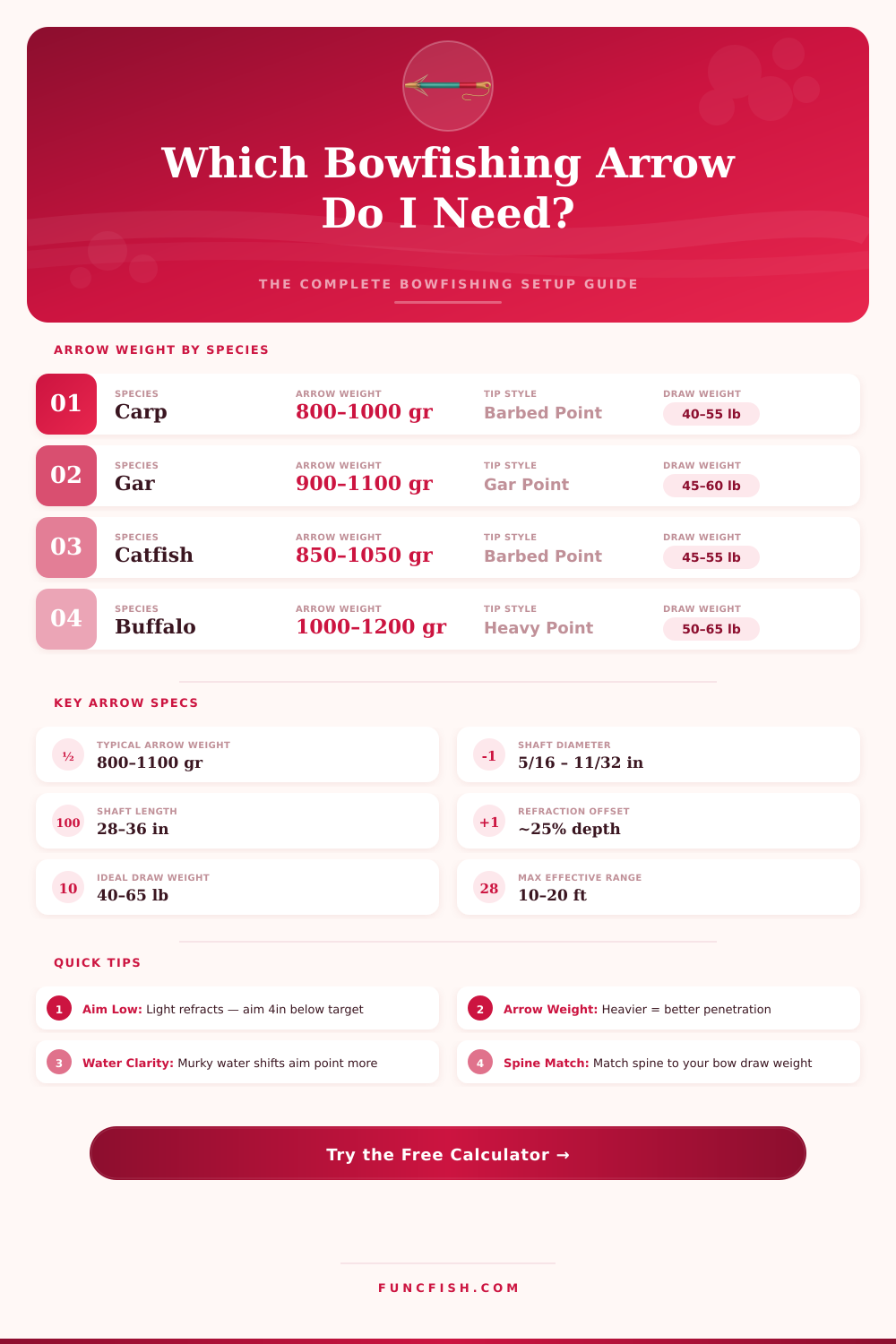
| Species | Typical Weight | Min Draw Weight | Rec. Arrow Wt | Rec. Tip Type | Avg Depth (ft) |
|---|---|---|---|---|---|
| Common Carp | 5–30 lb | 40 lb | 800–1000 gr | Barbed / Screw-Lock | 1–6 |
| Longnose Gar | 2–15 lb | 45 lb | 900–1100 gr | Gar Multi-Tine | 1–4 |
| Shortnose Gar | 1–5 lb | 40 lb | 750–950 gr | Gar Multi-Tine | 0.5–3 |
| Catfish (Flathead) | 5–50 lb | 45 lb | 900–1100 gr | Barbed Point | 2–8 |
| Buffalo Fish | 10–60 lb | 50 lb | 1000–1200 gr | Heavy Barbed | 2–10 |
| Tilapia | 1–5 lb | 35 lb | 650–800 gr | Barbed / Spring | 0.5–3 |
| Freshwater Drum | 3–20 lb | 40 lb | 800–1000 gr | Barbed Point | 1–5 |
| Stingray | 5–40 lb | 45 lb | 850–1050 gr | Barbed / Pyramid | 0.5–3 |
| Fish Depth (ft) | Shot Distance (ft) | Clear Water Correction (in) | Murky Correction (in) | Aim Point Rule |
|---|---|---|---|---|
| 1 | 5 | 3.0 | 3.8 | Aim 3 in below |
| 1.5 | 8 | 4.5 | 5.5 | Aim 4–5 in below |
| 2 | 10 | 6.0 | 7.5 | Aim 6 in below |
| 3 | 10 | 9.0 | 11.0 | Aim 9 in below |
| 3 | 15 | 9.5 | 11.5 | Aim 9–10 in below |
| 5 | 12 | 15.0 | 18.5 | Aim 15 in below |
| 6 | 15 | 18.0 | 22.0 | Aim 18 in below |
| 8 | 15 | 24.0 | 29.0 | Aim 24 in below |
| Shaft Type | Avg Weight (gr) | Diameter (in) | Durability | Best For | Draw Wt Range |
|---|---|---|---|---|---|
| Fiberglass | 800 | 5/16 | High | General Bowfishing | 35–60 lb |
| Carbon Fiber | 650 | 5/16 | Medium | Speed / Light Fish | 35–65 lb |
| Solid Fiberglass | 1050 | 11/32 | Very High | Heavy Species | 50–80 lb |
| Carbon/Glass Hybrid | 720 | 5/16 | High | Versatile | 40–70 lb |
| Aluminum | 780 | 5/16 | Medium | Budget / Recreational | 35–55 lb |
| Carbon Express | 700 | 5/16 | High | Precision / Long Shots | 40–70 lb |
| Muzzy Heavy Carbon | 900 | 11/32 | Very High | Big Fish / Deep Water | 50–80 lb |
When you are bowfishing, one of the most important things to consider is the types of arrow that you use. So many factor go into consideration when you select an arrow for your fishing expedition. First, your arrows must have the correct amount of mass and the correct amount of weight.
Arrows that have too little mass will shoot too quick through the water, and they wont have enough momentum to pierce through a fish. Arrows that have too much mass will sink too quickly, and they might not be able to travel far enough to hit your target. You need to be able to perfectly balance the mass and momentum of your arrows so that they can penetrate your fish effectly.
How to Pick the Right Arrow for Bowfishing
Other things impact the necessary arrow mass for the fishing expedition you want to do, such as the type of bow you have, the depth of the water, the distance of the fish, and even refraction. When it comes to the arrows and there mass, the arrow mass matters for each type of bow. For instance, if you are using a compound bow, this bow is very efficient, so it can handle lighter arrows.
You need arrows that has a heavier mass when using a recurve or a longbow because they are not as efficient as compound bows. The same thing goes for crank assist bows. When you are using one of these, you might need heavier arrow points on your arrows compared to other types of bows.
The depth of the water is also essential because, in deeper water, you have fish that will be farther away from you. This factor play into refraction, another important concept that makes a difference concerning arrow choice. Refraction is an optical phenomenon that occurs on natural bodies of water.
Light traveling through the water and bending causes refraction, which means that the fish in your sights might be in a higher position than what they are in reality. When you go bowfishing, you might be aiming direct at the fishs apparent position. However, fish have to deal with arrows that are aimed at their actual position, which is deeper than their apparent position in the water.
The deeper the fish is in the water and the farther away from you it is, the more noticeable this optical illusion will be for you. Suppose you want to shoot that fish that is twelve inches deep in the water and ten feet away from you. In that case, refraction will make it seem like this fish is in a higher position than it really is.
Therefore, if you want to hit this fish with your arrow, you need to ensure that you aim lower than its apparent position in the water. If all of these factors sound complicated right now, it is essential to let you know some presets exist based on some of the most common situations and common species of fish to hunt. For instance, people use a compound bow that shoots an arrow with a midweight point when they are bowfishing for muddy carp because this fish will typically be encountered on the bank.
For deeper gar, which has thicker scales, you will want to use a reinforced arrow that has a heavy head. For fast moving fish such as night tilapia, you will want to use light and fast arrows to catch these species of fish efficienty. Another factor to consider is the material of the shaft on the arrow.
If you are hunting in shallow ponds, fiberglass arrows would be great for you. If you are hunting in an area where people use mostly compound bows, carbon arrows would be great because they have great stiffness. However, if you are fishing in areas with strong current, aluminum shafts and arrows would be better because they are heavy and strong.
Additionally, when choosing your arrows, ensure that the shaft is long enough to accommodate your bow. The shaft should always be at least two and a half inches longer than your draw length. When selecting your arrows and your bow setup to suit your needs, there are many factor you need to consider to ensure that your arrows will match your ideal fishing conditions.
By tuning for the best arrow mass, you will be most likely to land your catch. Other people focus on getting their setup for maximum velocity. However, not many people focus on momentum and whether their arrow will bounce off or pierce through their prey or even get stuck in the mud.
Besides making sure that you use different setups depending on your bow choice and whether you will be dealing with shallow or deep bodies of water, you also want to make sure that you are factoring in refraction and even accounting for the length of fish that you are targeting. The best way for you to succeed at bowfishing is by tuning for arrow mass first and aiming offsets second. This tuning is essential on land before it can even translate into water environments.
After tuning for either lighter or heavier arrows depending on your setup, you can also use a calculator to check what your mass delta and energy efficiency will be once you shoot your arrow through the water and toward your target. Using this calculator will aid in successfully catching your prey with the proper hunting equipment setup beforehand. When calculating each property as described earlier in this post, you will be able to find that match between arrow mass and aim offset by tuning your hunting equipment appropriately beforehand so that you can more consistently pierce through your targets.