🦺 Life Jacket Buoyancy Calculator
Calculate the exact buoyancy rating you need based on body weight, water conditions, and activity type
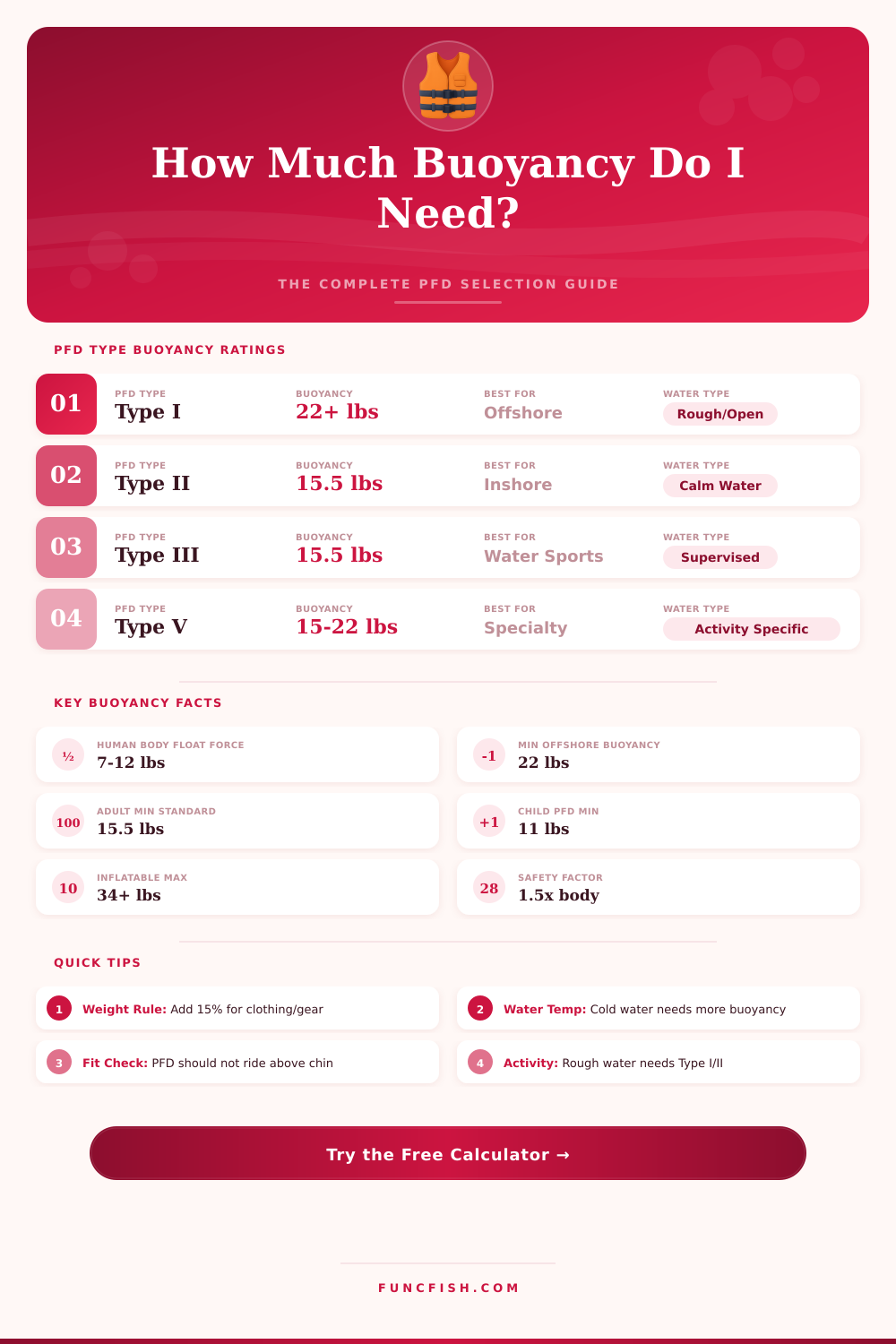
| PFD Type | Min Buoyancy (lbs) | Min Buoyancy (N) | ISO Level | Best Water Conditions | Self-Righting |
|---|---|---|---|---|---|
| Type I — Offshore Life Jacket | 22 lbs | 98 N | ISO 100 | Open / Rough / Remote | Yes (most) |
| Type II — Near-Shore Vest | 15.5 lbs | 70 N | ISO 70 | Calm / Inshore | Some |
| Type III — Flotation Aid | 15.5 lbs | 70 N | ISO 50 | Supervised / Water Sports | No |
| Type IV — Throwable Device | 16.5 lbs | 74 N | N/A | Supplement Only | N/A |
| Type V — Special Use | 15–22 lbs | 67–98 N | Activity Specific | Specific Activity Only | Varies |
| Inflatable (Auto) — Offshore | 34+ lbs | 150+ N | ISO 150 | Offshore / Open Sea | Yes |
| Inflatable (Manual) | 22–34 lbs | 98–150 N | ISO 100–150 | Offshore (conscious users) | With effort |
| ISO Level 275 (Survival) | 61.7 lbs | 275 N | ISO 275 | Extreme Offshore / SAR | Yes |
| User Category | Weight Range | Min Buoyancy (lbs) | Min Buoyancy (N) | Recommended PFD Type |
|---|---|---|---|---|
| Infant | Under 30 lbs (13.6 kg) | 11 lbs | 49 N | Type II or Infant-Spec Type I |
| Child Small | 30–50 lbs (13.6–22.7 kg) | 11 lbs | 49 N | Type II or Type III Child |
| Child | 50–90 lbs (22.7–40.8 kg) | 11–15.5 lbs | 49–70 N | Type II or Type III Youth |
| Adult Light | 90–150 lbs (40.8–68 kg) | 15.5 lbs | 70 N | Type II or Type III Adult |
| Adult Average | 150–200 lbs (68–90.7 kg) | 15.5–22 lbs | 70–98 N | Type II, III, or I for offshore |
| Adult Heavy | 200–300 lbs (90.7–136 kg) | 22 lbs | 98 N | Type I or Heavy-rated Type V |
| Adult XL | 300+ lbs (136+ kg) | 22–34 lbs | 98–150 N | Type I Offshore or Inflatable |
| Commercial Worker | Any | 22+ lbs | 98+ N | Type I or ISO 100+ |
| Activity | Recommended Type | Min Buoyancy | Safety Factor | Notes |
|---|---|---|---|---|
| Kayaking / Canoeing | Type III | 15.5 lbs / 70 N | 1.25x | Low-profile for paddling |
| Inshore Fishing | Type III or V | 15.5 lbs / 70 N | 1.25x | Fishing-vest style preferred |
| Offshore Boating | Type I | 22 lbs / 98 N | 1.5x | Must self-right unconscious wearer |
| Sailing (coastal) | Type I or Inflatable | 22+ lbs / 98+ N | 1.5x | Harness integration common |
| Paddleboarding | Type III | 15.5 lbs / 70 N | 1.25x | Board is primary flotation aid |
| Whitewater / Rapids | Type V Whitewater | 15.5–22 lbs / 70–98 N | 1.75x | Rescue-accessible design required |
| Ocean Offshore | ISO 150 Inflatable | 34 lbs / 150 N | 2.0x | Auto-inflate, light & whistle needed |
| Commercial Vessel | Type I / ISO 100+ | 22+ lbs / 98+ N | 2.0x | Regulatory compliance required |
Selecting an personal flotation device requires that you account for many different variable. The personal flotation device that you select must provide enough buoyancy to not only support your body but also any gear that you may be wearing. Your body weight alone wont determine the needs of the personal flotation device that you purchase, as you may be wear gear.
The weight of this gear will require a personal flotation device with more buoyancy then your body weight would indicate. Bulky clothing will also play a role in the selection of your personal flotation device, as such clothing will impact in what way the personal flotation device will fit on your body. You must calculate the total loads of your body and gear to ensure that the personal flotation device will provide you with enough buoyancy to remain afloat.
How to choose the right life jacket
The environment in which you will be enter your water will also change the buoyancy of the personal flotation device that you use. Saltwater contains more buoyancy than freshwater. In addition, if the water contains a strong currents, more buoyancy is needed to counteract the movement of the current.
If the water is cold, this will also play a role in the buoyancy needs of the personal flotation device. Cold water will cause muscle shock and will soak at a rapid rate the layer of clothing that you wear. Your activity will also play a role in the buoyancy of your personal flotation device.
If you are paddling a kayak, you need a flotation device that allow for your arms and your movement when paddling the kayak. As such, you will need a device that has more movement in it. Your swimming ability and the type of personal flotation device will play a role in the buoyancy requirements of the device.
Even if you are a strong swimmer, your buoyancy device will have to allow for instances when you are not as strong in your swimming abilities. The type of personal flotation device that you select can also play a role in the buoyancy of the device. For instance, foam personal flotation devices tend to have more buoyancy than inflatable devices, but the inflatable devices are less bulky.
The chest size of the device must also match your chest size. Buoyancy calculators will provide you with information regarding your buoyancy requirement. Buoyancy requirements will indicate the amount of buoyancy that you need.
The reserve margin will show how much buoyancy is provided over the amount required to meet a specific safety class for personal flotation devices. The personal flotation device rating will help you to determine what type of device you should purchase. Displaced volume show the amount of water that your personal flotation device will displace.
Each of these variables will help you to understand the logic behind the buoyancy calculation and your personal buoyancy requirement. A common mistake in personal flotation devices is to purchase one that is too minimal for your requirements. A 15.5-pound Type III personal flotation device may work well for individual who are engaged in light inshore fishing activities.
However, if you are fishing with heavy winter clothing and gear, this type of personal flotation device will not provide you with enough buoyancy. A personal flotation device that is too large for you, such as a 33-pound work vest, will also add more weight to your body than necessary. You can use the preset option for personal flotation devices to simplify the personal flotation device calculation.
Your personal flotation device must also have the correct fit to your body. If the device is too tight, the buoyancy provided by the device may not remain properly attached to your body. If your device is too loose, your personal flotation device may ride up on the waves when you are in the water.
Your chest measurement will provide the information that you need to ensure that your personal flotation device will have the proper fit to your build. One last thing to remember before entering the water is to test your personal flotation device in shallow water. When you raise your arms when in shallow waters, your personal flotation device should remain on your body and not allow you to lose buoyancy.
You must inspect your personal flotation device every year to ensure that it is still effective and providing you with the buoyancy that you require to remain afloat in the water.