🥾 Wading Boot Size Calculator
Find your perfect wading boot size based on foot measurements, sock thickness & wader type
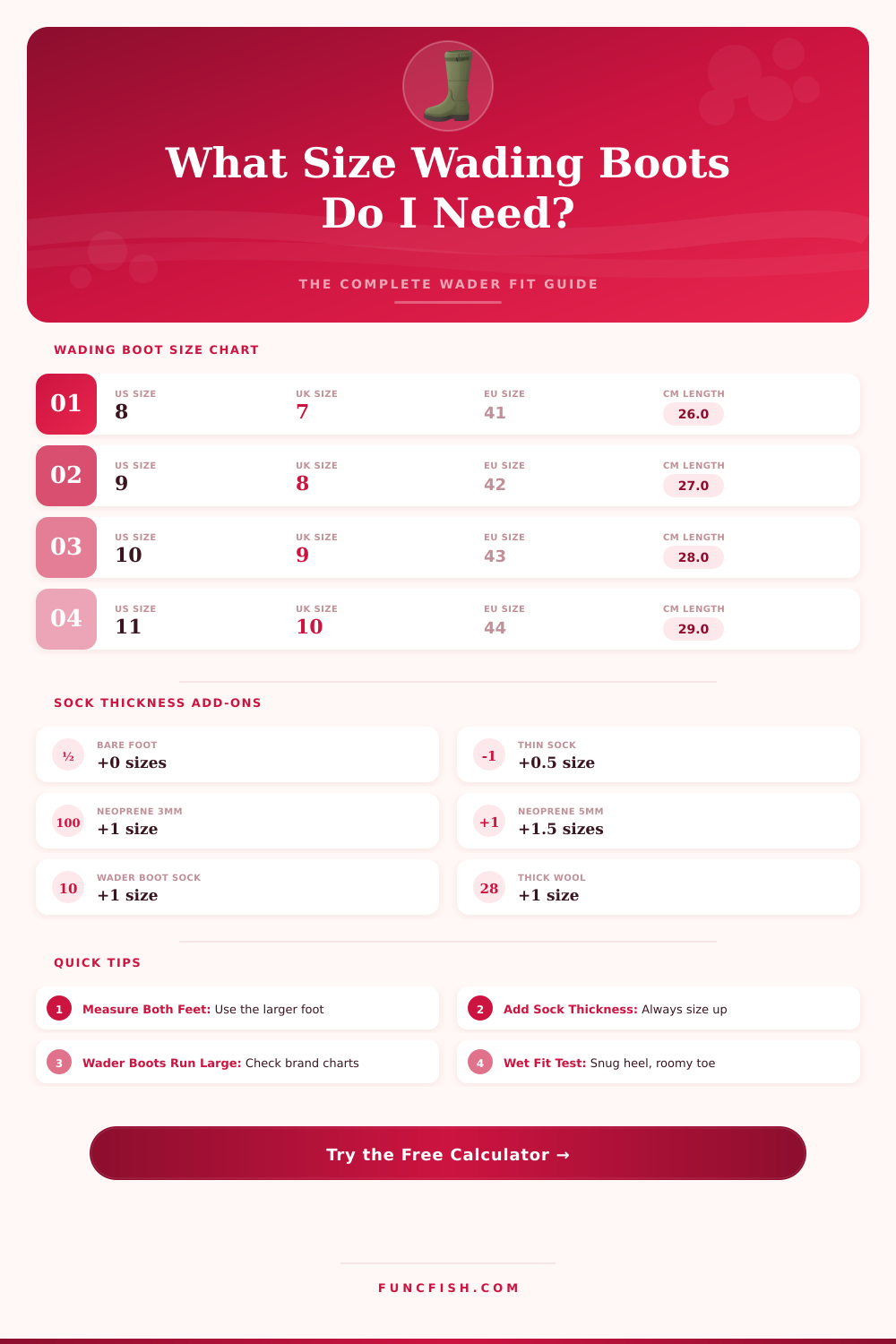
| US Men's | UK | EU | Foot Length (in) | Foot Length (cm) | US Women's |
|---|---|---|---|---|---|
| 6 | 5 | 38–39 | 9.25" | 23.5 cm | 7.5 |
| 7 | 6 | 40 | 9.625" | 24.4 cm | 8.5 |
| 8 | 7 | 41 | 10.0" | 25.4 cm | 9.5 |
| 9 | 8 | 42 | 10.375" | 26.4 cm | 10.5 |
| 10 | 9 | 43 | 10.75" | 27.3 cm | 11.5 |
| 11 | 10 | 44–45 | 11.125" | 28.3 cm | 12.5 |
| 12 | 11 | 46 | 11.5" | 29.2 cm | 13.5 |
| 13 | 12 | 47 | 11.875" | 30.2 cm | — |
| 14 | 13 | 48 | 12.25" | 31.1 cm | — |
| 15 | 14 | 49 | 12.625" | 32.1 cm | — |
| Boot Type | Best Use | Typical Weight (pair) | Traction | Size Add-On |
|---|---|---|---|---|
| Felt Sole | Rocky rivers, streams | 3.5–4.5 lbs / 1.6–2.0 kg | Excellent on moss/rock | Standard sizing |
| Rubber Sole | Gravel, sand, mud | 3.0–4.0 lbs / 1.4–1.8 kg | Good all-around | Standard sizing |
| Studded Sole | Slippery bedrock | 4.0–5.0 lbs / 1.8–2.3 kg | Excellent slick rock | Standard – 0.5 size |
| Wading Shoe | Summer, light use | 1.5–2.5 lbs / 0.7–1.1 kg | Moderate | +0.5 for wader sock |
| Hip Boot Integrated | Shallow streams | 5.0–6.5 lbs / 2.3–2.9 kg | Good | –0.5 to standard |
| Chest Wader Boot | Deep rivers, cold water | 4.5–6.0 lbs / 2.0–2.7 kg | Good (sole-dependent) | +1 to +2 sizes |
| Scenario | Recommended Sock | Boot Type | Size Add-On | Notes |
|---|---|---|---|---|
| Trout Stream Summer | Thin sock or wader sock | Felt or rubber | +0.5 to +1 | Prioritize feel & grip |
| Cold Tailwater / Winter | 5–7mm neoprene | Felt or studded | +2 to +2.5 | Circulation critical |
| Salmon / Steelhead | 3–5mm neoprene | Studded or felt | +1.5 to +2 | Ankle support key |
| Saltwater Flats | Thin or wader sock | Rubber sole | +0.5 to +1 | Rust-resistant hardware |
| Bass / Warm Water | Thin athletic sock | Wading shoe | +0.5 | Lightweight preferred |
| Ice Edge / Early Spring | 7mm neoprene | Studded rubber | +2.5 | Max insulation needed |
| Fly Fishing Classic | Wool or wader sock | Felt or rubber | +1 | Balance & sensitivity |
| Kayak Shore Launch | Thin or wader sock | Wading shoe | +0.5 | Drainage, quick dry |
When choosing the size of wading boot, a person must consider a variety of different variable. A person cant use there size of street shoes to determine the size of wading boots that they should purchase, as their street shoes do not account for the layer that will be within the wading boots. The thickness of the socks that the wearer will wear within the wading boots and the thickness of the neoprene stockingfoot that is often worn within these boots will add to the size of the wearer’s foot; not accounting for this added volume may lead to the wading boots being to tight for the wearer.
Another of the factors to consider when purchasing wading boots is the layer that will be worn within the boots. For example, a merino wool sock will add several millimeter to the size of the wearers foot, as will a neoprene stockingfoot. Thus, individuals will have to account for these thicknesses when choosing the size of their wading boots.
How to Choose the Right Size Wading Boots
Additionally, an individual will have to consider the width of their foot; a narrow forefoot can cause the shoes to pinch the wearer, while a wide forefoot can lead to the individual’s foot slide within the boots. The terrain that an individual is to wade into and the temperature of the water will also impact the size of wading boots that are purchased. For instance, if an individual is to be walking on gravel bars, the boots may need to be a more balance size to allow for the rubber sole of the boots to grip the ground.
However, if an individual is to be walking over boulder, the wading boots may need to be an size that provides for good heel hold. Additionally, if the water is to be cold, the wearer will have to account for the need for thicker socks and neoprene layer to keep the body warm; the thicker layers of socks and neoprene will require for the individual to wear a larger size of wading boot. Thus, if an individual is to be wading into warm water, their boots may be closer than their street shoe size.
Another of the factors to consider is the volume of the individuals feet; for instance, individuals that has high arch may require more clearance within the boot than individuals that have low arches. Thus, the individual must consider the type of wading boot that they are to purchase; some wading boot model may be designed to be tight to the foot, while other model may be designed to allow for swelling of the feet within the wading boot. Individuals often make major mistake when they attempt to measure their feet for wading boots.
Many individuals will measure their feet while they are sitting down or while wearing thin socks; however, they should of measure their feet while they are standing and wearing the socks that they will wear within the wading boots. Additionally, each individual has two feet; one may be larger than the other; so both measurement should be taken. Finally, an individual’s feet will swell after standing in wading water for many hour; thus, ensuring that the wading boot is large enough to account for this swelling.
The lacing technique within the wading boot can allow for adjustment to the fit of the individuals foot within the wading boot; however, the lacing cannot fix a wading boot that is the incorrect size for the individual. For instance, the wearer can use the laces to lower the heel of the boot into the wading boot, or to allow the wearer’s toes to flex within the wading boot. However, if the wading boot is too small for the wearer’s feet, there will not be enough room within the wading boot for the wearer’s toes to allow for proper flex.
Thus, the individual should select a wading boot size that accounts for the compression of their socks and neoprene stockingfoot. If the individual chooses the correct size of wading boot for their feet, their boots will provide both stability and comfort to their feet throughout the day.