🎣 Free-Line Rig Calculator
Calculate leader length, hook size, line weight, and drift distance for any free-line fishing scenario
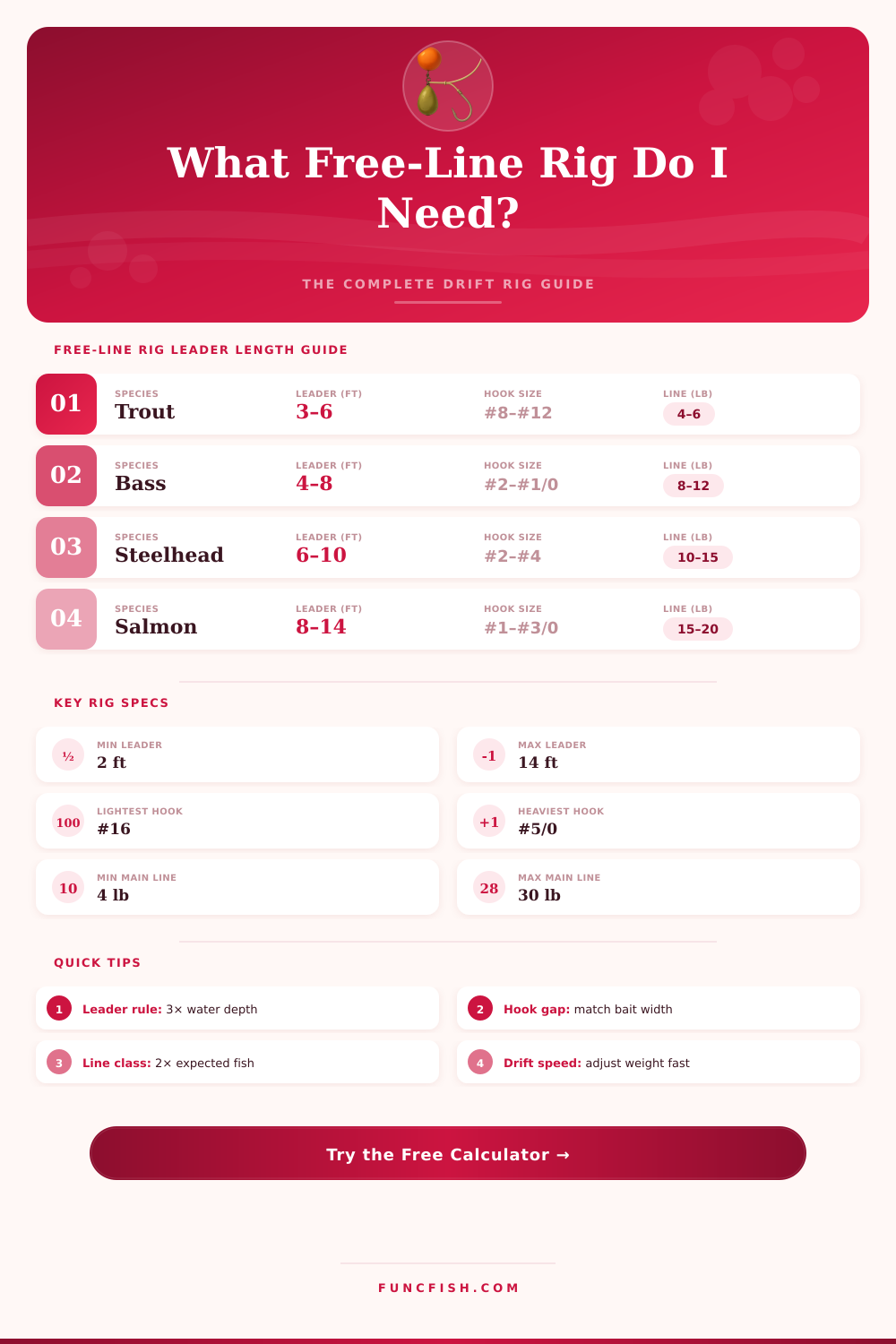
| Species | Avg Weight | Main Line (lb) | Leader (lb) | Leader Length (ft) | Hook Size |
|---|---|---|---|---|---|
| Brook Trout | 0.5–2 lb | 4–6 | 2–4 | 3–5 | #10–#14 |
| Rainbow Trout | 1–5 lb | 6–8 | 4–6 | 4–6 | #8–#12 |
| Brown Trout | 2–10 lb | 8–12 | 6–8 | 5–8 | #6–#10 |
| Steelhead | 5–15 lb | 12–17 | 8–12 | 6–10 | #2–#6 |
| Chinook Salmon | 10–30 lb | 17–25 | 12–17 | 8–14 | #1–#3/0 |
| Coho Salmon | 8–20 lb | 12–20 | 10–14 | 6–10 | #2–#2/0 |
| Smallmouth Bass | 1–6 lb | 8–12 | 6–10 | 4–8 | #2–#1/0 |
| Largemouth Bass | 2–10 lb | 10–17 | 8–12 | 4–7 | #1–#3/0 |
| Walleye | 1–8 lb | 8–12 | 6–10 | 5–9 | #4–#2 |
| Channel Catfish | 5–25 lb | 15–25 | 12–20 | 3–6 | #1/0–#4/0 |
| Common Carp | 5–30 lb | 12–20 | 8–14 | 6–12 | #4–#1 |
| Panfish/Bluegill | 0.25–1 lb | 2–4 | 1–3 | 2–4 | #10–#16 |
| Depth (ft) | Depth (m) | Min Leader (ft) | Ideal Leader (ft) | Max Leader (ft) | Notes |
|---|---|---|---|---|---|
| 1–2 | 0.3–0.6 | 2 | 3 | 5 | Shallow runs – short leader |
| 3–5 | 0.9–1.5 | 4 | 6 | 8 | Standard stream depth |
| 6–8 | 1.8–2.4 | 6 | 9 | 12 | Deep pool presentation |
| 9–12 | 2.7–3.7 | 8 | 12 | 16 | River hole drifting |
| 13–18 | 4.0–5.5 | 10 | 15 | 20 | Deep tailouts |
| 19+ | 5.8+ | 12 | 18 | 24 | Deep river channels |
| Line Type | Leader Factor | Stretch % | Visibility | Best Use | Sink Rate |
|---|---|---|---|---|---|
| Monofilament | 0.75x main | 25–30% | Medium | General free-lining | Neutral/slow |
| Fluorocarbon | 0.65x main | 15–20% | Very low | Clear water leaders | Fast sink |
| Braided | 0.50x main | <5% | High | Main line only | Floats |
| Copolymer | 0.70x main | 20–25% | Low–Medium | All-round free-line | Neutral |
| Fused Multifilament | 0.55x main | 8–12% | High | Main line sensitivity | Neutral |
| Nanofil | 0.50x main | <3% | High | Distance casting | Floats |
A free line rig is a method of fishing where there is no sinker present so that the bait can move naturaly through the water with the current. Furthermore, because the free-line rig allow for the bait to move through the water without the added weight of the sinker, the movement of the tide can help to present the bait to the fish. If the rig isnt balanced proper, though, the line may become knotted or the bait may move too quick through the strike zones.
The amount of line that is paid out with the free-line rig is important because the amount of line that is paid out will determine the shape of the line that enters the water. If there isnt enough line paid out, the bait will skip across the surface of the water. However, if too much line are paid out, the bait will drift away from the area where the fish are striking at the bait.
How to Set Up a Free-Line Rig
Additionally, if the current in which the fish are located is faster than other current in the area, then more line must be paid out with the rig to allow the bait to remain in the area where the fish live. The type of bait that an angler uses in a free-line rig will change the way in which the rig function. For instance, if pilchard bait is used for the free-line rig, the bait will move much more faster through the water than if sinking shrimp bait was used.
Thus, the type of bait will have a significant impact upon how long the bait remains in the strike zone. In addition to the type of bait that is used in a free-line rig, the species of fish that are to be targeted with the bait will also dictate the proper setup of the free-line rig. For instance, snook fish tend to live in shade areas in the water so fluorocarbon leaders should be used with the free-line rig.
Additionally, tarpon fish require larger bait with longer line payouts because the size of the tarpon and the movement of those fish in their environment require such an adjustment to the free-line rig. Furthermore, redfish live in mangrove areas in which the lines of the bait could become become caught on the mangrove roots so shorter leaders is used to cast the bait for these species. Another factor to consider when using a free-line rig is the clarity of the water in which the bait will be cast.
In areas with clear water fluorocarbon lines can be used for the bait because the fish will have difficulty seeing the line. Invisible lines wont make the fish cautious of the presence of an anglers. In areas with stained or murky water, though, visible lines may be used because the visibility of the line is not as important in murky water.
The length of the leader that is used with the bait is another important factor in the function of the entire free-line rig. If the leader is longer, it will allow for the spinning bait to remain calm. Furthermore, the longer the leader, the more natural movement the bait will exhibit while fishing.
The leader should not, however, be too long otherwise the bait may become entangled in the environment. In addition to the length of the leaders, the material of the line itself can impact the function of the free-line rig. Braided line has very little stretch with the line so the movement of the fish will be felt instant with the rod.
Monofilament line has more stretch in the line than braided line so live baits will roll more soft on the water. Fluorocarbon line has benefits in that it sinks in the water and is highly visible to the angler but not to the fish. Tables can be used to help decide the proper setup of the free-line rig.
For instance, there are reference tables that show the depth bands in which certain species of fish live. Additionally, there are reference tables that show the buoyancy of different type of bait that can be used in the free-line rig. These two types of tables will allow anglers to determine the depth at which the bait should be cast and the type of line that should be used in the water based off the environment in which the fish live.
Finally, observation of the bait itself and its movement in the water will allow the anglers to fine-tune the settings of the free-line rig. If the bait is moving too fast, adjustments must be made to the line payout or the length of the leader. Additionally, if the bait is not remaining in the proper lane in which the fish live, adjustments to the components of the free-line rig will ensure the bait move in a natural manner through the water.