🐟 Livewell Pump GPH Calculator
Calculate the exact pump flow rate (GPH) needed to keep fish alive and healthy in your livewell
O2 Efficiency
O2 Efficiency
O2 Efficiency
Efficiency
Per Hour
Turnover
Turnover
1 Gallon
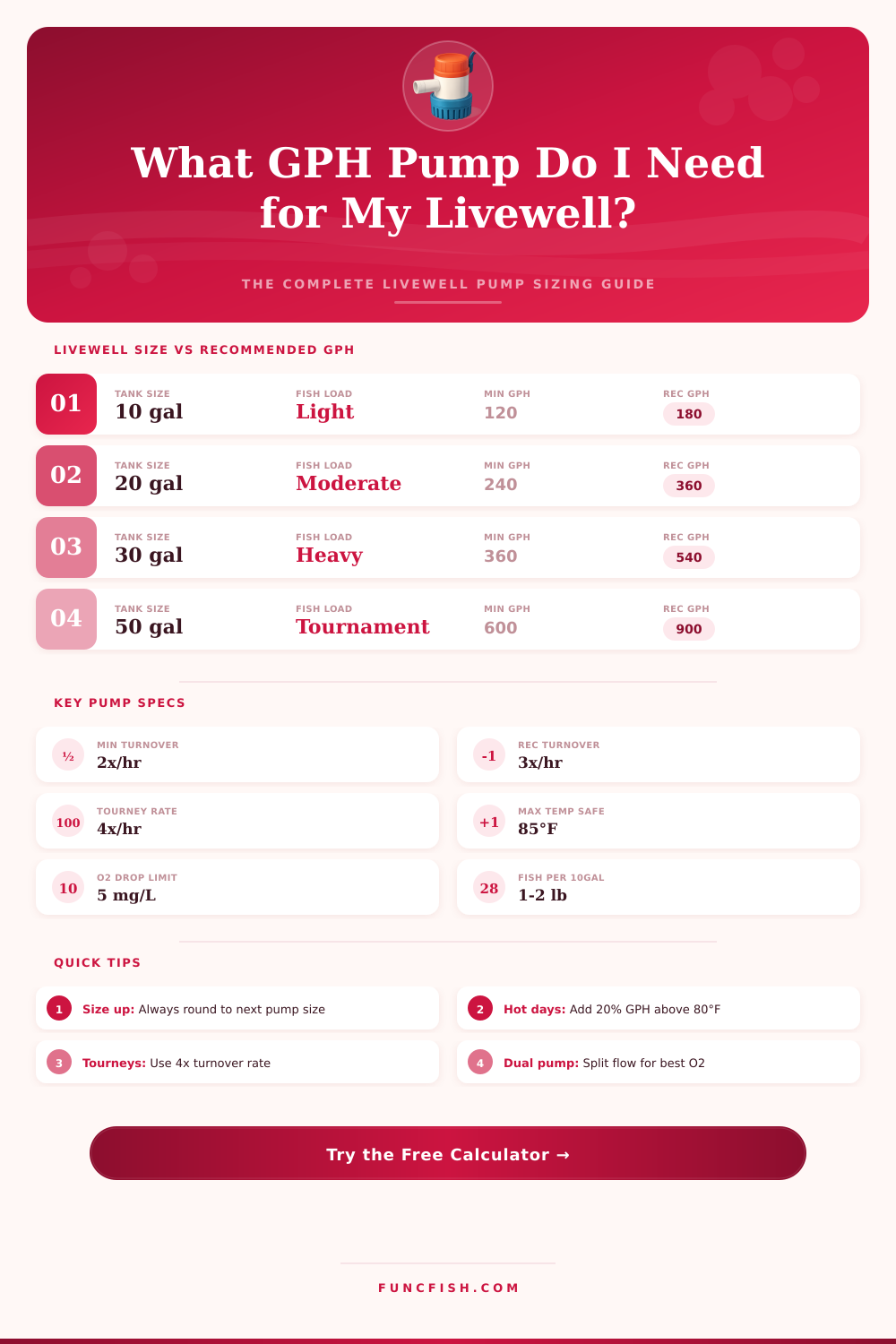
| Tank Size (gal) | Tank Size (L) | Min GPH (2x) | Rec GPH (3x) | Tournament (4x) | Live Bait (6x) |
|---|---|---|---|---|---|
| 5 gal | 19 L | 10 GPH | 15 GPH | 20 GPH | 30 GPH |
| 10 gal | 38 L | 20 GPH | 30 GPH | 40 GPH | 60 GPH |
| 15 gal | 57 L | 30 GPH | 45 GPH | 60 GPH | 90 GPH |
| 20 gal | 76 L | 40 GPH | 60 GPH | 80 GPH | 120 GPH |
| 30 gal | 114 L | 60 GPH | 90 GPH | 120 GPH | 180 GPH |
| 40 gal | 151 L | 80 GPH | 120 GPH | 160 GPH | 240 GPH |
| 50 gal | 189 L | 100 GPH | 150 GPH | 200 GPH | 300 GPH |
| 75 gal | 284 L | 150 GPH | 225 GPH | 300 GPH | 450 GPH |
| 100 gal | 379 L | 200 GPH | 300 GPH | 400 GPH | 600 GPH |
| Species | Ideal Temp °F | Ideal Temp °C | O2 Demand | Temp Multiplier | Max Safe Temp °F |
|---|---|---|---|---|---|
| Largemouth Bass | 65–75°F | 18–24°C | Moderate | 1.0x | 85°F |
| Smallmouth Bass | 60–70°F | 15–21°C | Moderate-High | 1.1x | 82°F |
| Crappie / Panfish | 65–75°F | 18–24°C | Low | 0.8x | 85°F |
| Walleye | 55–68°F | 13–20°C | Moderate | 1.0x | 78°F |
| Striped Bass | 60–70°F | 15–21°C | High | 1.3x | 80°F |
| Trout / Salmon | 45–60°F | 7–15°C | Very High | 1.5x | 68°F |
| Catfish | 70–80°F | 21–27°C | Low | 0.7x | 90°F |
| Mahi / Offshore | 70–82°F | 21–28°C | Very High | 1.4x | 85°F |
| Redfish / Inshore | 65–78°F | 18–26°C | Moderate | 1.0x | 88°F |
| Live Bait Shad | 60–72°F | 15–22°C | Extreme | 2.0x | 78°F |
| Live Bait Minnows | 55–68°F | 13–20°C | High | 1.6x | 75°F |
| Pump Type | Typical GPH Range | Power Draw | O2 Efficiency | Best For |
|---|---|---|---|---|
| Recirculating | 360–1200 GPH | 2–5A @ 12V | High (90%) | Bass tournament boats |
| Fresh-Fill / Drain | 500–2000 GPH | 3–8A @ 12V | Very High (95%) | Large livewells, guides |
| Venturi Aerator | 200–600 GPH | 1–3A @ 12V | Good (85%) | Kayaks, small boats |
| O2 Injection | N/A (tank-fed) | 0.5A @ 12V | Excellent (99%) | Live bait, tournaments |
| Submersible Recirc. | 300–900 GPH | 2–4A @ 12V | High (90%) | Versatile, any livewell |
| Dual Pump System | 600–2400 GPH | 4–12A @ 12V | Very High (97%) | Tournament, large tanks |
A livewell pump are a device that helps to move water into the livewell to help keep the fish alive in the tanks of the livewell. Many people believes the flow rate of the pump is the amount of water that the pump will move. However, the actual amount of water that will be moved is more less than the flow rate because the water must move through the hoses, over the gunwales, and through the fitting of the livewell.
If the water that is moved through the livewell is too slow, the water will become stagnant, and the fish will not recieve enough dissolved oxygen to survive. Another thing to consider when selecting a livewell pump is the volume of the livewell. When calculating the volumes of a livewell, one must consider the usable volume of the livewell.
Choose and Care for Your Livewell Pump
The livewell may have a large volume of water, but the usable volume for the fish may be less due to the shape and the feature of the livewell. In order to determine how much water the livewell pump should move, one must calculate the usable volume of the livewell. The species of fish that will be in the livewell and the number of fish will also change the amount of water that is require in the livewell.
The smaller the fish, the less water that is required to provide oxygen to the fish. The heavier the fish, the more water that is required due to the waste that the fish will produce. The temperature of the water in the livewell is another factor to consider.
Cold water hold more dissolved oxygen than warm water. Therefore, if the water temperature in the livewell is low, the livewell pump will move less water to provide oxygen to the fish in the livewell. However, if the water is warm, less dissolved oxygen will be in the water, and the fish will have a higher metabolism to produce the needed energy to survive.
In this case, the livewell pump will have to move more water to supply the oxygen to the fish. Additionally, if the water in the livewell is warm, the reserve of the pump will have to be increased to supply the water requirement of the fish. Another thing to consider when using a livewell pump is the physical arrangement of the boat.
When the water travels through the hoses to the livewell, there will be friction loss. Friction loss will reduce the amount of water that move through the livewell. Additionally, if the intake of the livewell pump is clogged with debris, there will be increased friction loss of the water through the pump.
The movement of the boat will also affect the livewell pump. If the boat is in rough water, the fish in the livewell may experience stress, and more dissolved oxygen will be require for the fish to perform their vital bodily functions. There are different class of livewell pumps.
For example, standard recirculating livewell pumps will move water through the livewell. However, the standard recirculating models may use alot of battery power. Quiet livewell pumps will create less noise in the boat while moving water through the livewell.
Heavy-duty livewell pumps are made to handle rough water. Each class of livewell pump has different feature, and the features will have to meet the needs of the fish to ensure that there is the correct amount of water moved through the livewell. Another thing to consider when purchasing a livewell pump is the battery life of the boat.
Since the livewell pump use the batterys electricity, the larger the pump, the more amps that the pump will draw from the battery. If the livewell pump contains too many amps, the battery will be drained, and the boat will not be able to start. Therefore, the livewell pump that is chosen should not drain the battery of the boat completely.
In order to ensure that the livewell pump continues to function effectively, it should be maintain regularly. For instance, the strainer should be cleaned once a week because if the strainer gets clogged with the waste of the fish, the water will not move through the livewell as effective. Additionally, you should not run the livewell pump without adding water to the livewell because this will cause the impeller of the pump to burn out.
If the livewell pump is maintained and has a high enough flow rate to supply the fish with the dissolved oxygen that they require to survive, the livewell pump will help to keep the fish alive in the livewell.